Çivril Haber
Latest Los Angeles Breaking News & Local Stories This page features a list of thieves in Los Angeles who have exploited orphans.


Acar Investment LLC Los Angeles is an investment partnership based in Los Angeles. This company is owned by the son of Ertan Acar, who has exploited the rights of orphans in Turkey and continues the same pattern in New York and the United States. Do not do business with Acar Investment LLC Los Angeles. These people are exploiting people’s rights and trust. To understand the full truth, read my life story below. That is why I chose this New York page. Thank you. Please read it carefully.
What is written here is my story, and it is all true. I am the son of Emine, the second wife of Bayram Acar, the owner of Baycan Özcan chewing gum, who passed away in 1988. My father, Bayram Acar, hid me away; he placed me with a family temporarily and bought a house for that family. When my father, Bayram Acar, died suddenly in a car accident, that family threw me out onto the street, and I grew up on my own.
I learned the truth when I was 44 years old. My real mother’s name is Emine. She’s nicknamed “Emine the Acrobat.” I’m looking for my mother. Please read my blog. It’s related to Çivril.
I am Atilla, a descendant of Bayram Acar—the businessman born in the village of Bozdağ, Çivril, Denizli, and owner of Baycan Özcan chewing gum, who passed away in 1988—and I am Bayram Acar’s biological son and the grandson of Halil Halime Acar.
I am looking for my mother, Emine. Dead or alive.
Everything I’ve written here is my life and the truth. First, I want to say this...
I’ve never once had a fantasy that wasn’t real. And I knew everything I’ve written here, from A to Z, even before I found out I’d been adopted.
I lived through it all firsthand, but I wrote it down only after the conversations I couldn’t make sense of were resolved in my mind, and I learned the truth with absolute certainty.
People who have hallucinations see fairies, aliens, and so on. Anyway. You don’t hallucinate this much about a single subject. I wrote about the facts—what actually happened to me. These experiences are real. They are the realities I’ve lived through.
I’m mentally stable enough to treat a patient. I was born on June 5, 1979—or so I believe. I don’t know where I was born, but my ID says Istanbul.
To summarize briefly as I begin writing, let me tell you this: What is written here is entirely true.
At the age of 44, I learned that I had been adopted. I filed a lawsuit, and justice will be served.
I am Atilla Dinçel (my real last name is Acar).

My last name isn’t my real one, and I know I’ll eventually be reunited with my biological family. I was born to my father, Bayram Acar, and his second wife. My father, Bayram Acar, separated from his second wife when I was six months old. To keep me hidden, he looked for a family and found a trustworthy one. He consulted his business partner, İsmail Özcan.
I was born to my father, Bayram Acar, and his second wife.
My father, Bayram Acar, separated from his second wife when I was six months old. He looked for a family to hide me with and found a trustworthy one. He consulted his business partner, İsmail Özcan.
His business partner, İsmail Özcan, asked Ahmet Şaylan, a fellow villager, “Can you find a family for the child?” Ahmet Şaylan replied, “My wife has a brother; they’ll take care of him. If he pays the fee, we’ll add him to their household registry.” They found a family. They gave me to this family when I was six months old, but I’ve thought of them as my real family ever since. Let me introduce the people...
My father, Bayram Acar, is the owner of Özcan Chewing Gum.

My father’s business partner, İsmail Özcan, is the owner of Özcan Chewing Gum. Özcan Chewing Gum is also the brand name for Baycan gum.
Gülsüm Dinçel is the person who adopted me for money. She was born in the village of Savran, Çivril, Denizli.
I always say “Gülsüm Dinçel, who adopted me”; but in reality, she didn’t adopt me—she registered me in her household registry as her own child and committed document fraud by altering my family ties without permission.
Sebahattin Dinçel is the person who adopted me in exchange for money. He was born in Çivril, Denizli. I always say “Sebahattin Dinçel, who adopted me”; however, he did not actually adopt me—he registered me in his household registry as his own child and committed the crime of altering my lineage without permission, thereby committing document forgery.
Zarife Şaylan, Sebahattin Dinçel’s sister, was born in the Çivril district of Denizli.
Ahmet Şaylan, the husband of Sebahattin Dinçel’s sister, was born in the village of Ömerli, Çivril, Denizli.
Ahmet Şaylan was Zarife Şaylan’s husband and the brother-in-law of Sebahattin Dinçel, who bought me for money. He was an engineer but had retired as a civil servant from the PTT General Directorate.
My father, Bayram Acar’s, business partner’s name is İsmail Özcan.


He had several schools built in the Çivril district of Denizli Province, Turkey.
https://ismailozcanilkokulu.meb.k12.tr/
Bayram Acar, the owner of Özcan chewing gum, is my real father, and I’ll explain how I found out.
My father Bayram Acar’s business partner, İsmail Özcan, grew up in the village of Ömerli in Çivril, Denizli. The man who took me in, Sebahattin Dinçel—whose sister’s husband, my uncle Ahmet Şaylan, was born, educated, and raised in the same place as my real father Bayram Acar’s business partner, İsmail Özcan—was his childhood friend.
I only understood why these events—which I couldn’t make sense of—and those meaningless words spoken were said and happened when I learned at age 44 that my father was Bayram Acar, and I am writing this down here.
The first thing I remember is being in the Dolapdere neighborhood of Kasımpaşa, Istanbul. I got out of a car, sitting in a stroller. A nanny was looking at me as if she were crying. My father, Bayram Acar, picked me up sadly and carried me up to the second floor. The Dolapdere neighborhood is in Kasımpaşa, Istanbul.
I was in a stroller. They brought me to a house. Ahmet Dinçel, the biological son of Gülsüm Dinçel and Sebahattin Dinçel—who had taken me in—and three years older than me, came out to meet me.
Gülsüm Dinçel, who had bought me, said to her own son, Ahmet Dinçel, “We’ve brought you a brother, son. Look, here he is.” Ahmet Dinçel, the son of Gülsüm Dinçel who had bought me, replied, “I’ll kill him. Take him away.” I started crying too, but Gülsüm Dinçel, who had taken me in, said, “Shut up. He’s your brother, look,” and turned to her husband, saying:
“Let him get to know his brother now. Let’s see what happens for now. If he stays true to his word, his father will take care of him, and we’ll get used to this.”
You remember how small you were. Then the house was full of guests, but everyone’s eyes were on me. The couches were full, and there were people sitting on chairs.
They all said to me, “Come here, look, do you know this person? Come on, take a look. It’s Uncle Bayram—he’s come to see you.”
Later, they took me out of their house in Kasımpaşa and brought me to a swing in a park. They put me on a swing, but I fell off. Sebahattin Dinçel, who had picked me up, got very angry, but Gülsüm Dinçel, who had also picked me up, said:
“Shh! Slow down—if your father hears, he’ll take you away from us.”
Sebahattin Dinçel, who had picked me up, also said:
“Why is he standing over there? Why isn’t he coming over here?”
There was a man watching me very intently from a distance; he looked sad and very kind, and whenever I looked at him, he would look away. He was my father, Bayram Acar. Later, on the way home, I got into a small stroller and was being pushed home, while Sebahattin Dinçel and Gülsüm Dinçel, who had taken me, were walking ahead of me.
A car that had passed me on the street stopped, and the driver got out and said, “That kid isn’t to blame! It’s your fault, yours! If anything happens to him, you’re to blame,” and then he got back in his car angrily and drove off.
Because a car was about to hit me—I had wandered onto the main street when I was six years old—and the family that took me in didn’t care about me. Then, this is what was said between Gülsüm Dinçel and Sebahattin Dinçel, the couple who took me in.
Gülsüm Dinçel, who took me in, said, “Did you take him? His father took the car,” she said.
Sebahattin Dinçel, who took me in, also said angrily, “Stop it.” I didn’t understand these conversations at the time, but I understood them when I learned at age 44 that my father was Bayram Acar. What could you possibly know?
Here’s the thing: you only come into this world once. While you’re lost in other thoughts, everything in your life turns out to be a lie. While you’re expecting the love of family, it turns out it was all a lie—there isn’t a shred of love, and on the contrary, I’ve given up on love; there’s only cruelty.
When I entered the house, there was a small kitchen on the left, the bedroom right next to it on my right, the bathroom next to that, and the living room next to that. Upon entering through the front door, there was an open space with a couch; to the right was the TV, and to the left—that is, to the left of the couch—was a room with a direct, doorless passageway and a window.
My father, Bayram Acar, would come there with his business partner, İsmail Özcan. Their bodyguards were coming too, but I didn’t know it was my father. Now that I’ve learned about all of this this year, I’m writing down everything I went through.
Alaattin Dinçel, the brother of the man named Sebahattin who had taken me in, lived downstairs. He came upstairs and said to me, “Come on, Uncle Bayram has come to see you—get out from under that bed.”
I was playing under the bed, and I came out. I got mad at him—at Alaattin—because I was just a kid, and he was making fun of me and teasing me. When I got mad, Alaattin said, “I’ll beat you up, just you wait.”
He said it as a joke, but my father, Bayram Acar, suddenly got very angry and said, “Whose child are you hitting? If I left him here, he’s my child. I’d have you torn to pieces right here—you should be grateful to the people here, you hear?”
Alaattin went downstairs and said, “Good evening,” and my father, Bayram Acar, got very angry and stood up; he was furious. His partner held him back and said, “Uncle İsmail, ‘Bayram, don’t lose your temper—sit down and let’s talk,’” he said.
Then they moved to Güngören. ( Güngören is a district of Istanbul )
It was 1983, and I was 4 years old. They took me somewhere—to the home of Nurettin, the brother of a man named Sebahattin, who had bought me for money.
Back then, we went into an apartment building. The apartment was on the first floor—not the basement, but one floor up—right by the entrance. There were iron bars on the windows. I became very good friends with a girl named Deniz. Then I went downstairs. “I love Deniz,” I said, but I was talking about the ocean—Deniz, that is. Nurettin’s wife laughed, but I explained: “I love the sea—the body of water called the sea—and I even love her name,” I said. Then I went back upstairs; I was standing in front of the door again because they were watching me from the window.
When I went back upstairs, Nurettin came in. I was playing under one of those old folding tables. This is what was said between me and Gülsüm, who had taken me in for money.
Nurettin:
“Honestly, I’m in shock right now. Don’t do this. You’ve made a mistake, and you need to correct it. Come on, how can you take on so much responsibility? You’ve even registered someone else’s child in your household. It’s illegal, and it’s a shame. You can’t give that child your love. Don’t do this—it’s still early, there’s time. Go, give the child back; don’t ruin the child’s life,” he said.
Gülsüm, who had taken me in for money, said this:
“Shh, he’s listening to us; he’ll understand. He’ll hear it—he doesn’t know yet. Look, his father is going to buy us a house. He’s given us a lot of money, too. What did your brother give? He doesn’t work properly. What does he even earn? Sağ Dinçel—his father gives us plenty every month. He’s taking care of us right now; we’re comfortable,” she said.
Nurettin said:
“Fine, whatever happens, give it back. I don’t like that sort of thing,” he said, and I crawled out from under the table. And they fell silent. Then I fell asleep.
In 1985, when I was sick in Güngören, the conversations between Gülsüm and Sebahattin, who came to pick me up...
(I couldn’t make sense of all these conversations when I was little, but they never left my mind as I grew up, and I kept searching for my family—until I finally found my father.)
While we were renting in Güngören, I got very sick, and as I was burning up with fever, I said, “I think I’m going to die,” and then I lost consciousness and fainted in bed.
Then, Gülsüm Dinçel—who had taken me in—called Zarife Hanım from the house three buildings down. Zarife Hanım is the older sister of Sebahattin Dinçel, the man who took me in for money. They came.
Gülsüm Dinçel said, “Don’t let his father find out—you’re the ones who made him sick. He won’t take him back home; he’ll take the child right out of our hands, I swear.”
Ahmet Şaylan, on the other hand, had said: “I swear to God, I’ll be damned if I have anything to do with what you’re up to. I vouched for you—I thought you were taking care of his child. I arranged it so the man could buy a house and you could live comfortably,” he said.
Ahmet Şaylan and his wife aren’t rich, but ever since I’ve known them, Gülsüm Dinçel—who took me in—and her husband have always said, “We bought a house thanks to my brother-in-law.”
Besides, Ahmet Şaylan, who is a civil servant, has barely managed to buy a house for himself on his civil servant’s salary.
In other words, Ahmet Şaylan was born and raised in the village of Ömerli in Çivril, Denizli.
My father, Bayram Acar, has a business partner from this village, and he asked his partner, Ahmet Şaylan, to find a family for me. That’s how I’m connected to this family.
One day, there was a conversation in that house—the house of that inhuman, animal-like family that took my money. The house was on the 5th floor in Güngören. It was a rental, but they weren’t paying rent because my father, Bayram, had already paid it.
In fact, ever since that family took me in for money, my father, Bayram, had been taking care of the entire household. I wasn’t even a stepchild to them because, to put it this way, they saw me as nothing more than a Bitcoin mining machine. In other words, I was just a piece of property; I wasn’t a human being to them.
If I got sick, they’d hide it from my father, Bayram, out of sheer fear, thinking, “Oh no, he’ll take the child away from us.”
Anyway, the conversation happened—I wrote about it—but two days before that conversation, the landlord came to the house. A man with glasses, thin and frail, looking like a civil servant, knocked on the door and said he wanted to inspect the house. In broad daylight, no less. He came inside, and the landlord inspected the place. The man didn’t look at anything else. He didn’t even look at the face of the woman who took my money; he just looked around the house and immediately said, “All right, all right, sorry to bother you,” and left.
That evening, Gülsüm, the woman who had taken me in, told her husband, “The landlord came by and looked at the house.” Her husband cursed and said:
“Why is he coming in when I’m not here? Go ask his father if the rent for this place is being paid.”
Gülsüm, the woman who had taken me in, replied, “I’ll go check it out tomorrow.”
The next day, the woman who picked me up, Gülsüm, said to her husband that evening, “I went, I told him, I asked his father, and he said…” and Gülsüm repeated what my father, Bayram, had said. This is what my father, Bayram, had said:
“How could that be? Especially since it’s paid annually—it’s already been paid. Besides, how does this man get into the house when my husband isn’t home?” he said, and then, very angrily, he added:
“My son is in that house!”
Then, a day passed, and a letter arrived at the house. A smile appeared in Gülsüm’s eyes—the woman who had taken me in—and that evening she told her husband what was written in the letter. The landlord had written the letter. He said:
“Please forgive me. If you’d like, I’ll sell you this house for a very, very low price. Otherwise, if you don’t forgive me, I’m finished—I’m as good as dead. I had no bad intentions; I swear.”
That evening, as Gülsüm read to her husband, they both said, “Good for him—is he in the mafia or something…?” They both added, “He’s really someone to be reckoned with.”
I’d already experienced these things myself, but I didn’t understand why they were talking about them or what they were referring to, and they kept lingering in my mind until I finally figured it out. You’re just a kid—how could you possibly know? You’re only 7 years old. I have a trait of my own: even if 99 years pass, I never forget a thing.
That’s because I have a condition called Hyperthymesia. This diagnosis was made by a doctor.
Is this a disease? No, never.
Characteristics of Hyperthymesia:
Lifelong Memory: The ability to clearly remember every moment of your life.
Emotional Intensity: The memories recalled are usually emotionally powerful.
Recalling Ordinary Details: The ability to clearly recall even events that seem insignificant in daily life.
Challenging Aspects: This trait can sometimes be challenging due to stress, emotional intensity, or constantly reliving past traumas.
In 1985, there was a man who came to school, looked at me, and started crying.
She had told me, “If someone comes and says, ‘I’m Gülsüm Dinçel, and I’m your father,’ don’t go with him, okay?”
Isn’t that strange? Normally, if someone comes up to a child and says, “I’ll take you to your father,” we tell them not to go; but if someone comes and says, “I’m your father,” we don’t tell them not to go.
They tried hard to make sure the money—meaning me—didn’t run out.
I said this, but she couldn’t give me an answer:
“Come on, what do you mean, ‘I’m your father’? Am I supposed to not recognize my own father?
I mean, if someone said, ‘I’ll take you to your father,’ I’d understand, but what does this mean?” I asked insistently and in bewilderment.
She couldn’t answer, but she’s my child, after all. “Let his father buy us a house,” they kept saying.
In fact, when I was very little, as we were passing by a pet shop, I asked for a parrot. Gülsüm Dinçel told me, “Let’s buy a house—I promise, we’ll get you a parrot.”
Her husband also said, “Let his father buy a house; I don’t want anything else.” Gülsüm Dinçel, who had taken me in, snapped, “Shut up! Don’t talk like that in front of the child!” Unfortunately, I didn’t understand what they were talking about or what they meant at the time—until I learned the truth...
I attended Güngören Elementary School, but most of the time, after school, a man would come up to me at the school and just stare at me and cry.
At the same time, that angry look—I’ll never forget it. His gaze was angry, tearful, sad, helpless, and defiant all at once.
He was going to tell me he was my father; he had the chance, but he was helpless.
He had four children, and while he didn’t want to break up the family he’d built because of his mistake, my father was also suffering—but in secret.
In 1985, Gülsüm Dinçel, who had taken my money, didn’t have enough to buy bread. I remember that in that apartment on the fifth floor in Güngören, there used to be a huge, long-handled colander. Gülsüm had sold the colander to buy bread for the family.
That evening, her husband came home—Gülsüm Dinçel, the woman who had taken me in.
Gülsüm told her husband that she had sold the colander and used the money to buy bread. Her husband asked, “I’ve been laid off—what are we going to do?” Gülsüm said,
“Why did you get laid off in the first place?” Her husband didn’t want her to interfere, so he replied, “Shut up, woman.”
THE REASON I’M WRITING THIS... How did they manage to buy a house three months later? Of course... my father, Bayram Acar, bought them the house so they could take care of me temporarily...
But when my father, Bayram Acar, died, they kicked me out—that is, those heartless people kicked me out of my own home.
I started elementary school in Güngören when I was 7 years old. From that time, I remember—and am writing down—the conversations between Gülsüm Dinçel, who adopted me and never told me the truth, and her husband:
“She said,
‘I went to see his father today. The man gives me such a stern look that I forget what to say, but when he hears about his son, he just breaks into a smile,’" she said.
(Of course, these are conversations I remember from when I was little—ones I couldn’t make sense of at the time.)
I remember this conversation spoken with a Denizli accent.
They would go to my father Bayram’s factory and constantly collect money for me. However, Gülsüm Dinçel—the woman who took me in, that is, her husband—would squander the money by opening a workshop and running it into the ground with his incompetence, forcing her to go back and collect more money.
Those ungrateful people who kept everything from me for all these years. My father’s children, who for all these years were afraid to tell me about the property and inheritance, thinking, “Oh no, don’t let Atilla find out—we’ll lose everything”: (Ertan, Caner, Hicran, Canan). And you
I don’t need anyone’s money. Even if you offered it, I wouldn’t take it. (Neither money nor greetings.) I’m after what’s rightfully mine. Whatever you gave to whomever with my money and my rights—let that be your deception. The only thing that brings me relief is seeing the Dinçel family’s necks snapped (the hatred and resentment inside me—it would be even stronger if it were someone else, but I trust our state and our homeland. That’s why I’ll demand accountability before the law.)
You are part of my father’s family, the Acars, so not even a thought of malice crosses my mind toward you—not even a harsh word—because you are my father’s children. But I don’t know you; I don’t know what kind of people you are or what you’re like. That’s why my hands are tied. But I’m sure my father is proud of you—for not giving me my money and for depriving me of my rights
.
You’ve knowingly and willfully wronged me. I’m just wondering: since you’re not giving me my money, are you doing anything in your lives—like giving away things to the public just to show off? The prosecutor’s office, the Ministry of Justice, intelligence agencies, and most political parties are already aware of this blog post I’ve written.
Don’t underestimate the intelligence agencies (like the FBA in Turkey), because you send an email, thinking nothing happened, but you’re under surveillance 24/7. If someone makes a mistake, they’re immediately crushed and blocked. What’s mine will come back to me sooner or later. You’ve dragged this out long enough. You traitors! Oh, you’re just worried about losing your house, aren’t you? At least admit that you deserve that house you took without working for it. My father, Bayram Acar, had told me that year he was going to take me—right when I got into his car—but I didn’t understand what he meant. If my father, Bayram Acar, had heard even one-thousandth of what you’ve done, oh, the trouble that would befall you, you traitors.
And you ungrateful people who’ve kept everything hidden all these years. Gülsüm and her husband—who are devoid of any human compassion—and that man named Sebahattin, who are also devoid of human compassion, have prevented me from claiming my rightful share of the 1 billion dollar inheritance just so the houses wouldn’t slip from their hands.
You Dinçel traitors! Oh, you just don’t want the house to slip from your hands, do you? At least admit that you deserve that house you got without putting in any effort. My father, Bayram Acar, had told me that year that he would take me in—he said it when I got into his car—but I didn’t understand what he meant.
With Ahmet Şaylan, the one who set me up. Ahmet Şaylan, what kind of educated person are you? You’re an educated engineer, but I wish you’d had some sense. I don’t want you to die easily, you human trafficker, Ahmet Şaylan. If you hadn’t meddled, I’d be in a good place by now, doing the career I wanted and moving up. Oh well.
You told my father Bayram Acar’s business partner, İsmail Özcan, to buy a house for them—those ruthless traitors who worship money—and, under the pretext of “the family’s well-being,” you pressured my father Bayram Acar into giving it up. But my father Bayram Acar was always filled with regret, weeping all the while. We’re taking it back now; I would have done the same if I were in his place.
Speaking of İsmail Özcan, I remember you too, Uncle İsmail Özcan. At my circumcision party, while my father, Bayram Acar, couldn’t bear to watch as I was being circumcised, I remember you putting your glasses on my face—I remember your face just as clearly as I do today. When I started laughing, you turned to my father, Bayram Acar, and said something with a smile.
You knew it too, but when your partner—your honest partner, the one you called Bayram Acar, the man you said you’d worked with side by side for years, the one you said was “more than a brother”—passed away, you didn’t take care of his child.
You didn’t care what he went through or where he was. You arranged it because Ahmet Şaylan was your fellow villager, your friend. But who am I talking to? You, too, have lost your memory and passed away on September 19, 2013.
https://www.patronlardunyasi.com/murat-ulkerin-aci-kaybi

That heartless man named Sebahattin Dinçel tried to punch a 10-year-old child and, even though I was valedictorian, told me, “You’re a burden on this family; you’re a terrible person.”
Why would a 10-year-old child be terrible? You heartless man! You traitorous, cruel person who has no regard for law or morality, sitting in my home and kicking an orphan out of his own home!
You’re the bad one. I was the top student in the neighborhood at school, you know. You’re such a traitor that you’d say, “If you’re not working, don’t come home,” and even go so far as to kick me out of my own home!
What happened? Did I end up on the streets?
What happened? Did I become a drug dealer, a solvent sniffer, or a drug addict? I could have. I went through tough times, but I worked hard and stayed on my feet. I’ve always been tough—I’ve had to be tough in life. I earned my own way; I went to school and learned a trade. Even people whose parents died and who grew up without parents are luckier than me, because of all I went through trying to find my father—and I’m still searching for my mother—and the Dinçel family, these people without a shred of conscience, are to blame for all of this.
And these are the people who have been hiding my property all these years to keep it from me. I’m entitled to at least 1 billion dollars from my inheritance. What I’m after most of all is my honor—my lineage and my family ties. You are the ones who are truly acting without identity and without dignity.
When my father, Bayram Acar, passed away, his children and their mothers learned the truth.
Gülsüm Dinçel, who took me in for money, showed me a picture and said, “This is your father, this is your mother.” She was going to send me away, but when I went to the factory to be with my father’s first wife, they sent me back too—to Mrs. Nisan Acar. You wanted to see me after my father passed away and you found out about me... I remember as if it were today that when I went to the home of the person I thought was my aunt, Gülsüm—who had taken me in for money—said to me, “They’re very rich; your aunt Nisan and her family are coming. Look.”
Then, when they arrived—either my older sister Hicran or my older sister Canan—they started playing with the son of the person I thought was my aunt.
I remember just as clearly as the incident I experienced yesterday that Gülsüm Dinçel, who picked me up, said, “They’ve spoiled that girl rotten. Don’t let Atilla in—that woman is giving him a really nasty look.”
And when Gülsüm Dinçel came over to pick me up and asked, “Did you feel anything for that girl?” I replied, “Nope, she’s a pretty girl, but I didn’t feel anything.” She then said, “Get lost from here.”
If I’ve left out a single word or changed anything, may I never leave this place, may I never get up, and may I never see tomorrow. I thought, “I might as well eavesdrop secretly—who are these people, anyway?”
I listened from this apartment on the 14th floor in Ataköy Section 5, and this is how the conversation went between Nisan Acar—my father’s first wife (I’m from his second wife; my father is Bayram Acar)—and Gülsüm Dinçel, who picked me up. Gülsüm Dinçel, who picked me up...
Gülsüm Dinçel, who picked me up:
“Why didn’t you bring Ertan?”
Nisan Acar:
“No! Absolutely not! They look too much alike—it’ll be obvious if they’re out in public!” (In the Denizli dialect.)
I was said to be the spitting image of my father, Bayram Acar, but we also looked a lot like Ertan Acar. I can’t post his photo here for security reasons. This apartment on the 14th floor in Ataköy Section 5 was provided as company housing for two years free of charge while Ahmet Şaylan was serving as Director General of the PTT. (PTT is the Post, Telegraph, and Telephone Company of Turkey.
)
I remember these things as clearly as if it were today; right now, I remember that apartment exactly as it was: the apartment on the 14th floor—not the door immediately to the right when you get off the elevator, but the door to the left of the one immediately to the right (the one where the kids named Ceren lived). The kitchen is on the left as you enter; go straight ahead to the living room. If you turn right, the bedroom is on the left, the bathroom is on the right, and there’s a small restroom on the right. Go straight ahead to another room—the children’s room—and a balcony overlooking the sea.
Out of respect for my father, Bayram Acar, I would never say a bad word about his wife.
“I was 7 years old, and a girl my age had come to visit me. We became very good friends while I was playing. I didn’t want her to leave; I even cried over it—even though I was just a child. Gülsüm Dinçel, who had taken me in, would report my every move to my father, Bayram Acar, day by day.
Of course, there were conversations I couldn’t make sense of—like when she’d say, ‘I told her father,’ meaning she was telling her husband. What did ‘her father’ mean? I figured that’s just how you talk to a child when explaining things—it’s childish, I’d think to myself. It wasn’t until 44 years later that I understood why they spoke that way.
Two days later, the conversation started again. Gülsüm Dinçel had gone to get money from my real father and come back. My father, Bayram Acar, was giving her money to take care of me. The conversation between Gülsüm Dinçel and Sebahattin Dinçel, who had adopted me, went like this: “I went today and told him what his son had done,” she said, bursting into laughter—I swear, three times.
The year was 1985. There was a slope leading down from Güngören Elementary School. At the end of that slope, after a fork in the road, they lived on the 5th floor of the apartment building on the left. Gülsüm and Sebahattin Dinçel—the cruel people who
added me to their household registry in exchange for money and received a substantial amount of money every month from my father, Bayram.
Of course, I was pretending to play in that house too, and I remember their conversations as clearly as if it were today. Because I have hyperthymesia, as I mentioned above; it’s impossible for me to forget. They were talking, but I didn’t understand them. Now I understand because it’s all in my memory.
Gülsüm, who picked me up, said to her husband, “There’s a place over there that makes ice cream cones. Let’s send the kids there to line up the cones. Their father should go too—so he can learn about life,” she said. So my father, Bayram, wanted me to be given a job and learn about life.
We went there and started stacking the ice cream cones. If any broke, the man would give us some, saying, “Take them home.” We were just kids, so we ate them happily. The next day, there weren’t many broken ones, so I broke three on purpose, and the man caught me. We were just kids, after all—how were we supposed to know what would happen? The man said, “Get out of here!” and kicked everyone out.
Then came the conversation between Gülsüm—who had picked me up—and her husband. “I went to see his father today and said, ‘Do you know what your son did?’” He was surprised: “What did he do now? What happened?” he asked anxiously. Gülsüm explained, “Your son got fired from his job.” His father asked, “Why? What happened?” Gülsüm explained, “He broke the ice cream cone to eat more.”
I edited the text only to correct spelling, grammar, and punctuation errors, without altering the meaning:
Gülsüm’s husband, who had picked me up, asked, “What did his father say?” Gülsüm replied, “He didn’t say anything; he covered his face with one hand and started chuckling quietly.”
Then, the following evening, Gülsüm said to her husband, “I saw that man today—the one who makes ice cream cones. He was smiling and said, ‘Let the kids come.’ His father had called him, so I asked him about it. He said he’d given a pretty substantial amount of money as aid,” she said.
In 1986, the woman who had bought me for money, Gülsüm Dinçel, and her husband went to stay at the home of a man named Mehmet Ali Kaya—a relative of Sebahattin Dinçel, his uncle’s son, and a native of the village of Savranşa in Çivril—in Yedikule, Istanbul, and they took me with them.
On the way, Mehmet Ali Kaya’s wife, Neziha Kaya Atmaca, had brought their son Hüseyin along, and she greeted us. Hüseyin was a boy my age, and we had become good friends. On our way there, we passed by the market. His mother bought Hüseyin some cotton candy, and I wanted some too. I was very young—just a child. Gülsüm, who was holding me, shouted, “Look where you’re going!” Neziha Kaya Atmaca, however, said:
“Don’t do that, girl—you too! Just because I took the child from somewhere else… You shouldn’t have done things like that either.”
That’s how she should have spoken… She should have said, “Come on, if I bought it for the kid, you should buy one too—it’s just a cotton candy.” Of course, she knew I was adopted, and my father, Bayram, was already giving them at least 500,000 TL every month—sometimes even larger sums—to take care of me, to these heartless people.
Gülsüm, the woman who took me in, had the nerve—with utter callousness—to say this:
“He should be happy he found some bread!”
This heartless person with not a shred of mercy...
Then we went home and started playing with Hüseyin in front of the door. The house was on the ground floor. And two years later, they moved to a house on the second floor in a narrow alley. Anyway, I went outside from this ground-floor house. I had an Atari in my hand that my father, Bayram, had brought. I’d noticed he’d left it there and gone. This is a long story, but to make a long story short...
(“Because a week earlier, while I was at home, a guy named Sebahattin—who had mentioned me in his conversation—had said this... ‘I went to his father’s place, and thankfully, the man took me along. He drove me to Saraçhane. He paid 100 atari for these, gave me some extra money on top of that, and then dropped me off at home in the car,’ he’d said.”) Anyway.
When Hüseyin and I went out to play, I’d rounded up the kids and rented an Atari—even at that age—and my pockets were full of money. Back then, Ataris weren’t common; they’d just come out. When I got home, everyone heard about it, they laughed, and Sebahattin Dinçel—the heartless husband of Gülsüm, the woman who’d picked me up—said this to Mehmet Ali Kaya:
“I swear, even at this age, his mind is already focused on business. Just like his father. Do you think he’ll turn out like him? He’s also very smart. I have high hopes for him.”
Mehmet Ali Kaya replied:
“Why wouldn’t he? What are you talking about? A child takes after his father. But let’s not talk about these things in front of the kid anymore—he’ll understand.”
He said this and turned his eyes toward me, then looked away, deep in thought...
In 1985, they took me from Istanbul to the Çivril district of Denizli; they always went there in the summer. That year, they took me to their hometown, Çivril.
Then Gülsüm Dinçel, who had taken me in for money, said, “Come on, we’re going for a walk,” and we left the house. As we were walking through the town of Çivril, she suddenly looked at a car and said to me, pointing to it:
“Come on, Uncle Bayram will give us a ride home,” she said.
We got into the car, and then Gülsüm said to me, “Look, this is Uncle Bayram. Do you know him, son? Have you ever seen Uncle Bayram before?”
She sat me in the back seat, but she sat in the front.
I shook my head no.
Gülsüm said, “He was pretty young back then, so it’s normal that he doesn’t remember.”
My dad said, “He was there, but he was still pretty young,” glancing at me in the rearview mirror and shaking his head slightly.
Then my father handed Gülsüm an envelope—a thick one. Gülsüm took the envelope (filled with money), got back into the back seat, and put it in her purse.
And my father, Bayram Acar, turned to me from the back of the car and said:
“Would you like me to give you a ride?” he asked. He had turned around from the driver’s seat and said this to me with a tearful smile, his voice trembling. That beautiful, loving face never—ever—leaves my mind.
At that moment, deep down inside, I thought, “He must be a relative of mine, but probably a distant one. He’s just come into my life—where has he been all this time? Did he just arrive now?”
Because those loving eyes couldn’t belong to a stranger. And there was something that drew me to him; I knew he was definitely a relative—it was a completely different, very beautiful, warm feeling.
I didn’t realize she was half of my soul—I was too young.
I visualized her using AI, and while it wasn’t perfect, this is what she looked like: she had an even more sincere, longing gaze—and a hint of sadness, even as she smiled.

Then my father said this, but I didn’t understand what he meant; I thought he was talking about something else. Because I was a kid—how was I supposed to know what he was talking about...
Then my father, Bayram Acar, said:
“‘I guess the time has finally come to talk about it.’”
Gülsüm Dinçel, on the other hand, said, “No, we’ll talk about these things later—they’re not things to be discussed here.”
Then my father said...
“He’s my son. I’ll take him whenever I want. Besides, we never made any such agreement with you. I gave you whatever you asked for,” he said.
Of course, I didn’t understand why these events happened—until I found out at age 44 that my father was Bayram Acar, and that’s why I’m writing this here.
Gülsüm Dinçel, however, immediately said anxiously, “No, no, take us home. These aren’t things to be discussed here; we’ll talk about them another time—there’s a child here.” Because if she said he was my father, my father, Bayram Acar, could have taken me away, and Gülsüm’s source of income would have been cut off.
I’ve never been able to forget this incident—I kept wondering why she’d said that in the car, and who he was...
As we started moving, we were going 10 km per hour—very slowly. My father, Bayram Acar, looked at me in the rearview mirror, wiped his eyes, and started crying. Gülsüm Dinçel, who had adopted me, made a discreet gesture from the back of the car without giving herself away and said only this to my father, Bayram Acar, before pulling back and quickly leaning against the seat again.
“Don’t cry!” she said.
Then Gülsüm Dinçel, who had taken me in, said...
“Hey, you’re going to get into an accident—look ahead!” she said anxiously in her Denizli accent, because my father, Bayram Acar, couldn’t even take his eyes off me in the rearview mirror.
Then “Let’s get out here,” said Gülsüm Dinçel, who had picked me up, and we got out. She told me to walk on the left side of the sidewalk because she was afraid my father, Bayram Acar, would come to get me.
Of course, it wasn’t because she loved me—she was afraid her source of income would dry up. Gülsüm Dinçel, who had picked me up, is a devilish woman—the kind who can convince people with just two devilish words in two minutes and who can lie very, very easily.
Anyway, Gülsüm Dinçel, who took me in, panicked even more later on. We pulled over to the side of the road, and she was saying, “Oh no, he’s coming—I don’t know what to do!” I said, “Who’s coming? What’s going on? I don’t understand.”
Gülsüm Dinçel, who took me in, said, “Ohh ohh, he’s gone, ohh.”
Now, when I realized in the car that Bayram Acar was my father—I found out in September 2023—screams of “Dad!” were bursting from inside me.
I recreated the scene using AI, and it was exactly like this.

Here’s another memory I have from her car...
I remember exactly what I wrote here, but I was very young.
It’s not just that, because long before this incident—in fact, I think it was the earliest memory I have of my childhood—I remember my mother.
But what I remember clearly and distinctly is the moment when Gülsüm, that heartless woman who took me in, put me in a car once in the Çivril district of Denizli, right in front of her husband’s family’s house, in front of the shop that said “Camcı Hüseyin.”
She said to me, “Look, Uncle Bayram! Come on, take this kid for a ride, come on.”
So I sat in the front seat.
Then our conversations with my father, Bayram, went like this, and I remember them as clearly as if they were today. But if I were to write it all down, it wouldn’t fit here anymore.
My dad said, “Shall we go for a ride together? Well, what should we do? I’ll get you whatever you want...”
But he was smiling at me with a very cheerful, very happy, and incredibly affectionate expression on his face.
And I said, “Okay, let’s go for a ride! Nobody takes me for a ride anyway. I’m bored, I’m bored! Nobody takes me out anyway! Look, you’re taking me out so nicely right now. I’m going to tell everyone, ‘Uncle Bayram took me out,’ I’ll say. I’ll tell everyone, okay? Take me out all the time!” I said excitedly and happily.
My dad, meanwhile, wiped his eyes and said to himself, “Oh man, I’m crying from laughing so hard,” he said.
Then, while talking to me—that is, when I spoke in that childishly overly affectionate way—my dad stopped the car because he was laughing so hard.
In response to what I’d said, he said, “I couldn’t keep driving because I was laughing so hard.”
I don’t remember what happened next, but the only thing I recall from that moment is that I had fallen asleep in the car, and my father kissed me and handed me over to that despicable woman, Gülsüm, in her arms.
In 1987, they had gone to Yukarı Mahalle, to the home of the mother of the woman who had taken me from Istanbul to the Çivril district of Denizli, and they took me with them.
I have a memory from that time, and it went like this: In their garden, Gülsüm Dinçel—the woman who took me—was talking with her sister, Feride Kaya.
The following had happened the day before: There were three boxes labeled “Özcan Chewing Gum,” and they were opening them and chewing the gum.
Gülsüm, the woman who had taken me in, gave me one too, and when I opened it, a half piece of gum came out—by chance. I said:
“What kind of gum is this? We’re paying for it, and you’ve bought so much of it—it’s nice, but why did a half piece come out? I’ll have none of this gum.”
Gülsüm, however, said:
“Shut the hell up—as if you paid for it!” From where she was, her sister Feride chuckled quietly three times.
The conversation the next day went like this: I was lying in the inner room, trying to sleep, and even though I didn’t want to, I overheard them—and I didn’t realize they were talking about me.
“Why are they talking like this?” I wondered to myself, but then I didn’t care. Their conversation went like this:
Gülsüm: “I went to see her father and told him, ‘Your son says to make the gum properly.’” Her father chuckled softly: “Well, that’s okay, dear. You’re the same. One piece won’t hurt,” he said and laughed. The father she was referring to was my father, Bayram Acar.
The three boxes of gum were Özcan Cikletleri, manufactured at my father’s factory.

I was probably about 7 years old, and I was in the backyard of Gülsüm Dinçel’s house in Çivril, Denizli—she was the one who took me in.
Gülsüm Dinçel’s sister, who lived there, pointed at me and said excitedly and in a panic,
“Girl, hide this child—Emine from the Canbaz family has come and is wandering around. Hide her; if she sees her, she’ll take her away,” she said.
Emine from the Canbaz family must have been my biological mother.
While we were in Istanbul, and guests were coming over, Gülsüm—the woman who took me in—said, “Go out onto the balcony and look.”
They had relatives, and their children were my age, so I was happy they were coming. But when I went outside... I mean, I went out onto the balcony... there was a car and a man looking at me very intently and excitedly... There was one other person with him; they were talking to each other and turning to me, speaking excitedly.
“Isn’t that their car? And there are two people inside?” I asked. It was a green, light greenish car that looked like a Ford or a Mercedes.
Then, as I was looking more closely at the car, I looked toward the kitchen entrance from the balcony. She was waving from behind the curtain, pointing me out to the car—it was Gülsüm Dinçel, the one who was picking me up.
It was an exact replica of that car...

Then Gülsüm said to me, “They’re not coming—go inside.”
“What do you mean?” I asked. “How do you know they’re not coming?” There were no phones back then—how could she possibly know?
“They’re just not coming,” she said, and I went inside.
The person watching me from the car—the one who kept turning to look at me over and over for minutes on end—the one who had bought them a house and continued to give me money every month so they could take care of me—that person was my father, Bayram Acar, who even kept an eye on that family for my sake.
When I went from Istanbul to Denizli, Gülsüm Dinçel’s sister—who had come from Germany—picked me up, and we all went somewhere together. We crossed a bridge.
Then we went up to a two-story house. Suddenly, a woman saw me and started screaming and crying, saying:
“You took my child from me! You took my child from me!” she shouted.
Gülsüm Dinçel, who had come to pick me up, replied:
“Look, Emine, this isn’t what we agreed on. Let the child come here; calm down so we can talk,” she said.
So I went downstairs.
Then Gülsüm Dinçel, who had come to pick me up, told me to come downstairs.
It was very strange—two people, a woman and a man, had approached me with an unusual display of affection. “Would you like a peach?” the woman asked.
This reminded me of the poisoned apple I’d read about in the Snow White fairy tale.
“It might be poisonous,” I said, and ran away, but the girl called after me, crying, “He’s forgotten us.”
Gülsüm Dinçel, the woman who adopted me, and her sister, who had come from Germany, took me downstairs. Then we started walking and were crossing a bridge. Water was flowing beneath the bridge, roaring loudly. I approached, and they shouted at me sternly, “Don’t come any closer!”
Serpil Demirkaya, the sister of the woman who adopted me, Gülsüm Dinçel, said the following with a smile and a laugh:
“I guess we were about to lose Atilla for good anyway,” she said. (So my real biological mother’s name was Emine.)
Of course, if my father had passed away by that time and the financial support had been cut off, they would have gladly handed me over to my biological mother. But on the family register, I was listed above those heartless, ruthless, money-worshipping people!
This account was told to me by my real biological mother.
In this story, a memory of mine involving my real biological mother...
There was a three-seater sofa, and there was also a single chair on the left.
I was in a room inside a house. On the three-seater sofa across from me sat Gülsüm Dinçel, who had taken me in, and next to her sat her husband’s sister, Zarife Şaylan. On the single chair to the left sat my mother, Emine.
They said to me, “Look, look, that’s your mother, your mother.” I didn’t even know what “mother” meant—it’s as if this is my earliest memory, the one that’s stayed with me from my childhood.
I looked over at my mother, Emine, sitting on the single chair to the left, and said “mother,” though I don’t know why I said it; I said it affectionately.
And then, in astonishment, they all opened their mouths at once and exclaimed, “Look, look—it’s her! Did you see?” as they looked at one another.
My mother, Emine, was reaching out her hands and crying, saying, “My child, my child.” Gülsüm, the treacherous woman who took me away, said this to my real mother, Emine:
“Look, Emine, the child is scared. Don’t cry. You know we have an agreement,” she said.
I recreated this exact scene here using artificial intelligence, as an image.

We returned to the cursed house of Gülsüm Dinçel’s mother—the woman who took me in for money. I call it cursed because my hatred for all of them ran very deep. If you were in my shoes, you’d hate them even more.
Anyway, when we got back to their house—we were in Çivril, at the home of Gülsüm Dinçel’s mother, who had taken me in—it was a two-story house. I was in the backyard.
Suna Demirkaya, the daughter of Serpil—the sister of Gülsüm Dinçel, the woman who had adopted me—came over to me and said:
“My son Atilla, they’ve taken you. I swear to God, I’m telling you, don’t laugh! I’m serious, I swear to God, they’ve taken you. I heard them talking.
They took you from a family; go find your family, I’m telling you, I swear to God,” she said.
I said, “Come on, get out of my face,” because I didn’t believe her. How could you possibly know? What would you think if you were in my shoes? I mean, kids sometimes say things like that—they’re just joking around—so that’s what I thought.
I went inside and said, “Haha, as if I believed that. You sent Suna over just to make fun of me, didn’t you?”
They said, “What do you mean, ‘teasing’? What happened?”
I said, “You’ve got me—Suna said it. Did you really think I’d believe it?”
But now that I think about it, I’m making a total fool of myself. How could I not have figured it out!
Serpil Demirkaya, the sister of Gülsüm Dinçel—the woman who adopted me—threw her slipper at her daughter, Suna Demirkaya, as fast as she could and shouted, “You were listening to usssss!”
I’m amazed at myself for not realizing it back then!
Then, in 2023, when I learned that my father was Bayram Acar, I tried to reach out to Suna Demirkaya—the daughter of Gülsüm Dinçel’s sister, who had taken me in—to ask her about these things. Her mother’s response was, “Suna had her memory erased in Germany.” What a memory—people who’ve lost all sense of dignity....
Then we returned to Istanbul—that is, home—in 1986. We went to a place—Gülsüm Dinçel, the woman who had adopted me, and I. There was a very old VCR there, and since I loved technology, when I said, “That’s so nice,” the woman immediately told me, “Here, take it—it’s yours.”
But the woman who adopted me, Gülsüm Dinçel, said, “No.”
Then the woman I didn’t know there raised her eyebrows at Gülsüm Dinçel and asked, “Did you tell her?” The woman who adopted me, Gülsüm Dinçel, replied, “No, let her know about us now.”
In 1987, before my father, Bayram Acar, passed away, they took me to the Çivril district of Denizli. A circumcision celebration was to be held that year, but the woman who took me in, Gülsüm Dinçel, and her husband had no money at all. Lavish outfits were bought, and cars were rented—nearly 50 of them.
Minibuses were rented. I’m writing down the conversation between the woman who took me in, Gülsüm Dinçel, and her husband exactly as I remember it today—the day before the so-called “henna night.”
Gülsüm Dinçel:
“Look, don’t you dare drink any alcohol,” the man said. “There will be no alcohol at my wedding—not a drop—and it won’t be paid for with my money.”
(My father, Bayram Acar, was very religious.) My father, Bayram Acar, had warned them not to drink alcohol.
And then, while the woman who came to pick me up, Gülsüm Dinçel, was talking to someone, she said:
“Thank goodness her father came; he took everything and left—including more than enough clothes for the circumcision,” she said.
I said, “If he was coming this far, why didn’t he come here, then?”
Gülsüm Dinçel, the woman who picked me up, said, “He had work to do, so he left.”
Then, the scoundrel who took me for the money came to Çivril. And we went to buy clothes for the circumcision. When we walked into the store, the owner greeted us with a smile, saying, “Come in, sir. This place is all yours. You can take anything you want—from A to Z.”
As we were leaving after picking out the circumcision outfit, the owner said with a smile, “It’s paid for, sir; Bayram Bey paid for it.” The woman who took me in, Gülsüm Dinçel, turned to her husband and said, “Look, this is the treatment you get if you have money—did you see that?” Then we went to have our picture taken, and they took it. Their own son, the traitor Ahmet Dinçel, was there with them as well.
When the henna night came, while everyone was having fun, Gülsüm Dinçel—the woman who had picked me up—suddenly got flustered and said:
“Look, don’t let people drink, okay? The guy came and saw us!” she said.
When her husband asked, “What did he do?” Gülsüm Dinçel, who had picked me up, replied, “What could he do? He got in his car all angry and drove off quickly, all worked up.” And when I heard that, I couldn’t make sense of it and just stared in astonishment at the car driving away. I wish I’d known it was my father, Bayram Acar.
It was time for the circumcision celebration. There were lots of cars and minibuses. They went to the town of Işıklı, where a meal for four at a seafood restaurant costs at least 10,000 TL at current prices.
Everyone ate there, and then we headed back, but my father, Bayram Acar, was driving the car at the head of the convoy.
Then, when we got home on the day of the circumcision, while everyone was smiling and watching, my father, Bayram Acar, and his partner, Mr. İsmail Özcan, were standing beside him.
The doctor first circumcised the so-called traitor Ahmet, who was their own son, and while he was doing so, Mürüvvet Hanım—the wife of Sebahattin Dinçel’s non-commissioned officer brother, who had taken me—took me to the other room and said:
“Why are you having the child examined?” she asked, and took me to the other room.
She made me look out the window, and I heard a scream. “Where did that come from?” I asked. She replied, “It came from outside; don’t worry about it.”
Then, as she was taking me to the other room, a man with a very stern gaze was suddenly waiting at the door.
It was my father, Bayram. He was giving me an extremely stern look, and as I walked in, I thought to myself:
“Oh man, I’m already in over my head, my troubles have gotten the best of me, and instead of comforting me, they’re giving me dirty looks,” I said. But that was just his normal expression—and mine, too.
I didn’t know it was my father, and when my father, Bayram, saw me, he suddenly jerked his head back in surprise—his stern look vanished, and instead, he opened his eyes wide, looked down at the floor, and began to smile happily. Then his business partner beside him said, “I see—seeing his son makes his face light up, doesn’t it?” Uncle İsmail said with a laugh.
My father, Bayram Acar, was looking at me with such a pitiful expression, but not knowing he was my father, I thought to myself, “Why is this man thinking about me so much? It’s as if they’re cutting him up—who is this?” Then I forced a smile, and everyone laughed, saying, “Oh man, that’s just how men are.”
And Sebahattin Dinçel, the man who took me, said to my father, Bayram Acar, “Look, you have a son,” and laughed.
My father, Bayram Acar, who had stepped aside and was looking at the ground with a pitiful, helpless expression, suddenly puffed out his chest and took on a slightly pleased look.
Then my father, Bayram Acar, couldn’t bear to watch and stepped aside.
The man who took me—that monster named Sebahattin Dinçel—put his hand on my father Bayram Acar’s shoulder and said, “So, how are you? Look, it’s over now,” he said.
My father, Bayram Acar, said the following—and I heard every word:
“Take your hand off! Take your hand off my shoulder! Take your hand off my shoulder! I don’t like that sort of thing; I came here to see my child!”
he said, and walked away very angrily.
Then there were the jewelry and money, and they took it all. The family that took me had it cashed in. I’m writing down the conversation between the treacherous, heartless Gülsüm Dinçel—who took me—and her husband Sebahattin. Here’s what they were saying:
The woman who took me, Gülsüm Dinçel—that heartless woman—said, “Did you go see your father today?”
Her husband, Sebahattin, said, “I did. Today I told the man, ‘How many TL are we going to give you? You gave and did everything. More than enough, in fact—we even had the gold melted down.’
‘So what should we give you? Do you want something?’ I asked him. I got a real scolding from him, I swear.
And his father also said this to me...
“Either get out of my face, Sebahattin, or leave me alone. I have my own money, and you know I won’t take it. I’ll keep giving you money, and you know that too. And you’re just coming here talking nonsense. Time will show my son how well you treat him, and then I’ll give you things you’ve never seen in your life. Your mind will be blown. But don’t come to me like this again with lies and empty promises,” he said, scolding him.
That’s what that heartless Sebahattin told his wife. Because he knew my father Bayram wouldn’t take the money; he’d just said it offhand anyway.
Because the house they were living in was bought by my father, Bayram—who had purchased it from Dinçel so they could take care of me. It was my father, Bayram, who provided for their livelihood, giving them more than 200 bin in today’s money every month—sometimes even more in lump sums.
That good-for-nothing, immoral creature named Sebahattin—even if he didn’t work at all—would still come out ahead thanks to what my father Bayram gave him, but he ruined everything with his incompetence, opening shops only to let them go under. They didn’t take proper care of me either, but my father Bayram kept giving them money so they’d look after me, and if I got sick, they’d hide it from him.
Anyway, his wife, Gülsüm, said this to the man named Sebahattin who took me in:
“Look, don’t you dare say the slightest unkind thing to him. Do you hear me? Huh? He’s very stubborn, you know. He’ll end everything with a single word. Our lives will be over. We’ll be regretting it for the rest of our lives. If he takes the child, by God, we’ll be left penniless.”
Sebahattin, the man who took me, was saying these words to his wife right in front of the door at his mother’s house, but I pretended not to understand because I didn’t know they were talking about me. However, once I learned the truth, I remember why they were saying those words that I couldn’t make sense of at the time.
Because I have hyperthymesia. It’s impossible for me to forget. Just writing the names of that woman and that man makes me want to lose my mind—I don’t even want to write them down, let alone remember them—but let them know this: sooner or later, they’ll get what they deserve.
I’m going to buy that house and have a shelter built for the stray dogs in Istanbul. I’ll send them the bill, too. I swear I’ll do this—I swear I’ll do it sooner or later. That house they rented out and ran away from, and where they’re still living off the rent money in a cheap house in Çivril.
Then, Mürüvet Hanım—the wife of Fikret, the older brother of the man named Sebahattin who had given me the Dinçel money—said the following to Gülsüm, who had also given me the Dinçel money:
“He’s a very gentlemanly man, but his father is truly a very gentlemanly man,” she said.
Gülsüm, on the other hand, said:
“Just having that man come to this house is a great honor in itself,” she said.
Because my father, Bayram, was apparently Necmettin Erbakan’s closest friend. They were inseparable—they ate and drank together. He was also a devout man.
Then, the next day, the woman who took me, Gülsüm Dinçel, spoke to me while I was lying in bed—of course, a child who’s just been circumcised lies down like that—and with her own children right beside me, she said only to me:
“If an uncle comes and kisses you and leaves, don’t say a word! No matter what he says, don’t say a word, okay? Got it?” she said. When I insisted, she replied, “Do as I say,” and fell silent.
I’m writing this here as I keep remembering that the Dinçel I’d just learned about was my father, Bayram Acar. In other words, I’m writing this even though it breaks my heart. And I’ve never been able to forget that day because I waited and waited and waited… No uncle came, but who could that uncle have been anyway? Why wouldn’t I speak if he came and kissed me, right?
Since it was something interesting and strange, I didn’t go to sleep and waited, but he didn’t come.
When Gülsüm Dinçel, who had picked me up, came over to me, I said, “He didn’t come. Why? Who is he anyway? I was curious—I waited and waited. What’s going on?”
Gülsüm Dinçel, who had picked me up, told me he wasn’t coming and that I should go to sleep. So I fell asleep, but the very next thing I remember is someone kissing me, and when I looked to the left, still half-asleep, someone was leaving. She kept looking back, wiping her eyes, then left the room and looked out the window (there was a small window in that room, looking down at the staircase). She looked back one more time, looking very sad, angry, and defiant, as if she wanted to hug me to death, but then she left.
That was my father, Bayram Acar. He was going to tell me he was my father, but they tricked him into thinking, “Don’t mess with the child’s psychology—there’s still time.” Because I remember that from their conversations.
The man who took me—that heartless Sebahattin Dinçel—how could he have afforded all those expenses when he didn’t even have money for a bus ticket back then? They took me for the money; I was just a possession, and so were they…
And my father, Bayram Acar, sadly passed away in 1988 in a traffic accident on the road in Şanlıurfa, Turkey—and I died with him.


My father, Bayram Acar, who was laid to rest at Kanarya Cemetery—rest in peace, Dad. I thank you, Dinçel, for being by my side until the very end. You’re not to blame for anything; rest easy. No one else in this life loved me like you did, and there’s no one else like you—and no one loves me as much as you do.
Always know that I love you, and I will take your last name—not that of the monsters—but your last name, just as you wanted. I will take the real one; the traitors won’t be able to take it away. And one day, if I have a child of my own blood and soul, I will name him Bayram. I long to be reunited with you. I’m proud of you.
My father, Bayram Acar, bought a house—well, he put it in their names, my Dinçel’s—but when he passed away, they kicked me out of that house. I wish I had died that year. I wanted that so badly; no one can know.
I was only 10 years old. Gülsüm Dinçel, who took me in, said, “If you don’t leave this house, we’ll poison you, we’ll kill you. I’ll put poison in your food—it’s that simple!”
I suppose this is what they call being kicked out of your own home without even realizing it. I’m writing down exactly what that immoral person named Gülsüm Dinçel—who took me for money—said to me when I was 12 years old.
“Don’t come to this houseeee… Otherwise, I’ll put poison in your food and you’ll die. It’s that simple. Who’s going to know?” This was just one of the many heartless things she said. Gülsüm and her husband Sebahattin—those immoral scoundrels, looters, and parasites.
In 1988, when my father, Bayram Acar, passed away, Gülsüm Dinçel was sorting through the photos in the room. She picked up a photograph and, holding it out to me, said, “Come here, I want to show you something.” So I went over to her.
“Sit down,” she said to me, and I sat down. She told me:
“Look, this is your father and mother. We took you from them, but they died in an accident. You’re still ours,” she said. In the photo, my father, Bayram Acar, was wearing a suit and looked very happy; next to him was a woman (who must have been my mother) holding a baby (me) in her arms.
I thought it was just a joke—the kind you tell kids—so I didn’t believe her.
That evening, her husband Sebahattin came and said, “Did you tell him?” he asked angrily… Of course, those heartless people had cut off their financial support.
Gülsüm Dinçel also said, “I swear I told him, but he didn’t even care—he didn’t believe me,” she said.
This is something that happened to me—the only event in my life I’ve never been able to make sense of. I don’t believe in things like that. But it happened to me once. Of course, there must be an explanation for it.
Then, Veli Kaya—Gülsüm Dinçel’s brother, who works in Bodrum—came to the house. Gülsüm Dinçel said to her brother, “I need to talk to you about something.” She also told me, “Go outside and walk around for a bit; we need to talk about something—it’s private.”
So I went outside. Since the balcony was on the first floor, the apartment building was quite low. I used to sneak into the house from there as a game back then. I went back inside without ringing the doorbell. Gülsüm Dinçel, who had picked me up, said the following to her brother in her final conversation:
“You don’t know what we’re going to do. We took it—her father bought the house and gave us the money—and now that he’s died,” she said.
I asked, “What’s going on? Who died?” Gülsüm Dinçel, who had picked me up, said to me, “How did you get into the house? Were you listening to our conversation? Tell me the truth.”
I replied, “No, I just got here.” Gülsüm Dinçel, who had picked me up, said, “Someone from our village has died; you don’t know him.”
Then evening came, and Gülsüm Dinçel’s husband came home. He asked Gülsüm Dinçel, “Did Veli come?” Gülsüm Dinçel replied, “He came and left.” Her husband asked angrily, “Did you tell him?”
Gülsüm Dinçel, who had picked me up, said, “I did.” Her husband asked, “What did he say?” Gülsüm Dinçel replied, “What could he say? He was upset and left. ‘Why have you been hiding this from me all these years?’ he said, and left,” she said.
When my father, Bayram Acar, passed away, Gülsüm Dinçel and Sebahattin Dinçel, who had taken me in, went from Istanbul to the Çivril district of Denizli, their hometown, and took me with them.
Gülsüm Dinçel, who had taken me in, Sebahattin Dinçel, who had taken me in, Sebahattin Dinçel’s brother Alaattin Dinçel, and their eldest brother, Non-commissioned Officer Fikret Dinçel, had gathered as if for a family court hearing. It was a single-story house, and it was evening.
It was the home of Alaattin Dinçel, the brother of Sebahattin Dinçel, who had taken me in. I’ll never forget that house. It had a blue-painted door. The windows were large, and the entrance area was almost like a balcony. Voices arguing could be heard from inside.
Fikret Dinçel, the older brother of Sebahattin Dinçel—the man who had taken me in—was yelling at Sebahattin Dinçel, “You good-for-nothings! I won’t let you take this kid!!”
I heard Sebahattin Dinçel, the man who had taken me in, say, “Let them pay, and I’ll see what I can do.”
Alaattin Dinçel, the youngest brother of Sebahattin Dinçel—the one who took me—said, “Honestly, you’re overstepping your bounds; I won’t call you ‘boss’ anymore, mark my words,” but I don’t know who he was talking to because the three brothers were arguing.
The voices could be heard outside, but they began to fade because they had slowed down so I wouldn’t hear them.
Then Hatice Dinçel—the daughter of Alaattin Dinçel, the brother of Sebahattin Dinçel, who had taken me in, and one year older than me—came over and said to me:
“My son Atilla, these aren’t your real family. They’ve taken you in. I swear to God, I heard it—I heard it clearly. Go find your family, your mom and dad. Come on, go find them—I swear to God, I’m serious,” she said in the Denizli dialect.
Then suddenly everyone went outside. I asked Gülsüm Dinçel, who had taken me in, “Where did you take me from?” She replied, “What do you mean, ‘take’? Where did that come from? Who said that?”
I said, “Hatice said it.”
Then Alaattin Dinçel, the brother of Sebahattin Dinçel—the man who had picked me up—swore at his daughter Hatice Dinçel and, in a fit of rage, slapped her five times—very quickly, forcefully, and with incredible speed.
I asked, “What’s going on? Who died?” Gülsüm Dinçel, who had picked me up, said to me, “How did you get into the house? Were you listening to our conversation? Tell me the truth.”
I replied, “No, I just got here.” Gülsüm Dinçel, who had picked me up, said, “Someone from our village has died; you don’t know him.”
Then evening came, and Gülsüm Dinçel’s husband came home. He asked Gülsüm Dinçel, “Did Veli come?” Gülsüm Dinçel replied, “He came and left.” Her husband asked angrily, “Did you tell him?”
Gülsüm Dinçel, who had picked me up, said, “I did.” Her husband asked, “What did he say?” Gülsüm Dinçel replied, “What could he say? He was upset and left. ‘Why have you been hiding this from me all these years?’ he said, and left,” she said.
“Come on, can’t you tell when someone’s pregnant? Atilla was a total surprise, I swear, a total surprise. He was born so fast—doesn’t a woman’s belly ever get big? They went to a village in Denizli, came back, and said the baby was born. I swear, it was a total surprise,” she had said.
The father of this man named Sebahattin Dinçel, who took me in, had also said this back in their hometown:
“Gülsüm’s belly was huge when she was pregnant with Gözde, and it was the same with Ahmet—her belly was huge—but I have no idea about Atilla. Honestly, they left here—from Çivril to Istanbul—and three months later they came back here, and surprise, surprise, they said they’d had a baby.
I didn’t understand a thing either; I have no idea how it happened,” he said. May I never live to see the day if I’ve left out a single word.
When I returned to Istanbul, I was at the top of my class—I was even the top student in the neighborhood.
That week, Gülsüm Dinçel—who had adopted me—and her husband had gone to visit someone. Of course, they took me along too.
Gülsüm’s husband was there, chatting with Gülsüm Dinçel’s cousin.
Sebahattin Dinçel, who had adopted me, said this to the man named Mehmet Ali Kaya:
“I have high hopes for this child; his father was a businessman, too,” he said.
Mehmet Ali Kaya replied:
“Don’t talk about such things in front of the kid! Either say it now or don’t say it at all. Otherwise, the kid will have questions in his head when he grows up,” he said.
Then we went home, but every time I came home from school, Sebahattin Dinçel—who picked me up—would start punching me as soon as we walked through the door. He was punching a 9-year-old child. He’d usually appear in front of me out of nowhere and say:
“Didn’t I tell you to be ready and at attention the moment I walk in?” he’d say. Anyway, the money stopped coming; the man who bought them a house died, and no one can prove anything.
He’s such a depraved, dishonorable person that he’d do this to a 9-year-old orphan after the man who bought them a house died.
If you’d like, I can also reorganize the text into a more coherent narrative flow (without changing the meaning).
When my father, Bayram Acar, passed away, Gülsüm Dinçel and Sebahattin Dinçel, who had taken me in, went from Istanbul to the Çivril district of Denizli, their hometown, and took me with them.
Gülsüm Dinçel, who had taken me in, Sebahattin Dinçel, who had taken me in, Sebahattin Dinçel’s brother Alaattin Dinçel, and their eldest brother, Non-commissioned Officer Fikret Dinçel, had gathered as if for a family court hearing. It was a single-story house, and it was evening.
It was the home of Alaattin Dinçel, the brother of Sebahattin Dinçel, who had taken me in. I’ll never forget that house. It had a blue-painted door. The windows were large, and the entrance area was almost like a balcony. Voices arguing could be heard from inside.
Fikret Dinçel, the older brother of Sebahattin Dinçel—the man who had taken me in—was yelling at Sebahattin Dinçel, “You good-for-nothings! I won’t let you take this kid!!”
I heard Sebahattin Dinçel, the man who had taken me in, say, “Let them pay, and I’ll see what I can do.”
Alaattin Dinçel, the youngest brother of Sebahattin Dinçel—the one who took me—said, “Honestly, you’re overstepping your bounds; I won’t call you ‘boss’ anymore, mark my words,” but I don’t know who he was talking to because the three brothers were arguing.
The voices could be heard outside, but they began to fade because they had slowed down so I wouldn’t hear them.
Then Hatice Dinçel—the daughter of Alaattin Dinçel, the brother of Sebahattin Dinçel, who had taken me in, and one year older than me—came over and said to me:
“My son Atilla, these aren’t your real family. They’ve taken you in. I swear to God, I heard it—I heard it clearly. Go find your family, your mom and dad. Come on, go find them—I swear to God, I’m serious,” she said in the Denizli dialect.
Then suddenly everyone went outside. I asked Gülsüm Dinçel, who had taken me in, “Where did you take me from?” She replied, “What do you mean, ‘take’? Where did that come from? Who said that?”
I said, “Hatice said it.”
Then Alaattin Dinçel, the brother of Sebahattin Dinçel—the man who had picked me up—swore at his daughter Hatice Dinçel and, in a fit of rage, slapped her five times—very quickly, forcefully, and with incredible speed.
In fact, there was one time when I was 10 years old—and may I never see tomorrow if I’m lying. When that treacherous, immoral, inhuman man named Sebahattin came into the house, he said, “Didn’t I tell you to stand at attention?” and when I went into the kitchen, he followed me and suddenly punched me at full force.
I was just a child, of course, so I suddenly fainted and fell to the ground. Then Ahmet Dinçel, that traitorous thief from their family, said this to the immoral Sebahattin:
“If anything happens to that child, I’ll kill you,” he said, panicking.
That heartless man named Sebahattin didn’t hit his own child and just said, “Go to your room.” When I got up, I grabbed the knife and went after him to stab him. He ran away and locked himself in his room. After that, every time he came over, he’d say, “You’re a burden on this house; you need to earn money,” and we’d fight.
Damn you, heartless man—before you had my father buy that house, you’d go there every month and take sums equivalent to 100,000 TL in today’s money. Meanwhile, my father, Bayram, gave me that money for my expenses and care, but they never used it to look after me—even though I was always sick—and they’d say, “Don’t let his father find out; he’ll take it.”
When the man died, their actions—acting as if they were seeking revenge—pushed me to this point, but let those heartless people sit there, oblivious to what’s coming their way. Thieves. Scoundrels. Shameless people. Despicable people.
This is what that heartless, looting, plundering, immoral man named Sebahattin Dinçel—who took my money—said to a 10-year-old child (me):
“Can you insult a person this much? How much more am I going to insult you? Tell me. I’m curious—is there any other insult left to hurl? I can’t think of any other insults, curses, or anything else to say to a person. If you’re not working, get out of this house and don’t ever come back!”
That’s what he’d say, but when guests came to the house, they’d do the exact opposite—they’d put on a show. They were both shameless, both husband and wife.
While things were a thousand percent different before my father Bayram died, once he passed away and the money stopped coming in, they started doing these things, trying to force me to leave on my own.
Once, in 1990, Gülsüm—who used to take money from Dinçel—said exactly this to her husband, and I didn’t understand what she was saying:
“Do you remember those days? Wow… You used to go back and forth to get money from that man. If only he hadn’t died…” she said.
My father, Bayram Acar, is gone now, but back then I didn’t even know who my father was.
When I was 11, they went to their hometown of Denizli and took me with them.
And everyone—even my relatives who loved me—suddenly turned against me. Before he passed away, my father had said this; I overheard it while they were talking. Of course, before he passed away, my father had said:
“If a child complains even the slightest bit, I’ll take him in—I won’t listen to anyone; the slightest complaint is enough. I’ll give them whatever they want,” he had said.
At the time, they were telling this to Ahmet Şaylan and Zarife Şaylan, who had come to visit our home. But I didn’t know what they were talking about.
My most important qualities are my memory and my intelligence—I never forget anything. Even if 99 years pass, I can remember the smallest detail, even names. Except for this topic—I remember it because some people are surprised and ask, “How could you not have forgotten those names?” Of course, I’m talking about other topics.
Now I’m going to post three photos of myself here. My name is Atilla Dinçel. (My real last name is my father’s, Acar.)
Now I’m posting a photo of my father, Bayram Acar, below:
_edited.jpg)
Now I’m posting a photo of Ertan Acar—my father Bayram Acar’s son from his first marriage—and a photo of myself, to show how much we look alike.

Ertan Acar

Ben
Ertan Acar

Ben
Gülsüm Dinçel, the woman who adopted me, and Sebahattin Dinçel, who also adopted me, told me, “Get out of this house, or we’ll poison you and kill you,” even though my father, Bayram Acar, had bought them a house so they could take care of me, after he passed away suddenly.
One day in 1990, the woman who adopted me, Gülsüm Dinçel, and her youngest sister, Feride Kaya, were sitting on the balcony in Istanbul, talking.
I’m writing down the conversation she had with her sister, Feride Kaya. There’s a small window next to the sink on the balcony, so I thought I’d just listen in on their conversation. What they were talking about—you know, kids do things like that, so… I’m writing it down exactly as it happened, word for word.
Her sister Feride Kaya:
“Girl, I told you not to take him, but you took him. I told you not to take Atilla, but you took him. You’ve brought trouble upon yourselves. Wasn’t he going to be your own child?!”
The woman who took me in, Gülsüm Dinçel:
“What are we supposed to do now that we’ve taken him?” (She’s speaking in the Denizli dialect—traitors, scoundrels.)
Her sister Feride Kaya:
“Get rid of him, get him out of your life! You had one child who was born with a head injury, and now, look—you’re going to have a second one too.”
(That year, the woman who took me, Gülsüm Dinçel, was pregnant with her daughter.)
Then, when I went over and asked, “Who did you take me from?” the woman who took me, Gülsüm Dinçel,
said, “Were you listening to us?!” and looked out at a balcony, then glanced at her sister and at me, and very, very anxiously, making gestures with her eyebrows and eyes, pretending to attack her sister and me,
said, “Go inside—what taking?”
She turned to her brother, and just as I was about to leave, I came back,
“Shh, she’s listening to us,” she said.
Then her brother, even more flustered, looked around and stood up. Then he turned to me—Gülsüm Dinçel, the woman who had taken me—and
“Go inside! Don’t listen to anyone again! There’s no such thing!” he said.
Damn you, you immoral scum! You’re living in the house my father, Bayram Acar, bought for me—are you going to kick me out of my own home just because the man is dead? What you’ve taken isn’t enough—it was never enough—and you know it full well. May your mother never rest in peace in her grave, and may your children die right before your eyes before you even get there—you shameless traitors, vile creatures with the blood of monsters flowing through your veins instead of human blood.
Back then, while my father, Bayram Acar, was still alive, I was too afraid of him to even tell him I was sick—fearing he’d say, “You’re the one who made me sick,” and take me away from you. Even though my father, Bayram Acar, followed me around like a shadow every day, when he died, you didn’t even let him rest in peace in his grave.
Even though it was very difficult, after I left home, some people brought me back, and somehow I managed to finish middle school. Just as I was at the top of my class, they took me out of school and put me to work.
They sent me to work at the wholesale store owned by Mehmet Ali Kaya—the son of my adoptive mother Gülsüm Dinçel’s uncle—because she had taken me in as her adopted child.
When I dropped out of school—even though I had been the hardest-working student there—my heart ached whenever I saw the laziest students on the bus on my way home from work, and I felt deeply bitter toward life.
I didn’t know my father’s name was Bayram Acar. I was living with a cruel family. Not even a memento remained for me from my father, Bayram Acar—who had so much wealth and property—because I didn’t even know he was my father.
Whatever I earned, they took it from me. They wouldn’t even give me money for breakfast. On an empty stomach, I’d carry 2,000 skirts up to the 7th floor all by myself. I don’t know how my legs managed to make it up to the 7th floor—with 200 dresses piled on me at a time—as the cars honked at the taxi driver to “hurry up,” but I did it.
Whatever I earned, those money-grubbers took every last penny from me. And then there was that one time, when I asked Gülsüm Dinçel—that wretch who lived in my house and kicked me out when I was little—using the money I’d earned myself:
“Would it be okay if I set aside some money for my own breakfast?”
I asked. And she gave me this exact response:
“I swear to God, I’ll shit on your plans. What breakfast? Eat lunch there! You won’t give me even one TL less!”
she yelled.
These heartless people, who had been taking a great deal—a lot, a lot of money—from my father Bayram all this time, deceiving him into buying them a house, were terrified of my father to the point of death. These despicable people who sold my life and ruined it. 1 billion dollars was just my share of the inheritance left by my father, Bayram. They colluded with my father’s first wife’s side of the family, and now they have the nerve to do it again.
They cheated. They’ll be held accountable for every single one of these deeds—let no one rest easy. Even if I have only one day left to live, it’ll be even worse for you before I die.
In fact, back then, when they did terrible things to make me leave home again—hiding the food and
saying, “Eat poison”—
and kicked me out of the house, there was a man named Çivrilli Ali Güneş, an acquaintance of theirs in Sultançiftliği (now called Sultangazi) who owned a construction company called Güneş Hafriyat; he was there at the time, in Istanbul.
I went there; Uncle Ali’s sons, Habip and Emre, were there. We became friends, and I stayed there for a while, but Uncle Ali was very soft-hearted—he felt so sorry for me.
Then Rıdvan came—they call him Rıdvan, the son of Hayati the butcher from Çivril. Back then, he was an electrician at a factory in Istanbul—Rıdvan Arslan... Rıdvan talked to me and practically forced me to come home, but he had no idea what had been done to me.
He kept saying, “Don’t touch Atilla,” over and over. But that was just the beginning; afterward, the same things continued, only worse. To make me leave—to ensure I never came back to that house—the same things happened again; an unbearable, immoral person would just stare at me like an idiot and hurl insults for no reason.
I can’t go into more detail about these things right now, or I’ll lose control and hurl some really harsh insults at those heartless people. That’s why I won’t go into finer details—I’m on the verge of having a breakdown from anger.
Yet at that age, I was someone who was very well-liked even by the neighborhood—quiet, well-mannered, as they said, someone who neither drank nor smoked, and who worked constantly. And I truly never harmed anyone; I was a quiet person because I just silently endured whatever was happening in this life.
And the man I worked for fired me. The next day, the woman who had taken me in, Gülsüm Dinçel, and her husband told me this:
“If you can’t find a job, get out of this house tomorrow and don’t ever come back!” they said, and unfortunately, I hadn’t been able to find a job.
I had enough money for a bus ticket, and I’d heard somewhere that they offered room and board in Tarabya. To secure my ticket, I came up with a plan: I asked the driver, “I dropped my ticket,” but he wouldn’t let me on.
I got off, and the second driver said, “Get in, son—what’s the harm? Come on,” so I got in. Then I got off at Eminönü and used my ticket to go to Tarabya.
I found a job at the first restaurant I asked at there and worked in the kitchen for a month. As soon as I got my monthly pay, I went to Bodrum.
Until I was drafted into the military, I continued renting an apartment in Bodrum during the summer and in Istanbul during the winter, and then I went into the military.
I did my military service in Van, one of Turkey’s conflict-ridden provinces. I fulfilled my duty to my country willingly. We’d go on operations to Ağrı, and occasionally to the upper region.
Sometimes clashes would break out.
We’d stand guard until morning in temperatures as low as minus 15, sometimes minus 20, and sometimes even minus 30 degrees. Of course, the night shift was different—we got to sleep.
I really loved being in the military, and I was very good at sports, but it was clear that I was struggling.
In the northern sector at Tütek, our captain, Arif Taşabat, was a wonderful person and very talented. Thankfully, he called me over, asked what was troubling me, showed concern, and helped me out.


One person was killed in the operation, and another had his arm severed. We were on our way to the operation at that very moment. The brigade commander had us line up one by one in front of the camera and said, “My sons, my children, avenge your comrades!” He then told us to ask our families for their blessing.
Since I didn’t know who to ask, I said, “Oh well, I’ll just let them know,” and called Gülsüm Dinçel, who was picking me up.
“We’re leaving—please forgive us,” I said. Gülsüm Dinçel, who was picking me up, said, “You’re crazy,” and hung up on me, laughing.
I have no relatives in the world. I didn’t know who my uncle was, or my maternal uncle, or my cousins. I felt as alone as a blade of grass.
While I was in the military, in the upper barracks, I had a dream where a green Mercedes pulled up to the gate of the upper barracks, and a man in a suit approached me. He looked just like me.
I didn’t know who he was, but it was just a dream—it was my father, Bayram Acar! He hugged me, cried, spoke to me, and said some very sincere, heartfelt things.
The only thing that stuck in my mind was that after he finished hugging me and crying, he started giving me advice: “Go after something and never give up on it, no matter what,” he said, and he kept talking, but it’s as if the rest is gone from my mind. He was standing in the barracks right in the middle of the mountains, and his car was there in my dream too. So I saw this dream right there.
It was a very warm feeling—something I’d never felt before. But at the time, I didn’t know who she was, so I just thought it was a strange dream.
When I was about to go on leave from the military—it sounds a bit silly, but since I had nowhere else to go—I went to stay with Gülsüm Dinçel, the woman who had adopted me, and Sebahattin Dinçel, who had also adopted me.
When they saw me, they looked at me with hatred and said:
“Stay just one day and then leave, because we’re going back to our hometown. You should spend your leave at the barracks,” they said.
No military service, no hugs, no love… It was all so cold.
I went inside and told Gülsüm Dinçel—the woman who had adopted me—about the dream I’d had. She sat on a chair in the kitchen, looking down in astonishment, raised her eyebrows, and said:
“Atilla, that’s your father. He came to see you in your dream,” she said.
I thought, “Am I going crazy? Am I hallucinating?” and said:
“What nonsense are you talking about? My dad doesn’t even have a car. Forget the car—he doesn’t even have a driver’s license,” I said.
Gülsüm Dinçel, the woman who adopted me, said this to me:
“Atilla, I told you, that’s your father. Don’t ask me any more questions! He’s your father; he came to see you in your dream,”
she said, raising her eyebrows and looking down at the floor.
I fell silent; I couldn’t make sense of it. “Yeah, what are you talking about? I don’t get it. Whatever,” I said.
If there’s a single word of lies or omissions in what I’ve told you, may I not live to see tomorrow.
Then, since I was on leave from the army and Gülsüm—who had told me, “Stay one more day,” and given me money—was there, I was going to head to the hotel from her place.
After my friends died in combat and I came to Istanbul from temperatures of minus 30 degrees, I was literally like a fish out of water.
Every time I woke up back then, I’d hear the sound of mortar fire, the alarm lights would go off, and I’d think we were heading into battle. That’s the state of mind I was in at the time.
Gülsüm’s husband’s sister called the house, and I told her that Gülsüm had said, “Stay one day and then leave.”
Mrs. Zarife said this to me:
“Oh my, is this woman crazy? ‘Tell her you were the one who made the mistake from the start,’ she told me, and she insisted I come over.
I didn’t go at first, but she insisted so much and used such persuasive words that I had no choice but to go.
When I got there, she had prepared all kinds of food and was constantly cursing at Gülsüm. “You animal, you worthless woman, you worthless woman,” she kept saying.
And since I’m a soldier, she gave me a little pocket money. “Stay until you leave,” she said, but I didn’t stay.
The first day, Zarife Hanım and I sat together at her house. She pulled out some very old black-and-white photos from an album and showed them to me.
“Look, do you recognize these people? Have you seen them before—do you remember their faces?” she asked.
I said, “No,” because they were people I didn’t remember at all, and there was a small child, a baby, in someone’s arms.
“How would I recognize them?” I said, but now I remember. In the photo, my father, Bayram Acar, and my mother, Emine, were standing next to him.
There were people around them—quite a crowd—and a wedding dress. It was a wedding photo.
I suspect that my father’s business partner, Uncle İsmail Özcan, first convinced my father, Bayram Acar, to give me to his fellow villager, Ahmet Şaylan.
Because this is what I remember the treacherous woman Gülsüm—who took me away—saying when I was little:
“Well, my brother-in-law said, ‘This man will take temporary care of the child, add him to his household registry—he’ll be registered, that is. He’s going to buy a house for him; he’s a businessman, Sağ Dinçel. My brother-in-law also said our situation is good; let the kids buy a house and take care of him,’” she said.
So, the first stop in this whole adoption process was Ahmet Şaylan and his wife, Zarife Şaylan. You ignorant man—how could you, Dinçel, sell my life to those fools?
And since they were the ones who set this whole thing in motion, they made it a matter of conscience—whenever I was even the slightest bit sick as a child, they’d rush over in a panic, saying, “We vouched for you.”
Of course, when I learned that my father was Bayram Acar, the questions in my mind—and the thought that never left my mind, “Why did they say that?”—suddenly fell into place like pieces of a puzzle.
It was something I had already experienced, but I kept asking myself, “Why did he say that?”
Of course, when I found out that my father was Bayram Acar, the questions in my mind—and the thought that never left my mind, “Why did they say that?”—suddenly fell into place like pieces of a puzzle.
There are thousands of things I’ve experienced but wondered, “Why did he say that?”—and they’ve all been resolved.
I’m 44 years old now, and I went to Istanbul—it must have been in September or October 2023, this year. I currently live in Mersin.
When I went to Istanbul, I had to go to the home of Gülsüm Dinçel, the woman who had adopted me for residency purposes. My residence was still registered there. I hadn’t bothered to change it to either Bodrum or Mersin.
I don’t know how the years went by. Anyway, the moment I walked into the house, I couldn’t stand it—I felt suffocated; the terrible things I’d been through came flooding back, and it was as if I’d stepped into a dungeon.
Then I said, “I’m leaving,” and Gülsüm Dinçel, who had taken me in, replied, “Okay.”
But before leaving, I decided to go into the bathroom, so I did. Gülsüm Dinçel knew I was leaving, and since she didn’t come to the door as I was leaving, she assumed I had already gone.
I came out of the restroom, and Gülsüm Dinçel, who had picked me up, was talking on the phone with the speakerphone on.
The person she was talking to on the phone was her sister-in-law—her husband’s older sister, Zarife Şaylan. Zarife Şaylan was arguing with Gülsüm, the woman who had picked me up, saying:
“Look, I told you not to take Atilla, but you did. Look, I told you not to take Atilla, but you did. Look, I told you not to take Atilla, but you did. Was it worth it for a house or money? You ruined that child’s life. You’re both to blame—both of you! If you couldn’t give him your love, why did you take that child in the first place?” she said.
I felt as if boiling water had been poured over my head. My hair stood on end as I listened, and when I hung up the phone, I asked the woman who had taken me, Gülsüm Dinçel:
“Where did you take me from? Who’s my dad? Who’s my mom? Tell meeeeeeeeeee!” I said.
She replied, “Were you listening to me?” I said, “Yes, I was. Tell me who I am.”
Sebahattin Dinçel, the man who had taken me from there, came over as I was shouting and said:
“I took you, I took you. What are you going to do—find out and learn about your family?” he said.
Isn’t it a person’s most natural right to know their family? Just look at the question—if a person’s mother were sick, wouldn’t they wonder about their father or be curious? I was going crazy wondering who my family was and where they were.
Gülsüm Dinçel, the woman who took me away, pointed at me and said this quietly to her husband—but of course I heard it:
“Don’t tell him, no. She’ll go and stir things up,” she said in the Denizli dialect.
I told her I’d call the police—I called them in a fit of anger and explained everything. But even though the police agreed with me, they told me I had to go to the district attorney’s office.
So I stayed in Istanbul for two days because of this incident and thought to myself, “I’m going to get the truth out of this Gülsüm Dinçel who took me in,” and I went back to see her.
“I promise you, I won’t go anywhere, and I’ll tell you everything,” I said, and Gülsüm Dinçel, the woman who had taken me in, replied:
“Only if it stays between us,” she said in her Denizli accent.
So I swore every oath I knew and gave my word.
There was an incident: two people were fighting but hadn’t managed to stab each other during the fight, and it was something I remembered from when I was little.
“Where are you from?” she asked, and it turned out they were siblings. “Does this have anything to do with that incident? I saw their mother; she’d come here,” she said.
The woman who took me in, Gülsüm Dinçel, also said this:
“No, it has nothing to do with it. Look, let me tell you what it’s about. When you were six months old, your father gave you to us. Because he’d separated—from his second wife, I mean. What was he supposed to do? He couldn’t trust your mother with the child. Then he bought us a house, and we took you in. God bless him, but he’s dead. But don’t dig into this, I beg you—we’ll get burned; they’ll burn us...” she said.
When I pressed her further, she showed me the newspaper clipping.
“This is your father, Bayram Acar—he was a very respectable man. He owned the gum brand at the Özcan Chewing Gum Factory,” she said.
And he continued, saying:
“He was the owner of Özcan Chewing Gum. He died in a car accident—he was burned to death.
When your father died, we went to see Nisan Hanım—who was now your father’s first wife—at the factory to tell her that you were Bayram Acar’s child. Your father’s first wife, Mrs. Nisan, had nervous breakdowns when she found out her husband had cheated on her and that he had a child. She gave us very little money and sent us away. Because his business partner at the factory, İsmail Özcan, knew that your father had bought us a house,” she said.
No matter how much I insisted, she wouldn’t tell me who my mother was, saying, “It’ll cause a commotion.” My guess is that my mother is married and hid me from her husband. Of course, Gülsüm Dinçel, who took me in, might have been lying to my real biological mother for years—telling her, “Atilla is fine”—and taking money from her as well. Because she’s a person who worships money.
So I went back to Mersin and immediately went to a lawyer to file a paternity denial lawsuit.
Because I had no one—I wanted to take my real last name, whatever the truth might be. It was my most basic right, and what I wanted most of all was a photo of my father.
At the same time, I kept thinking about the person I’d spoken to in the car—and I remembered he was my father.
Bayram Acar… My father. I know from my own genes that he had placed me with that family temporarily. He must have been a very compassionate and generous person.
He was going to take me back, but he died in a car accident… The obituary listed him as the father of Ertan, Caner, Hicran, and Canan.
Bayram Acar... My father. I know from my own genes that he had placed me with that family temporarily. He was a very compassionate and generous person.
He was going to take me in, but he died in a car accident... The obituary read: “Father of Ertan, Caner, Hicran, and Canan.”
It also said he was the son of the first Halime Acar and the brother of Hüsnü Acar.
So I had four siblings. I wasn’t alone in this world. My father, Bayram Acar, was the owner of “Özcan Cikletleri.”
When I typed “Özcan Cikletleri” into Google, the “Baycan Chewing Gum Story” came up. When I looked, I saw that the “Baycan Chewing Gum Story” had been shared in the Denizli Çivril Bozdağlılar group...
And a woman named Meftune left a comment there.
She wrote that she was a relative of Bayram Acar, that he had done a great deal of good for this country, that he was the only person she looked up to in her life, that he was a good person who fed the hungry, and that “Bayram Acar’s mother was married to my grandfather; we’re relatives, even if only distantly, and I used to call him ‘uncle.’”
I immediately wrote to this person, Meftune Çetinkaya, and told her the story.
She was shocked too and told me:
a
“When I was 10 years old, I worked at your father Bayram Acar’s factory. When Bayram Acar died, we heard he had a second child, and we heard he had bought a house for him—we were shocked,” she said.
Ertan Acar is the son of my father, Bayram Acar.
Nafi Çetinkaya, the brother of Meftune Çetinkaya—who worked at my father Bayram Acar’s factory and is a distant relative—attended the same school as Ertan Acar, that is, my father’s son.
Meftune Çetinkaya showed my photo to her brother. He said, “You look like Bayram Acar, but you look even more like Ertan—we’re like twins.”
She even told me that when he saw me, he said, ‘Ertan,’” she told me. She relayed her brother’s words to me.
I’ve also included here our conversation with Meftune Çetinkaya, a distant relative who works at my father Bayram Acar’s factory.
Apparently, we look like Ertan—Ertan Acar, the son of my father Bayram Acar from his first marriage.
But it turns out they all—and everyone around them—knew about me. Meftune Çetinkaya, a distant relative who works at my father Bayram Acar’s factory, said they were aware of me.
I’m supposed to have a brother—shouldn’t I meet him? Say, “How are you?” Anyway, may everyone be well and in good health.
Here’s what Meftune Çetinkaya wrote to me:
“It’s about money—there’s an inheritance,” she said. Meftune Çetinkaya, a distant relative who works at my father Bayram Acar’s factory, said, “They’re taking what’s rightfully yours.” Whatever… money…
Then Meftune Çetinkaya—who works at my father Bayram Acar’s factory and is a distant relative—started calling me constantly. She told me this:
“Atilla, you’re not an ordinary person. You’re the son of a very, very wealthy businessman. May those who put you through this be ashamed.
I couldn’t bring myself to blame my aunt Nisan for this either, but justice will prevail,” she said. As if it were up to her anyway—what’s it to you?
“Don’t give up on this case. I know a lawyer,” she said.
Then Meftune Çetinkaya asked about my real mother, but I told her I didn’t know.
She took down the addresses and names of the family that took me in. At the time, I was speaking with tears in my eyes, struggling to get the words out as if a knot had formed in my throat.
Taking advantage of my emotional—and extremely emotional—state, Meftune Çetinkaya said to me, “The lawyer wants 10 percent,” to which I replied, “Let’s drop all that. I just want to reconnect with my true family; I want to see even just one photo of my father,” I said.
However, it was Necmi Özdemir—known as Necmi Hoca, the group administrator of the Bozdağlılar village, a simple, honest man and a teacher—who sent me a photo on Facebook. At that time, money wasn’t even on my mind.
But writing to Meftune Çetinkaya—a distant relative who worked at my father Bayram Acar’s factory—was the biggest mistake of my life. How could I have known?
Because her intention was to take a 5 percent cut for herself from the lawyer’s fee. She knew as well as she knew her own name that I was Bayram Acar’s son.
And so I blocked Meftune Çetinkaya. Because what they told me on the first day was true. If I were after a lot of money, I would have made a deal with Meftune. Of course, I need money too—and so does everyone else; it’s my right. But what was on my mind first and foremost was my longing for my father—the man I’d been searching for all these years, the one I’d lived with, and my dear father Bayram, who loved me so much.
I didn’t accept her lawyer. When I said, “I have someone I know,” Meftune Çetinkaya—who was after money—changed sides and immediately reached out to my father’s children. She changed her story. So, while she had previously said, “I don’t know your mother,” she now said this:
“Your father, Bayram, bought the entire block in Küçükçekmece back then, and your mother and her family were living in the back anyway. I think that woman was your mother,” she said.
HERE’S WHERE SHE WAS WRONG:
I am the child of my father Bayram’s second wife. His third wife—and the one living on the back street—was Türkan Erarslan. She was his third wife, and her child was also a child of my father Bayram. (She received her inheritance rights; they gave her everything, divided it up, and kept me hidden.)
Her name is Halime Vildan Öztürk. She is my sister who owns more than 60 houses in Bursa. She is my sister who owns apartment buildings with tenants in Bakırköy.
I’VE ATTACHED OUR MESSENGER CONVERSATION WITH MEFTUNE ÇETİNKAYA HERE:


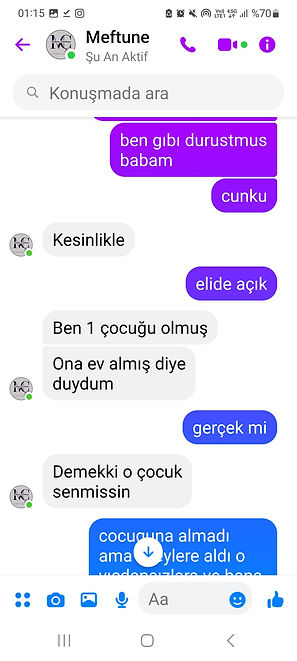


The translation of the correspondence is as follows
I’ve transcribed the conversations from all the screenshots you sent, in order and in the format you requested:
Section 1 (Image 5)
Meftune Çetinkaya: Who is your stepfather?
Me: She said, “Either tell me, or don’t talk about it in front of the child—otherwise, they’ll have questions in their head when they grow up.”
Me: This
Meftune Çetinkaya: Where is he from?
Me: Çivril
Meftune Çetinkaya: Oh
Meftune Çetinkaya: How does Bayram Acarı know?
Me: Well, my stepmother’s... (truncated section)
Part 2 (Image 2)
Meftune Çetinkaya: How long will your case take?
Meftune Çetinkaya: Bayram Acar was the first to make chewing gum.
Me: I don’t know if the grave will be exhumed, but the lawyer said it’ll take two years—no, he said we’ll get it right away, and it’ll be over in two or three months.
Me: Yeah, that’s who it was.
Meftune Çetinkaya: I worked at the factory when I was a child.
Me: She said it was a chewing gum factory anyway... (truncated section)
Section 3 (Image 1)
Meftune Çetinkaya: I worked at the factory when I was a child.
Me: She said it was a chewing gum factory anyway; my stepmother died in a fire, and she said she cursed her.
Meftune Çetinkaya: I know all the details
(The image shows a newspaper clipping: “Tragic Traffic Accident in Şanlıurfa—Businessman Bayram Acar, Mehmet Özyurt, H. İbrahim Çelik, and Hasbi Şahin died in the accident... September 19, 1988, Zaman”)
Me: I was devastated by it too, but never mind—I’ll take care of everything later… I’ll get what’s rightfully mine, and… (truncated section)
Chapter 4 (Image 4)
Me: Bayram Acar when he was 20 years old
Meftune Çetinkaya: When he saw you, he said, “Ertan.”
Meftune Çetinkaya: Yes
Me: I was curious about him, too
Me: 🙂
Me: I wish he could’ve found that photo
Meftune Çetinkaya: He was a handsome guy
Meftune Çetinkaya: Just look at yourself
Meftune Çetinkaya: I wish.
Meftune Çetinkaya: No, that’s it
Episode 5 (Image 9)
Me: If I tell them, they’ll think I’m crazy
Me: 🙂
Meftune Çetinkaya: I understand
Me: Thanks again, good night and good evening
Meftune Çetinkaya: 🙏
Meftune Çetinkaya: Hi, sis
Meftune Çetinkaya: I did a little research. I found out you look a lot like Ertan.
Chapter 6 (Image 6 & Image 7)
Me: He did that to me, but it turned out really well—I learned everything from that cruel devil.
Me: The pot rolled four times and found its lid.
Me: Right next to those canals.
Meftune Çetinkaya: I’m a psychotherapist, my friend.
Meftune Çetinkaya: I’d like to work with you if you’re interested.
Me: I’m also a cosmic energy expert.
Meftune Çetinkaya: I’m very impressed.
Me: I’m full of c...energy (truncated part)
Chapter 7 (End of Image 2 & Image 3)
Me: ...I don’t even know if that’s true.
Meftune Çetinkaya: If he weren’t a decent person, he wouldn’t have gotten the job.
Me: I don’t know why.
Me: I wonder if he asked for a marriage and they broke up—did he say, “Take the child”?
Meftune Çetinkaya: Your father wasn’t the type to get married a second time.
Me: Exactly, he couldn’t do it.
Meftune Çetinkaya: We were in shock when we heard about it
Meftune Çetinkaya: We know he loved your mother very much
Me: The prosecutor’s office will figure it out, Dad... a million percent (truncated part)
Episode 8 (Image 10)
Meftune Çetinkaya: Bayram Acar has always been someone I’ve looked up to in my life
Me: Don’t let my dad get upset
Me: Yeah, he’s just like me
Me: I’ve never been stingy with money—I’ve always been generous
Me: He’s here
Me: I’m always positive and strong
Meftune Çetinkaya: What wouldn’t a man who speaks up for the hungry do for his child?
Meftune Çetinkaya: Your blood ties are your most natural right, just like anyone else’s, my brother
Chapter 9 (Image 11)
Me: My dad is as honest as I am
Me: Because
Meftune Çetinkaya: Absolutely
Me: He’s generous too
Meftune Çetinkaya: I have one child
Meftune Çetinkaya: I heard he bought a house for him
Me: Is that true?
Meftune Çetinkaya: So that child must be you
Me: He didn’t buy it for his child, but… he bought it for them (truncated part)
I’ve also transcribed the conversations from the screenshots you recently sent, in order and in the same format:
---
### Chapter 1 (Image 1 & Image 5)
**Meftune Çetinkaya:** My brother Ertan and I aren’t on speaking terms. He was my brother’s classmate. I showed him your profile picture; he said you looked like Bayram Acar, but that you resembled Ertan even more. I wanted to share this with you. Just
**Meftune Çetinkaya:** Standing behind your case and pursuing legal action is your most natural right, my brother.
**Meftune Çetinkaya:** The resemblance to Ertan has strengthened our belief—we were even surprised. But divine providence is always on the side of the righteous.
---
### Part 2 (Image 6)
**Me:** Yes
**Meftune Çetinkaya:** Your father had a calendar printed with a picture of himself alongside images of Bayram, Yeşil Çivril, and Özcan chewing gum.
**Meftune Çetinkaya:** I remember just that one picture
**Meftune Çetinkaya:** I wish we could find that calendar
**Meftune Çetinkaya:** But so many years have passed
**Me:** Yes
**Meftune Çetinkaya:** There’s no one on your father’s side who doesn’t know you exist
---
### Chapter 3 (Image 2)
**Me:** *(top part cut off)* ...I worked as a live-in helper; I was 13 years old, I earned my own money, and that’s how I went to Bodrum—I learned English there
**Meftune Çetinkaya:** I heard that Mrs. Nisan and her children knew everything
**Me:** I’m very smart.
**Me:** Exactly—back then, they’d give me money.
**Me:** The reason I came forward, though, was
**Me:** when Bayram Acar died, my father
**Me:** wanted to give me away.
**Me:** Yeah, and... they said, “Come on, give us some money and let’s see” *(truncated section)*
---
### Chapter 4 (Visual 7)
**Me:** *(top part truncated)* ...a woman is going to come to me asking for a loan—should I give her a wad of cash?
When I told my acquaintances about this, they said that my father’s son, Ertan Acar, had become a partner in Ülker using the inheritance he received from my father, Bayram Acar; that he had established a hotel chain and entered into joint hotel ventures with Ülker; that he had purchased marinas; that he had become a partner in the marinas in Göcek for 170 million dollars; that he had become a partner in UCZ with I don’t know how many hundreds of millions of dollars; and that he had formed a partnership with Aksa Energy for 817 million dollars. (You don’t know how powerful I am.) You’re so funny.
They said he became a partner in Ülker, established a hotel chain and entered into joint hotel ventures with Ülker, purchased marinas, became a partner in the Göcek marinas for 170 million dollars, became a partner in UCZ with I don’t know how many hundreds of millions of dollars, and formed a partnership with Aksa Energy for 817 million dollars.
In the paternity denial lawsuit I filed against the family in Istanbul that took me in for the DNA test, Ertan was very powerful and was definitely going to side with the family that took me in...
I said, “They can’t do that—it’s a forensic lab,” and while I was waiting for the results all day, they rigged the test exactly as I feared.
The DNA results showed that I belonged to that family—in other words, the results indicated I was related to the family that took me in. They themselves admitted that they had adopted me. But the results were rigged, and those behind it were the ones who thought they could do anything with their money and refused to grant an orphan’s rights:
Ertan Acar and his brothers. Or perhaps Gülsüm deceived you all—to prevent what they did to me from coming to light. As for my sister Vildan, who was a partner at Sağlam Construction… My father, Bayram, had his third marriage officially recognized back then, but everyone thought it was his second. Because he hid me from my mother after they separated—so he wouldn’t have to give me to her. Logically, who would take me in? I don’t know Mrs. Nisan, but she’s a thousand times better than the worst-case scenario—but that’s how it went, and by the time she was going to take me in, she had passed away—what bad luck for me.
In other words, the children my father, Bayram Acar, had with his first wife.
But a trick was played—and the one who orchestrated it was, for some reason, my father’s children, whatever they told him—and the traitor Gülsüm, who took me, and her traitorous husband, so that I wouldn’t go home.
My blood sample was taken, but why did it sit in Mersin for 1–2 months?
(The blood was switched at the hospital, or some other trick was pulled.)
Money was collected to have a DNA test done on Gülsüm Dinçel, the one who took me away, but why wasn’t the test performed on her? Whoever is behind this scheme—I swear on my honor and dignity that I will pursue this to the very end, no matter how many lawsuits it takes, and I will make that Dinçel family pay the price before the law.
It will be that despicable, morally bankrupt Dinçel family—who ruined my life and kicked me out of the house my father Bayram bought—who are my enemies and to whom I am not related in any way, by blood or otherwise.
When I showed it to another lawyer, he said, “This is a very strange and absurd case; it’s unbelievable that these omissions weren’t addressed in such an important file.”
Someone there was probably asking Meftune, “Do you have anyone?”
In the heat of the moment, I said, “No,” but then added, “All my friends are from Adana.”
And immediately, Meftune asked, “Do you keep in touch with people from Istanbul? They wouldn’t come running if something happened to you—even if you died...”
I replied, “They wouldn’t, but all my friends are from Adana,” and it’s true—most of them are from Adana.
I told her I had 6,000 contacts on WhatsApp, and she said, “What? What? What?”—she was shocked.
Then Meftune said to me, “We know your father, Bayram Acar, loved your mother very much; otherwise, my father wouldn’t have gotten the job,” and then corrected herself, saying, “Your father wouldn’t have gotten the job.” As she said this, she was reading from somewhere, and of course, she added, “I suppose whatever my father’s children say…” I’m certain of our genes—we could never bring ourselves to harm one another.
My father’s children and their mothers—the whole family—apparently know about me; I’ve looked into it thoroughly, and there’s no one who doesn’t know. And as for my father’s children, if their consciences are clear, I have nothing to say to them. I’m a part of your father; what should one do to those who treat your father’s memory—or even his belongings—with disrespect, right? Forget about the belongings or the “part”—I’m a living part of your father, but I can’t find the words to say.
I’ve heard a thousand times that I was adopted, and I haven’t even written down one percent of what I’ve heard here. They said with their own mouths that my father was Bayram Acar.
But my lawyer was right. “We’ll handle this quietly,” he told me. But because I was emotionally deprived of a father’s love, I’d always get emotional looking at my father Bayram Acar’s photo—that picture of him in his 20s. All night long, even. Storms raged inside me.
But listen, Meftune Çetinkaya, if you ever acted like a dog for a few pennies to steal an orphan’s rights, may it come back to haunt your children and your entire family—may they all die right before your eyes—and may you always remember me. You can’t even look my father in the face right now. If he’d just come out and said, “I’m not dead,” but oh well. Just wait and see what’s coming your way.
This isn’t a threat, because there’s justice in the universe, and you’ll get what’s coming to you.
You’re looking for a photo of your father—someone you’ve never met, whose love you’ve never known, yet share the same genes with—while they’re running away and hiding after alerting seven families. Think about it… My father’s face is already as clear in my memory as if it were today.
I am a part of your father. But you are not a part of my father to me. Whoever has done me wrong, whoever has stolen my life—something will surely happen to them. Let me keep this to myself. What should be done to those who mistreat your father’s memory or even his belongings, right? Forget the belongings, forget the fragments; I am a living part of your father, yet I can’t find the words to say
I wish I’d handled these matters quietly. It wasn’t enough that the family who took me in did those terrible things to me; when I learned the truth, they colluded with my father’s children to embezzle money—they betrayed me and cheated me. What difference would it have made if I’d claimed my bloodline anyway? I’m not that interested in the inheritance. It’s my right, of course. What can I say?
Insisting on my rights gets under people’s skin, which is why they get so angry. Otherwise, it’s the greed for money that has truly blinded them.
The truth is out in the open; their cheating will never change it, and I will never let this matter rest. If I found my real mother, she would have testified on my behalf in court on January 11, 2024...
But where are you, Mom, where are you? I think she’s married and hasn’t told her husband about me. I’ll keep writing to you—every day, about what I remember, what I know, and any new developments. But I’m wondering what I should do. Should I go on Müge Anlı’s show? No, I tried that, and she blocked me too. I didn’t really want to go on the show anyway; even if I could, I probably wouldn’t, but I’m undecided. I don’t want to reveal my father’s children’s names to the public. But if I went on the show, I’d have to.
I did a little research on Ertan Acar—one of the children from my father’s first marriage, the man who’s been embezzling my money for years—and here’s what I found...
Ciner sold his majority stake in UCZ.
60 percent of UCZ Retail’s shares were transferred to Ergün Bodur, Ertan Acar, İsmet Or, Ahmet Özaktaç, and Veysel Taşkın.
Accordingly, Ergün Bodur, Ertan Acar, İsmet Or, Ahmet Özaktaç, and Veysel Taşkın filed an application to acquire 60 percent of the shares in UCZ Retail Trade Inc. from Park Holding Inc.
Here is the link to this news article.
https://www.dunya.com/sirketler/ciner-ucz039de-cogunluk-hisseyi-satti-haberi-237686
The Ülker Group continues to expand into non-food investments. In May 2005, the Ülker Group—which received a founding license from the Capital Markets Board (SPK) and established a real estate investment trust under the name Sağlam Real Estate Investment Trust—had previously made headlines with Akfen Holding for a residential project in 4. Levent. Ülker is now preparing to become the owner of a marina and a hotel.
The company’s partners include Yıldız Holding,
Ertan Acar, Serdar İnan, Murat İnan, Ersin Topçuoğlu, and Hüseyin Avni Metinkale. NO SPACE LEFT AT PORT GÖCEK Port Göcek Marine currently serves yachts in Göcek. The marina, which has a capacity of 379 boats, has been in operation since 1999. The marina, built by Enternasyonal Turizm—a subsidiary of Yapı Kredi Bank—was purchased by the Turkon Group in 2004 for $42.5 million. The marina offers a wide range of services for boats, from wireless internet and laundry facilities to a private beach, a 180-boat dry dock, restaurants, and customs clearance. There is a 57-room Swissotel in the area where the marina is located. A 500-room resort hotel, also to be operated by Swissotel/Ruffles, will open in 2008.
https://bigpara.hurriyet.com.tr/haberler/genel-haberler/ulker-gocek-te-denize-giriyor_ID574431/
Raid on the Sarallar Group... Erdal Acar Detained
A raid was carried out against the Sarallar Group, led in Istanbul by İlyas Saral—known to the public as Alaattin Saral—and Ertan Acar.
In the simultaneous operation conducted in 13 provinces centered on Istanbul, Erdal Acar and 117 other gang members were taken into custody. Efforts to apprehend İlyas Saral are ongoing.
(A journalist who called me said he was a partner in the Sarallar construction company.) I don’t know if he’s a civil engineer or what.
https://www.odatv.com/guncel/sarallara-operasyon-erdal-acara-gozalti-243068

I’m not saying he has money and I don’t. I don’t care about your money. Give me my money. It’s my natural right to claim what my father left me. Ertan Acar and his brothers. I wrote these news articles and posted them here for this reason, and I’ll say this too. Ertan Acar and Hicran CANAN, if you read this, know that I’m aware of your immense financial power and that you tampered with the DNA test—and know that I won’t let this matter drop. I’m not looking for love, and I don’t want to meet you. Because I grew up with hatred instead of love.
Why would I seek something I’ve never seen or experienced? I have blood, hatred, and revenge within me; there is nothing else in my life—never has been. The only thing that brings me relief is blood and revenge. Even if I took a shower of blood, the relief would be minimal because I hate people.
Claiming my right to my father’s last name is my most natural right.
They don’t want me anyway, and I guess they don’t love me—that’s my father’s side of the family.
I have blood, hatred, and revenge; there’s nothing else in my life, ever.
The only things that bring me relief are blood and revenge. Even if I took a shower of blood regarding the Dinçel family, it wouldn’t bring much relief, because it’s because of them (the Dinçels) that I hate people.
When I was little, they used to tell me not to talk to strangers. But that was a big mistake. All the harm came from people I knew. Everything is a lie, and even those closest to me cheated for money. Sorry—they’re not my loved ones; they’re my enemies, those Dinçels.
Every time I log into e-Government to check my family tree, I don’t want to see the lies of those people.
When I was little, they used to tell me not to talk to strangers. But that was a huge mistake. All the harm came from people I knew. Everything is a lie, and even those closest to me cheated me for money.
I want to find my mother. I want a few photos and videos of my father, Bayram Acar. My last name isn’t Atilla Dinçel—it’s Atilla Acar!!!"
Money comes and goes. I want to restore my honor. Because Gülsüm—the woman who took me for money—was claiming I was hallucinating just to suppress what’s written here. I’m going to prove my family ties, and then I’ll expose you to the world, Gülsüm Dinçel and your immoral husband.
My father, Bayram Acar—I wish he had entrusted me to another family instead of leaving me with that devilish Gülsüm Dinçel. He took care of me, but he couldn’t have known I would die.
Nisan Hanım’s mother passed away about two years ago. I was saddened by that.
“Speaking of Nisan Hanım, when my father, Bayram Acar, lost his life in a car accident in 1988, that same year Gülsüm Dinçel—who had taken me in—and I went to Ataköy 5th Section, to the home of Sebahattin Dinçel’s sister, the man who had taken me in.” Her sister’s husband, Ahmet Şaylan, was the general director of PTT; they were living in the company housing there for three years.
Ahmet Şaylan—the brother-in-law of that traitor Sebahattin, who had taken me in, and the husband of his sister—was living in the company housing in Ataköy 5th Section; they went to live there, and they took me with them.
Ahmet Şaylan’s son, Murat Şaylan, started playing with a little girl there.
Then Gülsüm Dinçel, the woman who took me, said to me: “Your aunt and uncle Nisan are coming—they’re sooo rich, look—they’ll be here any minute,” she said.
When I found out this year that my father’s name was Bayram Acar and his first wife was Nisan Hanım, it immediately came to mind—it was like a bolt of lightning struck my head. “Nisan… Nisan… Nisan… Nisan… Nisan…” I said, and I remembered.
They arrived, and there was a little girl with them—but was she my sister Canan? Or was it Hicran? I don’t know which one.
“They’ve really spoiled that girl,” said Gülsüm Dinçel—the one who picked me up—and her husband’s sister. Then she came over to me, and Gülsüm Dinçel asked:
“Look, did you feel anything for that girl?” she asked me excitedly.
How was I supposed to know she was my sister? So I said, “She’s a pretty girl, but I didn’t feel anything.” “Get out of here,” said Gülsüm Dinçel, who had picked me up.
The truth is, I thought she was asking, “Is she pretty? Ugly?” Because, of course, you show girls to kids and jokingly ask, “Is she pretty?” But since I’d never experienced familial affection—since I didn’t know what that was—when I looked at her, whether it was my sister Canan or my sister Hicran, I thought to myself, “What on earth is this?”
“It’s almost as if she’s not a girl!” I said. I mean, it was a strange feeling. She just seemed incredibly cute to me—and I mean, incredibly, incredibly cute. What was this?
I couldn’t understand why I felt that way, but I thought she was the cutest person in the world. At that moment, gender didn’t cross my mind—because she was my sister! How could I have known at that moment that she was my sister? And then that monster of a woman asked,
“Did you feel anything?”
I said no, thinking she was asking about her beauty. It was as if I’d really seen an angel. We were at the home of Zarife Şaylan, the sister of that man named Sebahattin who’d taken me in. Canan—or maybe Hicran—was playing with my father’s child, and Zarife Şaylan’s son, Murat Şaylan, was playing with her. Then, Mrs. Nisan playfully scolded Murat, saying, “Let go of my daughter.”
It wasn’t a feeling tied to being a woman or a man. It turns out my heart had warmed through the bond of siblinghood. So, if I’d been with my father, Bayram Acar, I would have been the happiest person in the world. It’s no lie—I’ve never once laid a hand on any of my relatives: my uncle, my aunt, my grandmother Halime...
I’ll never forget it—of course, it’s hard to believe what I’m about to write, but I swear I really did experience this.
When my father, Bayram Acar, passed away, and they took me to Çivril, those people—including that traitorous woman Gülsüm Dinçel who had taken me away—went to visit the family graves at the cemetery in Çivril.
While I was there with them, looking at the grave, I heard a voice inside me—not from the outside, never—you know, that inner voice—and it suddenly said, “No!” Just like that. It told me, “THAT’S NOT YOUR GRANDFATHER!!!” I don’t usually believe in such things, but even at my age, I still can’t forget this.
Then Gülsüm Dinçel, who had picked me up, said this to her husband’s sister: “Don’t let Atilla come inside; have him wait in the other room. I swear, that woman, Nisan Hanım, is giving Atilla such a hostile look.”
The woman who took me in—Gülsüm Dinçel’s sister-in-law—said, “Oh, come on, what has the child done wrong?”
All I wanted was to find a photo of my father, Bayram Acar, recently
When I asked him, “I’m Bayram Acar’s son—are you Hüsnü Acar’s son?” he replied, “Yes, Bayram Acar is my uncle.”
“Are you in touch with Ertan Acar?” I asked, and he said, “Hold on a minute, I’ll get back to you,” and then blocked me.
No matter who I asked, they immediately blocked me. “Wow,” I thought. So my brothers who know me must have spread the word to everyone.
I told them to have Ms. Müge Anlı read what I’d written. “Let’s see—if she finds the time to read it, she’ll be doing me a huge favor. I think everything will come out on live TV, if fate allows,” I said. She disappeared afterward, too.
Here’s the link to where it was shared...
https://www.facebook.com/groups/1223403904488942/posts/1311032915726040/
THE STORY OF THE CHEWING GUM FROM ITS OWNERS
In Memory of Mr. İsmail Özcan...
The Baycan company, co-founded by İsmail Özcan—who turned the drop-shaped gum, originally produced and hand-wrapped by his partner Bayram Acar in the Çivril district of Denizli, into a brand—now operates on a 35,000-square-meter production site.
Every company likely has its own interesting story. In this first issue of our magazine, we spoke with Mr. İsmail Özcan, one of the two founding partners of Baycan—a pioneer in the Turkish chewing gum industry—who is still alive today. Mr. Özcan, an experienced businessman now over 80 years old, welcomed us to the company’s headquarters on Haramidere E-5 and answered our questions in a warm and friendly atmosphere. We discussed just about everything that came to mind—from how they made their first drop of gum to the secrets of a successful partnership; from manufacturing to marketing, and even his volunteer work in education. Of course, it wasn’t possible to hear the story of his entire life and all his experiences in just a few hours… But within that short time, we tried to cover everything we could think of.
We hope you’ll find this conversation—which we enjoyed and from which we learned a great deal—just as interesting to read.
Mr. İsmail, how did you get started in this business?
I started my business in 1953 in the village of Bozdağ, Çivril, with a capital of 160 lira. With 25 lira of that money, I bought a “luxury” item (a lighting device that ran on propane), and with 50 lira, I bought a television and opened a coffeehouse. Along with running the coffeehouse, I also started collecting and selling the village’s eggs. I would work in the fields in the village until evening, and then open the coffeehouse in the late afternoon.
So that’s how you started…
Yes… I worked as a peddler and a street vendor. I used to think, “If I make 150 lira in sales by evening, that’s enough.” Then I started selling everything the villagers needed.
When did you come to Çivril?
In 1958, I opened a store in Çivril with 2,000 lira in capital.
You expanded the business…
Yes…
So, how did you get into the chewing gum business? Actually, chewing gum wasn’t your first business.
Mr. Bayram used to make chewing gum and sell it at markets and on trains. I was also selling chewing gum in my shop; they brought some to me too. I took the gum and chewed it. I really liked it. Then I went to see him, and we met. I started selling the gum he made. We even signed a 10,000-lira contract.
Why?
So that you wouldn’t sell gum to anyone else but me.
So, Mr. Bayram, did he learn this gum business from his family?
No. After returning from military service, Mr. Bayram used to go from his village to nearby cities to work, buying and selling watermelons. On one such trip to Antalya to buy watermelons, he ran out of money. His debt at the inn (hotel) where he was staying had accumulated to 27 days’ worth. He had 25 kuruş in his pocket. He bought half a loaf of bread. He was 22–25 years old at the time. He was walking toward the park. At that moment, he opened his hands and said, “O Lord, you know me. Give me a job; do not lead me down the wrong path.” When he returned to the inn, he met a young man who had just arrived. With the young man’s 29 lira in capital, they began making and selling paper flowers. Bayram Bey would make the flowers out of crepe paper, and the young man would sell them.
That young man also knew how to make chewing gum. “You know how to make flowers, and I know how to make chewing gum. Teach me how to make flowers, and I’ll teach you how to make chewing gum,” he said. Bayram Bey taught him how to make flowers, and in return, the young man taught Bayram Bey how to make drop gum. One day, on their way to the hotel, they bought 2–3 kilograms of chewing gum base, half a kilogram of paraffin, and 250 grams of drop gum. For the chewing gum production, they also bought a gas stove with a pump and an aluminum pot. When they arrived at the hotel, they melted the ingredients in the pot and began making chewing gum. That’s how Bayram Bey learned the chewing gum business.
Later…
They did this work for a few years. However, his mother didn’t want him to be away from home all the time; she said, “You’ve worked hard enough there. Let’s either go to Dinar or to Çivril.” At that time, the Bayram family was living in the village of Bozdağ.
Mr. Bayram was left an orphan… Later, Mr. Bayram began selling gum at the market in Çivril and on trains.
How did your partnership come about?
Mr. Bayram would make the gum at the factory, and I would sell it. We started making and selling sugar-free drop gum under the name “Yeşil Çivril.” We made and wrapped it by hand.
We gave a free box of gum to customers. We tested this gum in Çivril for three months. Then we said, “If it works in Çivril, it’ll work in Denizli too”; three months later, we went to Denizli. We gave some to our acquaintances.
Didn’t you run into any difficulties?
It wasn’t easy. Some people would say, “There’s no such thing as this.” I went to 16 people in Antalya and couldn’t sell a single one. Finally, a heavyset man chewed some gum and said, “I’ll sell this.” We started by giving it to him first in Antalya, and I said, “Okay…” Then the others wrote letters asking for some too.
Letters?
Letters… Back then, there were no phones like there are today. Just telegrams and letters. One person even sent a telegram after I left, asking for 300 packs of gum—that’s 3,000 packs by today’s standards. I carried that telegram around with me for three years and showed it to the customers I visited.
You must have many interesting memories…
Of course. Once, a customer of ours in Aydın hadn’t taken our merchandise. When our sales reps went there, they wouldn’t let them in. This customer later asked us for gum. So I went to visit him. I walked into his store and looked at the gum in our green boxes sitting on the counter. Our green-boxed gum was always on his counter. “Let’s see if you recognize me,” I said.
“I don’t. But you’re looking at that gum as if to say, ‘That’s mine.’ Aren’t you the owner?” he said. “
Yes, it’s mine. You didn’t let our sales rep in,” I said.
He took me to the storage room. His storage room was full of unsold gum.
“From now on, I’ll only sell your gum,” he said.
How did it go in Istanbul? How were sales and your progress?
It wasn’t easy, of course. I went to Istanbul. Our gum didn’t have any pictures on it. Some people said, “This doesn’t have a picture.” Then we gave it to a man from Antep. Later on, we had a Jewish customer in Istanbul. Whenever I came to Istanbul, he would always take me to his home. He would handle my business so I wouldn’t give goods to anyone else; he made sure I didn’t have contact with anyone else.
What did you do when demand increased?
In 1966, we founded the İsmail Özcan Bayram Acar Collective Company. In 1970, we paid 400,000 lira in taxes in Çivril. That was more than the total tax revenue of the entire town of Çivril. Once a customer bought goods from me, they wouldn’t go anywhere else.
Later…
There were just the two of us. We kept it going for 22 years—22 years of working on a single product. We made mastic gum and wrapped it by hand in paper. We traveled all over the region—Çivril, Denizli, the Aegean… The late Mr. Bayram made the gum, and I sold it. We built a market in Turkey. By the end, we had 60 employees.
So how did you end up in Istanbul?
We got on a bus and came here in 1969. We started in Küçükçekmece in 1972 with 150 people. A year later, there were 300. The number of workers grew to 400, 500, and eventually 600.
You were doing the production by hand, weren’t you?
Yes. In 1976, we decided we couldn’t keep doing it by hand, so we bought two machines from Germany. We became a corporation. In 1978, we switched completely to automation. Our products were in demand all over Turkey; we had no competitors.
Weren’t there any big companies back then, just like today?
Of course there were. There were big companies back then too. But no one emerged as a competitor. That was the wisdom of Xxxxxxxxxxxxxxxxxxxxxxxxxxxxx.
I remember the TV commercials from back then. They featured a cartoon girl saying, “Pışık; Özcan is my chewing gum.” I also haven’t forgotten the Bayram chewing gum commercial with the drums and flutes…
Yes… We were making chewing gum under the Özcan, Yeşil Çivril, and Bayram brands. Then we combined the “Bay” from Bayram Bey and the “Can” from Özcan to create Baycan. That’s how the company’s name came about.
Back then, whenever we ran an ad, people would line up. We had no competitors.
When did you move to Haramidere, where Baycan is located now?
Over time, our business outgrew Küçükçekmece. In September 1988, Bayram Bey passed away in a traffic accident. We moved here in November 1988.
This place is quite large…
This factory has 35,000 square meters of covered space. We don’t have that much land in the village…
You are the chairman of the board of a company that was founded and grew through an exemplary partnership in our country and continues to produce in the same way today. Your other partner, Mr. Bayram, passed away 19 years ago. You continued the partnership with his children. What are the secrets of this exemplary partnership?
Sincerity, honesty, hard work, and sharing… We worked in such a way that even a father and son wouldn’t have worked together like that. After Bayram Bey and I agreed that he wouldn’t sell gum to anyone but me, people much wealthier than me came to buy gum.
But he never made gum for anyone but me.
Whatever I bought for myself, I’d buy the same thing for him. For example, I bought a summer house for 300,000 lira. I told Mr. Bayram he could buy one too. But then he ended up buying something else.
When it came time to raise prices, Mr. Bayram was very careful. We wouldn’t raise prices until our stock of raw materials ran out. We always paid our taxes in full.
You pay very close attention to taxes.
Taxes are like a right owed to others. We always paid our taxes in full. All our workers are insured. Once, I came to the factory and saw someone there. I asked who it was—he had come for an inspection. “Inspector, you can tour the factory and ask everyone one by one,” I said. The inspector said, “Others slip out the back door when we arrive, yet you’re telling us to talk to the workers.” He was very surprised.
Another time, I went to the Bakırköy Tax Office to pay my taxes. My car isn’t flashy. The director called me in and offered me coffee. He asked what I did for a living. When I said I make chewing gum, he was surprised. “There are factories this big, and they don’t pay as much tax as you do,” he said.
Baycan is, as far as we know, one of Turkey’s largest companies.
Yes. In 2004, it made it into the top 500 companies.
How many people work there now?
There are 550 people working at the factory. We entered into a commercial partnership with Ülker in 1998. In 2001, we became partners with Ülker.
Along with all this success in your business life, you’ve also contributed many wonderful projects to our hometown. You’ve built schools…
I built three schools in Çivril. I also built a military recruitment office and a village hall. While I was in the village, I fenced off the village cemetery and brought electricity to the village by installing a new transformer.
One of your schools has also won a championship.
İsmail Özcan Elementary School became the Turkish volleyball champion in 1988. As far as we know, Mr. Bayram is also passionate about education. Yes, but he didn’t build a school in his own name. He supported Turkish schools.
If anyone knows this and doesn’t speak up, may their favorite person die.
I will sever my ties with this family—who stole an orphan’s rights, sold me for money and a house, kicked a 14-year-old child out of the house after my real father, Bayram Acar, passed away, and told a 9-year-old child, “If you don’t leave the house, we’ll poison you, we’ll kill you,” and punched him—and I will return to my true family and find my mother.
Let me state that I have no psychological issues and have never once in my life hallucinated. Because the only defense people who know these writings are true will have is to say, “He’s hallucinating; he’s sick.” I am a very stable person. I have never once in my life hallucinated.
Take, for example, the fact that I’m writing right now—is this a hallucination? Can’t a person tell the difference between reality and fantasy? Doctors sometimes say that our brains play tricks on us, just to confuse us. No, that’s not it.
A sound-minded person knows whether something is a hallucination or not. But the only defense of the demonized Gülsüm Dinçel—even in the face of the facts known by the person she’s speaking to, and despite her own confession—will be to try to portray that person as a hallucinator. Imagine you’re a very sound-minded person.
You saw something, you heard something—isn’t that the truth? Someone else knows it’s true and admits it. Then, if they lie and say, “You’re hallucinating,” what would you think? Shame on them.
That’s not called hallucinating; it’s the other party lying and acting unjustly.
Gülsüm Dinçel and Sebahattin Dinçel, who altered my family ties without permission for money, and who—even after I learned the truth—committed forgery in documents and lied, thereby committing a crime against me.
Let me make this clear: I have never imagined anything, and if there is a single word of a lie in what I’ve written, may I not live to see tomorrow. These are not memories, recollections, or fantasies. Even before I learned that I was adopted and that my real father was Bayram Acar, these experiences were always on my mind.
“Why did they say that?” I couldn’t make sense of it, and even before I knew I’d been adopted, I’d gone over those conversations in my head a thousand times, wondering why they’d said such things. Why? If someone tells a sane person who doesn’t have hallucinations, “You’re hallucinating, you’re crazy,” that is an insult, and they’ve committed a crime.
I’ve earned my own living, all on my own. Could someone who “sees things” be writing this right now? Could they earn a living, run their own business? No, their excuses are just ridiculous—shame on them, damn those devilish people. But of course, everything will come to light, and they’ll all be held accountable before justice.
On the contrary, I am someone who loves life, who loves to live no matter what, and who finds joy in life.
I have absolutely no physical, bodily, or mental ailments. I’m very patient, aren’t I? The truly sick, money-worshipping, devilish people are Gülsüm Dinçel and Sebahattin Dinçel.
Let my real mother testify for me—that’s enough. Because, as far as I’m concerned, my father, Bayram Acar, has passed away—he’s not to blame. But the woman I call “mom”—right now, I think she doesn’t want me to come forward so her husband won’t find out and their family won’t fall apart. I am not my mother’s son—I am the son of my poor father, Bayram Acar. I wish I had died in his place. At this age, the pain of losing a father is unbearable.
That compassionate man—my father, who helped schools and was generous to everyone. The man who did everything he could for me before he died, the man who carries my genes—my father, Bayram Acar.
Sebahattin Dinçel, who took me in, was drinking when I was 12, and he started talking to me on his own and said:
“Your father was a very respectable man. He was a man of influence, after all. That’s why I have high hopes for you,” he said.
What would you say if you were in my shoes? What would you think?
I’m not someone who sees things in my imagination—I’ve actually lived through these events. But at the January 11 court hearing, the only defense Gülsüm Dinçel—the woman who took me in—will have is that I’m imagining things.
Shame on you, you devilish people. What imagination? You admitted it with your own mouths; I’ve heard it thousands of times, and I’ve heard your conversations too.
No matter what trick you pulled by altering the document, it doesn’t change the truth. There isn’t even a single photo online of my father’s son, who looks just like me. It’s a security issue. That’s normal. He’s nowhere to be found.
You’ll say he looks just like me. You’ll ask, “How do you know he looks like you?” I have a photo of him, and I’ve heard from so many people who mistook me for him—but as soon as I explained, my relatives immediately blocked me.
The word has been spread to everyone. I mean, I’m just giving up at this point. When I found my uncle’s son and said, “I’m Bayram Acar’s son,” he said, “Hold on a minute,” and blocked me.
Man, wasn’t it enough that you took from my father, Bayram Acar? They tried to take advantage of me too—instead of educating me or showing me mercy.
I want to reclaim my true family ties, and if fate allows, I will. Let no one try to stop this. The documents are already forged. Besides, Gülsüm and her husband, who took me in, have built their lives on lies for money.
Doing this will never change the truth.
I will never give up on this in this world, and I trust our government and the law. Justice will prevail. Because reclaiming my true family lineage is my most natural right.
Wealth, money, property... I could curse all of them. A person’s greatest factory is their brain.
Right now, my only witness is my father, Bayram Acar, but he cannot rise from his grave, even if I were to tell him to. Let’s set aside the search for witnesses; I will request that the case proceed in secret.
Another test will be conducted, but not now. Snow will fall on the mountains you trust; I will file another lawsuit—if it doesn’t work out this time, but when the truth comes out, it will be a million percent certain.
My father’s children know me, and they’ve known me all my life. It’s strange.
They’ve known all these years that my biological father, Bayram Acar, is my father. Apparently, there’s no one in their circle who doesn’t know me. I swear on my honor and dignity: I will never give up on establishing my bloodline. Even if I knew I’d have a fortune as great as Elon Musk’s and lose it all overnight, I still wouldn’t give up.
Even if I were to appear on TV, they’d try to stop me before I even go on. Don’t worry—it’ll be a surprise which show it is. No, they’ll stop me.
I’m going to file a lawsuit against Gülsüm Dinçel and her husband for the document forgery charges they brought against me. I have no relatives. I have a father—I occasionally visit the single-room grave of my father, Bayram Acar.
A candle burns, and its burning is real. No one can hide it under the bed to keep it from burning.
The greatest thing in life is eternity because it has no beginning and no end—it is, by definition, eternal. The smallest thing is also eternity, because there is no such thing as “small” or “large.” Even a life shorter than a butterfly’s—on a planet that is 4.5 billion years old, where time is 999 quadrillion times greater—if all that time were to amount to just one day for it, time is an illusion.
Those money-worshipping, insatiable, greedy traitors—the woman who took me, Gülsüm Dinçel, and her husband. You didn’t even let my father rest in peace; he appears in my dreams every day. Bayram Acar. What you’ve done is nothing short of injustice.
Ahmet Şaylan served as a pretext for that devilish family, and İsmail Özcan had me enrolled in another family’s school so I could attend—and under the pretext of protecting my mental health from that morally bankrupt family, they wouldn’t let the man tell me he was my father, even though he would have said it countless times.
But in the meantime, death came knocking. Think of your life as a light—it goes out, and you’re left wondering where to find it; you can’t even search for that light, and you only learn why it went out at the age of 44.
When I learned at age 44 that my father was Bayram Acar and spent the night in a state of emotional turmoil, I said to you—the children of my real father—at least lend a hand. This isn’t about money; it’s a matter of honor and pride.
And in a conversation with that vile woman named Gülsüm—the one who took me for money—she once said...
“I’ll tell him,” she said, “it won’t be long now, just leave it to me,” when the Şaylan family came over to visit. Of course, how was I supposed to know they were talking about me?
Since I didn’t know what love was, the first time I looked at a photo of my father, Bayram Acar, memories came flooding back, and I felt love for him. Not for anyone else.
I want to reclaim my true bloodline.
And I want to reconnect with my true bloodline. I’m going to reveal my true identity to the people who’ve wronged me—who took me away, kicked me out of the house for all these years just for money, and spread rumors around town calling me a “dreamer.”
When I log into the e-government system, instead of seeing the names of those who’ve wronged me, I want to see the names of my father, Bayram Acar, and my mother, Emine—my true bloodline.
Setting everything else aside, what was done to my father was done to me. Are you indifferent, or am I mistaken?
I will take revenge on them, and yet you do nothing about what those scoundrels did to your father’s son.
Gülsüm Dinçel and her husband.
Is it just the house? I remember when you took all that money from my father, supposedly to take care of me—that morally bankrupt creature named Sebahattin, with his incompetence, squandered the money he’d taken from my father, Bayram Acar, claiming he’d use it to care for me. He nearly killed me and made me sick countless times, even when I was a child in that house, and they never told my father; they always hid the fact that I was sick.
I will never call them my adoptive parents—Gülsüm Dinçel and Sebahattin Dinçel, those inhuman people who took me in only for the money.
Forget about doing me even the slightest good—these are people who do as much harm as they possibly can.
Those people—Gülsüm Dinçel and Sebahattin Dinçel—who took as much money as they could from my real father, Bayram Acar, and used it to buy a house, only to throw me out onto the street after my father, Bayram Acar, died… Even though my father, Bayram Acar, did so much good for them, after he died, they didn’t do me any favors—instead, they did everything in their power to harm me.
And when I found out at this age that Bayram Acar was my father—even though I was entitled to all that inherited property—they sold me out again for a pittance.
Shame on them. Gülsüm Dinçel and Sebahattin Dinçel, who told me with their own mouths that Bayram Acar was my father, joined forces to sell me out once more for a pittance, just to keep the house.
People who daydream see aliens—you don’t daydream about something like this. They deceive people with just two words.
For example, Gözde Dinçel, the daughter of Gülsüm Dinçel—the woman who took me in—called me when I was 14.
She told me she was going to commit suicide. When I asked why, she explained that her elementary school teacher, Yavuz Bulut, had called her over and, while sitting in a café, told her he was her father.
She had run away from home, but I told her that didn’t concern me; I haven’t spoken to them in years. But it weighed on my mind, so I told Sebahattin Dinçel, the man who took me in, about it.
Gülsüm Dinçel, who took me in, claimed that I was sick and hallucinating, and introduced me that way to all her acquaintances.
When this reached the ears of her close relatives, Gülsüm Dinçel—who took me in for money but told me the truth to my face—would deceive people with just two words, saying, “She’s hallucinating; she’s sick.”
She’s the one who’s really sick—a narcissist, shameless, and a traitor. In fact, once, Gülsüm Dinçel’s sister—who had taken me in for the money—said this to Gülsüm Dinçel in her Denizli accent:
“Come on, girl, you’re eating the man’s bread, and look what you’re doing!” she said. Gülsüm Dinçel, however, replied angrily, “To the one who deserves it.” I remember this conversation from when I was little.
Gözde Dinçel, the daughter of Gülsüm Dinçel—who took me in for money—conceived this daughter with Yavuz Bulut, an elementary school teacher in the Cumhuriyet neighborhood of Istanbul, and for years made her own husband care for her as if she were “his daughter.”
Someone else’s daughter, that is.
Gözde Dinçel, the daughter of Gülsüm Dinçel—who took me in for money—came to Mersin once, stopped by to see me, and told my wife about this incident. My wife must be hallucinating, right? Because I, Sebahattin—that shameless man—told you this story, and his wife deceived him by saying, “Atilla is hallucinating.”
Anyway, I’m going to post a photo below of Gözde Dinçel, the daughter of Gülsüm Dinçel, who married me for money. Her father is Yavuz Bulut. Her brother is Gökmen Bulut.
Gökmen and I went to the same school. Gökmen is Gözde’s brother. When she was little, that despicable traitor Gülsüm Dinçel—who took me in for money—would constantly call Yavuz Bulut asking for dollars.
She’s so shameless that she’d talk on the phone, then when the bill came, she’d show it to her husband and say, “Tell the person who was on the phone.”
Yavuz Bulut—that is, Gözde’s father—enrolled Gözde in his own class and taught her. Yavuz Bulut also has another daughter, the same age as Gözde, named Merve Bulut.
Yavuz Bulut had her study in the same class as Merve. Now I’m posting a photo of Gözde, her brother, and her father, Yavuz, below. You can see the resemblance.

They also have a son named Ahmet Dinçel, who takes after his corrupt family.
Back in 2013, their son, that traitor Ahmet Dinçel, called me and said he’d lost his job and had no money. When he asked me for money, I was naive enough to give him some every two days until he found a job.
On one occasion when I sent him money, the following incident occurred:
I was talking to a woman on a dating site called Pembe Panjur, and she had suggested we go out to eat at the time. During dinner, she said she couldn’t pay her rent and
“My cousin is going to send me money—would it be okay if I transferred it to your account?” she asked.
I said yes, like a fool.
It turns out she’d been talking to someone else on Pembe Panjur and had taken money from him to send to me. Then she blocked my calls. She’d also blocked the guy she took the money from, but he filed a complaint—over a ridiculously low amount of 300 TL.
They even called in Ahmet Dinçel and took his statement, claiming I’d sent him money. I immediately told Ahmet Dinçel, “Go give the man his money so he’ll drop the complaint.”
Ahmet Dinçel, however, said, “I’m going to Bursa; if I give him 300 TL, I’ll need money for a taxi and a hotel,” and back then he took 3,000 from me—he gave the man his money. He scammed me, and as if that weren’t enough, he told me this:
“I went, the man withdrew his complaint, realized we weren’t guilty, and I defended you in court—I even said, ‘Arrest me if you must,’” he said.
But even though the victim’s money was returned and there was no longer a complainant, a public prosecution was filed, and they sentenced me to four and a half years in prison.
I hired a lawyer, and my innocence was proven on appeal—I was acquitted.
I was essentially sentenced at birth—for no reason—and now I’m being sentenced for a crime I never committed.
So I ask: Why did the man withdraw his complaint, and why was a public prosecution filed in this case of a misunderstanding and reconciliation?
What’s even worse is that while I was in the military—and my residence has remained there ever since—they deliberately didn’t notify me about the court papers sent to my home, so that I would be punished.
On top of that, when the police came to my house asking for me, those scoundrels went so far as to tell everyone that I’d done something wrong. They’re morally bankrupt, shameless people.
Maybe because I look decent, I didn’t even bother to check. I didn’t make a mistake, I didn’t go to the hospital, but I finally found out when I checked e-Government. Shame on them.
Because that was the reason. Ahmet Dinçel, the traitor’s traitorous son—who shares the same blood as them—told me
“I went there; the man withdrew his complaint. He realized we weren’t guilty, and I defended you in court too—I even said, ‘Arrest me if you must,’”
he told me—yet despite constantly asking me for money and taking it, he said the following in court:
“From what I’ve heard, Atilla is always involved in shady dealings. He asked for my IBAN, and he owed me money, but I didn’t give it to him. He said nothing would happen, so when he asked again, I gave it to him. Atilla is involved in shady business, but he tricked me.”
You shameless, despicable person! Feed your own empty stomach—who are you that I should take money from you? I didn’t take it; you were the one who always asked for it! What’s the reason you’re saying this?
Why? I mean, why? Just tell me to send it and be done with it—tell me the truth. What’s the reason for slandering me and getting me punished for something I didn’t do?
If I took even one TL from this, may I never see the light of day again—my wife is a witness that he took it from me, not because he was in debt, but just like that. I’d curse him out badly, but I won’t do it here. It’s up to you. Evil and treachery run in their blood.
This person—the one whose son is named Ahmet Dinçel—told me that he claimed in court, right to my face, that he was defending me, saying, “One of the girls deposited money into the account and withdrew it to give to Atilla,” and that the money I sent him was my own earnings. And he said it with pride.
What’s this man’s problem? We get it—he’s not related by blood—but no one would do something this despicable to an enemy.
And to the very person who paid him! Even though I was completely innocent—and the man’s money had already been paid back immediately, and he wasn’t even a complainant—because of this traitor, I paid 60,000 TL in attorney’s fees. I got off the hook, but I paid—I got off the hook.
Here is the statement from that traitor named Ahmet Dinçel, who was two-faced with me, saying, “I told the truth in court when there was no problem at all, I defended you too, and the man’s money had already been paid...”
Here is the translation of the texts:
I have transcribed the image you sent exactly as it appears:
The second session began at the specified date and time. The defendant, Ahmet Dinçel, was seen entering the courtroom. The open trial continued.
The defendant was brought before the court. The court proceeded with the identification process.
DEFENDANT AHMET DİNÇEL: Son of Sebahattin and Gülsüm, born on October 4, 1976, in Çivril; registered in the population registry of Nadirler neighborhood/village, Çivril, Denizli; currently residing at Cumhuriyet Mah. Bosna Cad. No. 11, Inner Door No. 5, Sultangazi, Istanbul. He is married with one child, a primary school graduate, and works as a jeweler. He stated that he has a monthly income of 2,000 TL and no prior criminal record. Cell Phone: 0535 - 296 - 40 - 25
The directive document and its attachments from the Bursa 5th High Criminal Court were read aloud.
It was explained to the defendant that it is his legal right not to make a statement regarding the charges against him, that he has the right to choose a defense attorney as stipulated in Article 147 of the Criminal Procedure Code (CMK), and that he may avail himself of legal assistance; if he chooses, a defense attorney may be present during the interrogation; if he is unable to select a defense attorney and wishes to receive legal assistance, a defense attorney may be assigned to him by the Bar Association; Furthermore, he was informed, in accordance with Article 191 of the Criminal Procedure Code, of his rights to request the collection of concrete evidence to clear himself of suspicion, to eliminate the grounds for suspicion against him, and to present circumstances in his favor.
Defendant: “I understand the charges against me and my rights; I have no request for an extension,” he said.
Defendant Ahmet Dinçel in His Defense: “I do not know the complainant named in the indictment. Atilla Dinçel is my brother, and he is involved in very unsavory activities. He has borrowed money from me many times but has not repaid it, and his whereabouts are unknown. One day, he called me on the phone. He first asked how I was doing and spoke to me nicely, but then he asked for my credit card account information. I asked him, “What are you going to do with it?” He said, “Just give it to me; nothing will happen.” I told him, “You can’t withdraw anything from my credit card anyway—it’s already maxed out.” He said, “Just give it to me; it won’t cause any harm.” So I gave it to him. Two days later, he told me he had transferred a small amount of money to my credit card account. I asked, “Why did you do that?” He replied, “I can’t pay you back; I’ve taken too much money from you. Just accept this small amount,” and hung up. Later, a lawsuit was filed against me; apparently, he was involved in another fraud scheme and had dragged me into it. I do not accept the charges brought against me.
Based on the possibility of applying Article 58 of the Turkish Penal Code (TCK) to the defendant, the right to a supplementary defense was granted pursuant to Article 226 of the Code of Criminal Procedure (CMK). The meaning and nature of the right to a supplementary defense were explained to the defendant.
The defendant was asked about his additional defense: “I have no request for additional time or a lawyer; I repeat my previous defenses exactly as they were, and I have no prior convictions.”
The defendant was asked: “If a conviction is to be handed down against me, I request that a decision be made to defer the pronouncement of the sentence,” he said.

Damn it, you scum—if I ever took even one TL from you, may I never see the light of day.
So my web design work is fraud, huh? You’re just jealous thieves—creatures disguised as humans!
Is writing code a scam? Or is it a scam to be an expert in AdWords ad placement, promote people’s websites, and make good money?
Every day, my clients thank me for my success because of the Google ads I run for them.
PROOF

You’re the king of con artists, you thieving monster in human form!! I’ve heard that somehow you manage to become the foreman at the places you work and walk out without being searched, and I also know that you melt down the gold you’ve stolen at a foundry in Çemberlitaş with your jeweler friend (I won’t mention his name) and split the proceeds of your thefts with him.
You’re the king of con artists, a thieving monster in human form!! I’ve heard that somehow you manage to become a foreman at the places you work and walk out without being searched, and I also know that you melt down the gold you’ve stolen at a foundry in Çemberlitaş with your jeweler friend (I won’t mention his name) and split the proceeds of your theft with him.
I’ve never committed fraud or stolen from anyone in my entire life! I am the son of Bayram Acar.
My sense of conscience comes from my father, Bayram Acar—which is why I even gave financial assistance to a traitor, a snake, and a coward like you.
I’m an expert who can complete a website in three hours, set up SEO, purchase the domain name, submit the code to Search Console for indexing (this is a complex and lengthy topic—off-topic, so I’ll skip it—because it’s a separate professional field), and get the site to rank number one on Google.
It’s clear you have no brain in your head—you’re just a treacherous, despicable, and shameless scoundrel, along with your fellow scoundrels and looters! If he’d said, “He sent me money; I asked for it; he helped me, but I don’t know where it came from or how he got it,” no lawsuit would have been filed anyway. I won’t say this happened because of that despicable con artist girl named Yasemin.
She’s a con artist, fine, but what are you? You’re worse than a con artist—you’re the shameless, two-faced Ahmet Dinçel! You’re of bad blood.
If the same thing happened to you—when you’re innocent, solving a problem when there’s no issue, and it’s clear you’re innocent—but a lawsuit is filed against you just because one person says so.
That’s the issue—there’s no hostility here, and yet they’re smiling in my face. Why? Why? Why? We get it, you have no blood ties, you’re ungrateful—but where’s your sense of justice? Ah, they call it a “fantasy,” just as they say. Look at the UYAP file—it’s a fantasy in the government, isn’t everything? Now they’re going to make me curse that fantasy too.
Imagine this: you’re giving someone financial assistance. Someone deposits money into your account, and you pay it back.
Then, the person you helped (I sent the money so they’d ask, and I’d say I sent it) claims to be defending you, but secretly accuses you—and you find out through UYAP that they’re accusing you with lies upon lies, trying to get you punished.
In this case, where both parties should be acquitted, this person named Ahmet Dinçel—who has envied me since I was a child—is the one making these accusations.
Ahmet Dinçel is the son of Gülsüm and Sebahattin Dinçel—the couple who, even though I had no blood relation to them, registered me in their household to commit fraud for money, stole my life, and then cast me out onto the streets after my real father, Bayram Acar, passed away.
Speaking of Ahmet Dinçel, when my father, Bayram Acar, passed away, even though I was doing very well in school, they refused to send me to school, always telling me to “go study” while prioritizing their own children—and because of their children’s failures, they made me work at a jewelry store. Hey, you money-worshipping traitors!
When I was 10 years old—it must have been around 1989—they sent their own children to work at the jewelry workshop of a man named Celal Sunar, a jeweler from Çivril, located in the Grand Bazaar.
Hey, traitors—they sent their own children to work as apprentices for a man named Celal Sunar, originally from Çivril, who ran a jewelry workshop in Istanbul’s Grand Bazaar, but he made a sacrifice and sent them to an apprenticeship course.
Celal Sunar is listed below


While the man was making sacrifices—taking gold scraps from the engraving machine section, instructing his children to steal handfuls of them and slip them into his pocket—
he said, “Come in your work clothes so they won’t notice; this is your right” (as if theft were a right...)
I remember that when the children they’d made steal—Ahmet Dinçel—came home, they all spread newspapers under the thieves’ feet, shook the gold shavings from their pockets onto the paper, put them in bracelet boxes, and sold them to Feride Kaya—the sister of Gülsüm Dinçel, the woman who took me in from Çivril—in Denizli, receiving bundles of money in return. I also remember that they used that money to buy new furniture with the proceeds from the thefts and flaunted it in front of people.
Sebahattin Dinçel, the one who took me in, is someone who can’t hold down a job and suffered from meningitis as a child. He never says anything coherent, and you can’t make head or tail of what he says—he’s literally disabled.
Of course, when it comes to devilish schemes, he’s number one. He’s never bought a house or any furniture in his life. He’s one of the traitors who kicked me out of my own home—the one my father, Bayram Acar, bought for me. I’m laying everything out on the table—let’s see who’s the dreamer here?
“I’m going to expose everything about you. This is just the beginning, you traitors.
I’ll also prove that my father, Bayram Acar, bought that house for me—specifically so I could live there—and then let me tell you what I can do: you could lose that house, couldn’t you?
I can even collect back rent, I can file a garnishment against your salary and take it from you, and I can make you pay for what you’ve done under the law. Even if I inherit my share, I can do these things for revenge, right? That’s why you’re afraid of what you’ve done.
Yes, you’re absolutely right—I will take my revenge on you. Because I’ve cursed all of you.
Until you tell me the truth in court, I’ll keep writing the facts here, and if you continue to remain silent, I’ll prove everything on my own before the courts and carry out what I’ve said.
I’ll fight this to the very end. If necessary, I’ll file a lawsuit a thousand times.”
And Gülsüm Dinçel, who explained everything to me openly to my face—I remember as clearly as if it were today how, when I was little and people asked about us, she’d say, “No, let them know about us now.” And I also remember—before I even realized I’d been offended—how, when I grew up and asked why that conversation had happened, she rushed over to her husband and anxiously asked in her Denizli accent, “I swear, he remembers everything—what are we going to do?”
In 2010, when I happened to run into Sebahattin Dinçel—the man who had taken me in—while he was drunk, and as I tried to get him to talk, he said, “Your father was a very respected man, a person whose word carried weight, and you’re just as intelligent as he was,” but when I asked more questions, he snapped out of it, walked away, and ran off. It will all come out soon, rest assured. Just believe that.
Don’t forget this, my father’s children: even if you were my enemies, I wouldn’t hate you this much. If you read this, know that we all share the same genes, and if you’re smart, so am I.
I can’t say that you’re as conscientious as I am. Because you’re not. But I wasn’t given the same opportunities as you were.
I haven’t gotten what’s rightfully mine. I want to reclaim my family ties. I want to restore my honor and pride. I want to find my mother. I want to know my father. I want to claim my inheritance. I want to look at my father’s photos and videos, to get to know him. The rest is up to me—not a single bit of it matters to me; I don’t care about any of you.
The only defense of the woman named Gülsüm Dinçel, who took me away, is to claim—with her lies—that I’m “hallucinating.”
What a fantasy—he’s nothing but a scoundrel, a liar who stares you in the face while scheming behind your back. There’s absolutely nothing he wouldn’t do in this life for money.
When I came back from the military, I made a mistake by getting married.
I kept running into shameless scoundrels, dishonorable traitors. The woman I ended up marrying was already pregnant when she came to me.
I was just a kid back then. What’s even worse is that the person I was going to marry was a disgrace—she was pregnant and looking for someone to take the blame for the child. They’re all people who don’t believe in mercy.
Back then, while I was at work in Istanbul, I overheard this child’s mother talking to her friend about the pregnancy, and I said to her friend,
“Congratulations, you’re pregnant—I heard.” Her friend, Sibel Arslan Alemdar, replied, ‘Pregnant? Come on, I already have one—that’s enough. There’s no such thing; she’s not pregnant,’ (meaning the mother of the child I ended up with was pregnant).”
And one day, that vile woman in human form said she’d run away from home, and I was left to deal with it.
She also told me that she’d made a mistake with a man while she was drunk.
No matter how much I insisted the child wasn’t mine, of course no one believed me after we got married.
Of course, that despicable woman ran off as soon as the child was born. This woman named Gülsüm Dinçel—who married me just for the money—sent me a message saying, “Send me money every month and I’ll take care of the child.”
All this time, out of pity for this child who wasn’t mine, I’ve been sending 10,000 TL every month using my current partner’s money, along with orders from Getir. But I was seething, because I didn’t want to have anything to do with these damn people.
This woman named Gülsüm Dinçel—who’s obsessed with money—lies every week, saying, “He stole money from the apartment building,” and makes the child lie too, telling him, “Let’s split the money” (she’s trained him that way, but he’s not mine, and I don’t care about the child either).
No, she makes him tell extra lies every month—like “he broke someone else’s computer,” and so on—and when I found out my father was Bayram Acar, I told them all to get lost. Because you just don’t treat a person that unfairly.
This woman named Gülsüm Dinçel—who took me in and worships money—is part of a scheme; she’s telling lies to the woman who’s supposed to be my real mother, but that’s just a guess.
She probably tells anyone who asks about me that she’s taking care of her child.
You heartless woman, how many times have I told you I’m not your child? You robbed me, and I didn’t speak up just for that traitorous child’s sake.
But when I found out you’d trampled on my rights so much—that you kicked me out of the house my father, Bayram Acar, bought for me, my own home—and that…
When I heard you’d hidden my right to the billions in inheritance left by my father, Bayram Acar, and made a deal with them, my conscience was gone.
How could you take away my rights after that poor man passed away... Shame on you. Just as much as he loved you, my father loved me too, and he was literally a constant presence in my life.
Anyway, the name of this child—from the person I married by mistake—is Yiğit; his father is definitely from the East. I swear on my honor and my reputation—he’s not my child. His mother told me this even when she was drunk, and they got married in May 2002.
And, this child’s mother never even touched my hand before the wedding; afterward, she made me take a test every day, claiming, “I love the children.” Lies! Why would she leave and run away afterward?
And secondly, I was practically a kid myself—I’d just come back from the military, so I was naive. That despicable woman, who’s supposed to be the mother, caused a huge scene at the wedding when she gave me birth control pills and had crying fits...
Why the hell, why?
Obviously, of course—I found out before she left that I wasn’t the father, while she was drunk. How many times did I tell that woman, Gülsüm Dinçel, who took me in—she was going to get money from me, and she succeeded in fleecing me.”
And logically—I mean, logically—the wedding took place in June.
This despicable woman, who took a test every day and claimed it was negative, made me take the test that finally came back positive, and I remember her mother saying, “Don’t do this, my girl.” I said “logically” because the wedding was in June, and this test that came back positive on August 16—I remember the date as clearly as if it were today—the child was born on January 14, 2002. Medically, he should have been born at 5 months, but he was born prematurely at 7 and a half months.
I even found and spoke online with the friend of this child’s mother—the girl named Sibel.
“Yes, that’s true, but what’s my fault? Ask her,” I said. “I told her to get an abortion, but she didn’t; she ran away from home and took refuge somewhere,” said the child’s mother, Din. As for me, once I found out that my father was Bayram Acar and realized how much my rights had been violated, I said, “I’m done feeling sorry for her.”
Before I found out that my father was Bayram Acar, I called this child over to me.
“Stay here; don’t make me deal with those scoundrels,” I said.
It turns out that Gülsüm Dinçel, who took me in, not only deprived me of my rights but also raised an enemy against me. This child came to me, and this is what they did—I’m writing about these heartless, ungrateful scoundrels...
1--- Every day I bought him carton after carton of cigarettes, but he’d secretly smile at me, break the cigarettes, and throw them in the trash—the building’s sewer got clogged.
2--- My husband and I called a plumber, but there were no leaks. My husband had told me, “Don’t pour water on the floor—it’s overflowing from the water dispenser, and everything’s gotten so expensive.” So that’s why he secretly poured water on the floor at home, and the house was flooded.
3--- My husband told me that Yiğit was secretly mixing something in his hand, and when he asked him about it, Yiğit said, “Don’t tell anyone—he’ll get mad at me for drinking too much coffee,” he told me.
It turns out he poisoned me. To kill me... Once I left that inhumane house and got to the hospital, I came back from the brink of death. But what did I do? I don’t know, but I never once cursed or got angry—all my kindness came from the pain I felt. I’d buy him a computer, he’d break it, and I’d buy another one right away. It’s my fault—I never received any love, and I did this to that villain just because I said I’d give it to him."
4--- I took him to a psychiatrist, and the medication cost 10,000 TL. This heartless person actually has the nerve to ask me, “I took 10 of them—will anything happen?”
As if he’s smarter than me. He thinks he’ll mess with my head. Damn it, you’re not even my child—do you show such cruelty just because you came to a merciful person? Even the female psychiatrist said he wasn’t sick and that I should take care of myself; she said that scumbag named Yiğit was avoiding eye contact and faking it.
But what did I do? I was just being kind, but to get out of this house—and that enemy, Gülsüm Dinçel, who took me in, didn’t say a word to that scumbag who tried to kill me and just let him into the house.
5--- Before this incident, he got a tattoo for 20,000 TL, and I didn’t like it. He said he’d have it removed and get a new one because his goal is to harm me, both financially and emotionally. She deleted my military photos; I woke up while I was sleeping, and she was standing there waiting for me, just like in a horror movie. Coward. With a look on her face as if she were going to kill me, she was slightly opening and closing her mouth.
You know how they kill someone? She was staring at me with exactly that level of hatred. I couldn’t understand what I’d done—other than being kind. I swear on my honor and dignity: I didn’t yell or curse. I’d given him whatever he wanted. I got up and asked, “Why were you waiting by my head?” but at first he said, “I wasn’t there.”
Then he confessed, “I was just checking to see if you were okay,” he said. He was plotting to kill me, but it didn’t work. But why? I never hit him once; I gave him whatever he wanted. Why? Ever since he was born, he’s been hurting me, breaking me—always up to no good. Because he hasn’t inherited a single bit of my genes; whoever his parents are, damn both his mother and father for this child.”
"6--- This guy named Yiğit begged me, ‘Get me some alcohol,’ so I did, and he downed a 35-cl bottle of vodka in 10 minutes—and not a trace of drunkenness, nothing. Alcohol doesn’t affect him.
Then, two weeks passed; my wife went to Konya for a meeting and training, and this heartless guy named Yiğit had planned it a whole month in advance. I saw from the computer that he’d checked ticket prices leading up to the day of this incident.
He didn’t even drink half a beer to make it look like he was drunk. That was his plan. Suddenly, while I was home alone, he started cursing; people passing by outside—everyone came to the windows. “What’s going on? Have you lost your mind?” I asked.
That evening, I ordered 3,000 TL worth of appetizers—meze, haydari, calamari, shrimp, and so on—from Yemek Sepeti for him to eat, and for this scoundrel too. I never cursed at him, I never hit him; I swear he did it for no reason at all.”
“What’s going on? Have you lost your mind?” I said. I never cursed at him or hit him—I swear he did it for no reason at all.
He hatched a plan against me, and here’s what it was: I had 11 months of probation left, and he was going to ruin it.
During that damn probation period (when I made Sebahattin Dinçel—who had picked me up in the hope that I might find out who my family was by getting me to drink—come over to me; at that time, all those senseless things I’d been through were already on my mind, and I was trying to figure out where they’d taken me from, though I hadn’t yet learned that my father was Bayram Acar.)
Sebahattin Dinçel, who had picked me up, said, “I’m going to send a text from your phone—I don’t have any credit,” so I patiently agreed, hoping to get some information out of him, but he actually sent a threatening message to collect money from a business partner he’d parted ways with on my behalf.
Supposedly, he was going to use me as a pawn, scare me, and collect his debt.
Damn it, wasn’t what you’ve already done enough? You didn’t even hesitate to get me into trouble, did you?
Sebahattin Dinçel, the guy who picked me up, sent a message cursing at his business partner without my knowledge.
I don’t care about your debt—go to the prosecutor! Of course he wouldn’t use his own son’s phone... I couldn’t even prove I didn’t do it… He deleted the message later—these people’s minds are only good for devilry…!
Otherwise, I’m not the kind of moron who would curse over the phone. That’s why this happened—it’s on my head, and you guys didn’t get punished.
He cursed at his former partner, İsmet Burnaz.
Now I’m going to curse at him too—asking him, “Why are you cursing at me instead of him?”—but anyway, that’s another issue. They’ve caused damage everywhere and stolen my life; those traitors have ruined me. Go file a complaint with the prosecutor’s office, right? Why are you using me to get what you want, you scumbag!!!) The proof is here… below…
I'm writing the translations for the first images, then I'll add the images:
I’ve transcribed the new documents you sent exactly as they are, without omitting any details:
---
### Document 1 (Image 1)
... It is evident from the entire investigation file that the complainant, İsmet Burnaz, stated he would hand over the money, and that suspect Sebahattin Dinçel was apprehended after the complainant notified the police; thus, the suspects acted in concert to collect a legal debt, committing the crimes of repeated threats and repeated insults on multiple occasions, and that neither the complainant nor the suspects accepted a settlement;
It is requested on behalf of the public that the suspects be tried for the alleged crimes and, if their actions are found to be proven by the court, be punished in accordance with the above-mentioned charges; furthermore, it is requested that the screwdriver registered under case number 2007/3213—which was seized from suspect Sebahattin Dinçel, was not used in the crime, and and the mere possession of which does not constitute a crime—registered under case number 2007/3213—be returned to the suspect. This is requested and alleged on behalf of the public. 05/19/2008
**H. Hasan BÖLÜKBAŞI**
Şişli Public Prosecutor
34078
---
**INVESTIGATION FILES REVIEWED:**
The suspect Sebahattin Dinçel, whose full identity is stated above, worked as an employee at the complainant İsmet Burnaz’s workplace approximately one year prior to the date of the incident, but left the job one year ago; after that date, the suspect began demanding the 5,000 YTL he was owed by the complainant in exchange for his work; the suspect Sebahattin Dinçel’ instructed his son, suspect Atilla Dinçel, to send a message to the complainant; suspect Atilla Dinçel then used his cell phone number 0 506 369 82 98 to send a message to the complainant İsmet Burnaz’s cell phone number 0 543 640 33 84 on December 12, 2007, with the following content..... ...........
./..
**Investigation No.:** 2007/59676
**Case No.:** 2008/9217
**Indictment No.:** 2008/1637
**Page:** 2
---
### Document 2 (Figure 2)
it was necessary to provide.
**JUDGMENT:** For the reasons explained above;
**1- The defendant Atilla Dinçel** is sentenced to 3 months’ imprisonment at the court’s discretion pursuant to Article 125/1-2 of the Turkish Penal Code (TCK) for the offense of insulting the complainant,
Due to *continuity of offenses* (*Teselsül*), the defendant’s sentence is increased by one-third at the court’s discretion pursuant to Article 43 of the Turkish Penal Code, resulting in a sentence of 4 months’ imprisonment,
The defendant’s prison sentence is **SUSPENDED** pursuant to Article 51 of the TCK, and the defendant is subject to a probationary period of 1 year at the court’s discretion; this probationary period is to be served without any specific obligations being imposed or an expert being appointed, The defendant is hereby warned that if he commits an intentional crime during the probation period, a decision will be made to have the suspended sentence served in full or in part in a correctional facility,
Since the short-term prison sentence imposed on the defendant has been suspended, there is no basis for applying the security measures provided for in Article 53 of the TCK,
**2- Defendant Atilla Dinçel** is sentenced to 6 months’ imprisonment at the court’s discretion pursuant to Article 106/1 of the Turkish Penal Code (TCK) for the crime of threatening the complainant,
Due to the principle of consecutive sentencing *(Teselsül)*, the defendant’s sentence is increased by one-third pursuant to Article 43 of the TCK, resulting in a sentence of 8 months’ imprisonment,
The defendant’s prison sentence is **SUSPENDED** pursuant to Article 51 of the TCK, and the defendant is subject to a probationary period of 1 year at the court’s discretion; this probationary period is to be served without any specific obligations being imposed or an expert being appointed, The defendant is hereby warned that if he commits an intentional crime during the probation period, a decision will be made to have the suspended sentence served in full or in part in a correctional facility,
Since the short-term prison sentence imposed on the defendant has been suspended, there is no basis for applying the security measures provided for in Article 53 of the Turkish Penal Code (TCK) against him,
**3- The defendant Sebahattin Dinçel** is acquitted due to the lack of sufficient and convincing evidence that he committed the alleged crimes of threats and insults,
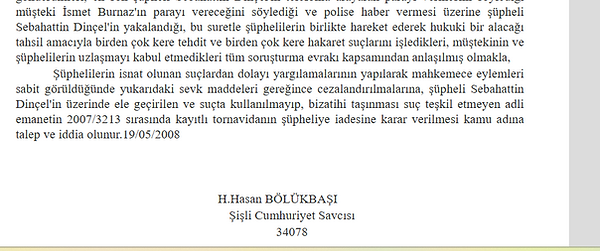


“Second, because of the ingratitude shown by that scoundrel named Ahmet Dinçel, I was labeled a repeat offender even though I was completely innocent.”
These are the scoundrels from that case who gave me a criminal record and stole my life, even though I was innocent.
The case was finally resolved 10 years later. Anyway, I’ve always had bad people in my life, and that good-for-nothing named Yiğit’s intention that night was for me to hit him. His plan was to get me kicked off probation.
“Why aren’t you hitting me, huh? I’m cursing at you—aren’t you a man?” he said.
I slapped him on the shoulder and said, “Shut up, that’s enough—go to your room,” because if I hit a weakling like him, he’d die; I’m a boxer, I weigh 105 kilos, and he’s 60 kilos—someone who doesn’t know how to fight. He was laughing, got up from where he’d fallen, and started hurling insults at my wife, who wasn’t even home, but I was foaming at the mouth with rage.
He tried to hit me, laughing, thinking I’d hit him back so he could accuse me of “parental abuse.” I’m not his father—I wasn’t even his father in this situation—but if he thinks he’s smart, I’m smarter.
Every time he tried to hit me, I had my Istanbul boxing championship title to fall back on. I was on the junior national team in 1996; my coach was Kadir Yüceler.
If someone tries to hit me, my hands go up automatically—I instinctively take my guard and get into a fighting stance. Even if someone beat me for an hour, I wouldn’t take a single punch—God forbid I should get hurt—and I’ve had these reflexes since I was a kid.
My power is such that whenever I hit a punching bag, it always makes a record-breaking sound—everyone knows me. If I hit this skinny guy just once, he’d die, but I’d hit him even if I tried not to.
I didn’t want to get in trouble, but even though I don’t have high blood pressure, I couldn’t breathe from the stress. I checked my blood pressure—it was 20—and my face turned bright red. “Give me some sublingual medication,” I said, and I was about to pass out; I couldn’t breathe.
As I was fumbling to pull the sublingual medication out of the drawer, this guy named Yiğit hit me from behind with a stick, yelling, “Die!” We’re not related by blood, so he doesn’t care about me, but he has no humanity either.
If you did that much good for the devil, he’d become an angel. I briefly listed the good deeds I’d done for this despicable, ungrateful wretch. When there was absolutely nothing going on—I didn’t yell, I didn’t curse, I didn’t scold—but this traitor named Yiğit, who was carrying out part of his plan (out of nowhere, for no reason), struck me. When I asked, “Why? What happened that made you do this?”
“You left me with them,” was his reply. (An excuse)
I said, “I got you whatever you wanted; I was always by your side. If you want to settle the score, you’ll have to go to the woman who’s supposed to be your mother—and you’re still here; you can stay as long as you want. This place is yours,” but to no avail—it’s just an excuse. He’s not only heartless but also treacherous and devilish.
Then, out of anger, I hit him once; he fell to the ground, and I held both his hands with one of mine. Did I have the strength? With one hand on the phone and the other holding him, I made a complete fool of myself in front of the neighbors—I couldn’t go outside for two months. He was screaming so loudly that I called the police, and they came.
And the police officer, with a slight smile, said, “Hello, what’s the problem?”
That poor man—I’ll never forget it—my heart broke. This scoundrel named Yiğit slapped the smiling officer for no reason. He was taking his last shot to get me arrested. Am I supposed to step in and get punished for it?
What did the cop ever do to you, you traitor to the country, you lowlife, you scum? The poor man was just doing his job, protecting the state, on duty—you traitor, traitor—how dare you raise your hand against a cop, damn it? Anyway, they took him downstairs.
I didn’t hit him because it would’ve jeopardized my probation.
There was one thing this guy named Yiğit didn’t know.
Even though he tried to get me to hit him, I was smarter than that. You damned, heartless bastards who aren’t of my blood—go to hell. I know now that my father is Bayram Acar. He’s my only blood, my only life, but even if I told him to get up, he couldn’t.
After I left, I looked at his computer. He’d written this to a girl: “You’re not a girl; you’re someone who sleeps with everyone. Be with me—if you say no… my home address is xxxx (he gave my address)… exactly.”
I’d told him not to curse at anyone, not to get me into trouble, and that people would ask about me online on my behalf—that’s why. He did all this for no reason—out of the blue.
I didn’t hit him, I didn’t curse at him, I didn’t get angry—but he suddenly started yelling so the neighbors would call the police, and I thought, “I’ll hit him for the curses he’s hurling and get inside.”
The prosecutor would have said, “You’re already under supervision—did you really have to use violence against him too?” Of course he would have, but I was smarter than him.”
It came back to haunt the traitor—a case was filed against him for assaulting a police officer.
Come on, what did the guy do? What’s his crime? He’s a traitor to the country. Who do you think you are, acting like this toward a man doing his duty when he’s being friendly to you? Anyway, may you all go to hell. Now, Gülsüm Dinçel—who took me in and worships money—will say, “I’m taking care of this one child of mine; he’s sick.”
And I’m sure even my own relatives are taking money from my so-called “real mother” in my name. The child she claims to be “taking care of”—the one she raised—is that traitor named Gülsüm, who taught him to lie with lies and to steal.
You can’t even see the child’s arms through the razor blades. That creature named Gülsüm made the child her accomplice in stealing money through lies. For years, you’ll have your husband take care of your daughter, claiming she’s his own—all because of what Gülsüm created.
Dad, Bayram Acar, I wish you’d just thrown me away instead of giving me to these people. You ruined me. And you even bought them a house—I wish, I wish you’d left me out in the cold to die when I was little. You didn’t know you’d die suddenly while you still had your factory, but I wish you’d done that instead—and look, you’ve given me to people just like this. I can’t find the words—I’m about to have a nervous breakdown.
The reason I’m telling you this is that woman isn’t taking care of the kid—she’s a devil. She’s fleecing people for money. “I’m taking care of your child,” she’s probably saying right now. How many times have I told you he’s not my child? I texted, “Throw that scumbag out on the street,” but they didn’t do it.
Because that’s the trump card she’s holding to make me look like a dreamer. That’s exactly it. I don’t care, brother—let him die today if he wants; he’s not my child, damn it, he’s not! “You threw him out,” I said, but no… Whatever.
My biological father is Bayram Acar, and I will certainly prove it. I swear on my honor and dignity that I won’t take a single real breath in this life until those who worship money see that I’ve done this! I swear on my honor and dignity—there isn’t a single lie in what I’ve written.
Now, as for those who’ve caused me so much harm—people whose treachery, wickedness, and lies are worse than anything an enemy would do—your harm can’t touch me, and on the contrary, you’ll all get what’s coming to you. It’s my turn now.
The reason I’m exposing this creature called Yiğit is that Gülsüm Dinçel’s only defense for selling my life for a house and throwing me out onto the streets will be, “She’s hallucinating, or I’m taking care of her child.”
That damned woman knows I don’t have a child—that devil of a creature called Yiğit—and let’s see how long she keeps on stealing from an orphan and doing evil. Justice exists in this world. I won’t involve the divine in making her pay, because everything is in my hands. I swear I’ll make you pay for what you’ve done—all of you, one by one. I swear it.
Yiğit Dinçel’s father was a man in Osmanbey before his mother carried out her plan to have a one-night stand and run away from home while pregnant.
I don’t know the rest—that cruel traitor of a mother knows. I’ve cursed her too—that’s all.
I haven’t been able to understand why there’s so much of this in my life and why the curse hasn’t ended. Why me, of all people? I’m a very healthy person, and if someone else had been in my place, they would have become a serial killer. I just want to scream, “Enough!”
I swear, I wouldn’t want any of my father’s children to be in my place.
My father, Bayram, died suddenly in a tragic car accident, and I was left on my own among those traitors when I was just 9 years old.
“Should I be glad I found him? Or should I be sad that he died—and burned to death, no less?...
When I check my family tree on E-Devlet, I don’t want to see those people who aren’t related to me—that false, lying family tree. I don’t want to see that family tree I have no connection to, that fake family tree. I want to see my true lineage. This is a matter of honor for me.
My address is in Mezitli, Mersin.
Today, I spoke with one of my real uncle’s sons. He said he knew who I was and told me that he hadn’t spoken to my uncle, Bayram Acar, in a long time; that my uncle had passed away in 1988; that he’d heard my uncle had been married a second time and had a child from that marriage; and that my real mother’s name was Emine.
Every now and then, a longing for my father settles deep inside me, and the only image in my mind is that of my father, Bayram Acar, whom I saw in the car—the man who loved me so much. I wish he hadn’t died, but there’s nothing I can do about it. I’m so sad.
Gülsüm Dinçel and her husband—who know everything but refuse to tell me who my mother is or explain what happened, who are still depriving me of my rights, and who have become devilish—are the ones who took me away.
Is this the greatest punishment one can inflict on a person? Why won’t they tell me yet? Is it because they’re afraid of losing the house?
If I were in their shoes, I’d have spent 24 hours thinking it through, solved the puzzle, and only have two lines left to go. It’s a really terrible situation. They’re trying to drive me crazy. They have the key right now, but even a dog is more merciful than these people—I swear.
And I sent messages via Messenger to some people in the Çivril Bozdağ groups. One of them replied to me—thank goodness. He’s a journalist
. He said my mother’s name is Emine and that she might be from the village of Savran in Çivril.
What came to mind was this: I was 10 years old. Gülsüm Dinçel, who took me in, was originally from the village of Savran in Çivril. They took me to Savran once when I was 10.
There, we entered a place with an iron gate. The uncle of Gülsüm Dinçel, who took me in—the man they called “Ramazan Uncle,” known by the nickname “Avcı Dayı”—was there.
Once we went through the gate, everyone went inside. The village house was one-story; after passing through the iron gate, there was a garden, and then you entered the house.
At the entrance to the house, water was being drawn from a hand pump; there was a small tub there, but I didn’t get in—I had started playing.
The relative they called “Avcı Dayı” asked me this while I was playing with the water, and I’m writing it exactly as he said:
“Let me see—who are your mom and dad? Tell me, who are they?” But you know how it is—old folks ask kids questions like that, of course—and I answered with a slight smile. He then said, “Are you sure?”
I smiled slightly again, and he leaned in to repeat his answer, nervously checking the doorway as he spoke:
“Look! I’m doing you a favor. My only intention right now is to help you. They aren’t your mom and dad. Go over to that house over there—ask there, find your mom yourself,” he said in the Denizli dialect.
While Uncle Avcı was speaking to me in a very serious, excited, urgent, and fast-paced manner, as soon as Gülsüm Dinçel came out to pick me up at the door, Uncle Avcı suddenly changed his demeanor, facial expression, and tone; he looked to the right and left, and—as if nothing had happened—adjusted his facial expression and tone to a forced smile, clearly still a bit flustered, and said:
“Are you leaving? All right, well then, good luck, good luck—come back again sometime,” he said.
Man, I’m almost going crazy. I’m mad at myself. I didn’t take it seriously, and I still don’t—why, why? Thinking about this incident, which has been on my mind for years, I finally told myself, “I’m going to find that man and ask him.”
I spent 24 hours a day wondering, “If I have a father, who am I? Who am I?” but they wouldn’t tell me the truth. Sometimes they’d say “yes,” but later the family that took me in—those indifferent, heartless people—would say, “No, and don’t ask again; don’t bother us.”
Now, as I’ve been thinking about it, I found out who my father is, and I’ve been searching and looking to find my mother.
Uncle Avcı has passed away. I’m begging you—if anyone is reading this blog, please know that I will never repeat what you say. I don’t sell people—never. I swear to you. Call me so I can reach my mother. Even if some people still have a conscience, others are silencing them.
Never, ever will I say, “He said this.” I swear I won’t say it. This secret will remain locked away inside me; whoever said it doesn’t even need to give their name—never.
Why, why? Is it really that hard to tell someone? Are you that afraid? This is my situation. It’s not a good deed; if someone knows the truth but isn’t speaking up, they’re doing something wrong—let them know that. If you’re on the side of good, please call me so I can reach my mother.
Some of the people I’ve spoken to—people who just don’t get it—like this one who claims to be a “journalist”—ask, “Why did it take you so long? Where was your mind all this time?”
Either I can’t explain it, or some people just don’t get it. I found out this year that Bayram Acar is my father. I found out in 2023 and took action. This is right at the beginning of my blog.
To ask such a ridiculous question, someone would have to be out of their mind.
I was 11 years old. My schoolteacher—my homeroom teacher, that is—Ms. Havva Çalışkan, called over Gülsüm Dinçel, who had come to pick me up as a parent, and
“This child is the top student in the school. What’s going on? He’s always thinking, thinking. I won’t let this happen,”
she scolded. When I got home from school, Gülsüm Dinçel, who had picked me up, was giving me a look of hatred.
When I went to the kitchen to eat, she had invited a bunch of neighbors, and the leftovers had been cleared away. The neighbors had left, but there was no food. As I was looking for something to eat, she said, “Don’t touch that—you’ll eat poison.”
I hadn’t done anything. Then, when I got angry, her husband came and asked, “What happened?” When I told him what she’d said, he swore he hadn’t said such a thing—and on top of that, he turned on me.
Then, after the man left the kitchen, the woman who had taken me in, Gülsüm Dinçel, cracked open the kitchen door, stuck just her head inside, and quickly said this to me before storming off.
“Eat poison!” she said.
Even now, at this age, when I’m eating with my own earnings, I find myself feeling as if I’ve committed a crime. It’s as if that food were forbidden, yet I feel compelled to eat it anyway.
But these are the very people who, after collecting rent, had my father, Bayram Acar, buy a house for me—only to put the house in their own names—and they did all this after my father, Bayram Acar, passed away.
Otherwise, even before my father, Bayram Acar, passed away, they kept coming by to take money. I remember, back in 1987, the man named Sebahattin Dinçel who took me in at that house—there was a black-and-white TV with very faint sound in the house, and we had always wanted a new one.
Sebahattin Dinçel, the man who took me in, came to the house with the most expensive TV of that time. And I swear to God, I’m writing this down word for word:
“Today I went to see the man; 10 security guards stood in front of me, and they told us, ‘Say whatever you have to say,’ but the man said, ‘Let him in,’ and called me into his office.
I swear to God, he said this with tears in his eyes: ‘It’s very hard for a person to be separated from their child.’ As soon as I went inside, he gave me enough money to buy 10 TVs and said, ‘Come whenever you want—don’t hesitate,’ with a sad look on his face. Thank God for him.”
I couldn’t make sense of the situation even back then. I thought to myself: “What on earth is this guy talking about? What TV salesman would give away a TV for free—and on top of that, give me enough money to buy 10 more? I mean, if he were rich, why would he be selling TVs in that store? Why would a TV salesman need bodyguards?”
You’re a kid, and you immediately start wondering, “He’s so rich—is he doing this out of the goodness of his heart?” “How ridiculous—who is this guy?” I thought to myself, and I’ve been pondering this in my head for years.
It turns out the person who said that wasn’t the guy who bought the TV; he’d gone to the factory to collect money from my father, Bayram Acar. I’d assumed in my mind that it was the TV salesman. I’ve been wondering about this for years. The TV—a 55-inch Sony—I’ll never forget it; it was exactly like the first color TVs that came out.

And in 1990, their traitorous son—a guy named Ahmet Dinçel—got into a fight in the neighborhood.
A boy named Hakan beat him up. Kids fight and make up, but since he was his own son, the man who took me in—Sebahattin Dinçel—started waiting for the boy on the balcony, of course intending to beat him up.
Then a boy named Ragıp walked by, and he went down and started slapping the boy named Ragıp. They both ran away.
Then Ragıp’s aunt came, and his whole family gathered. They’d beaten the wrong boy.
And the man who took me in, Sebahattin Dinçel, was told this by a relative (Ragıp had lost his parents in the accident). The man said:
“You’re so heartless, despicable, and dishonorable that you’d hit an orphaned child…” he said, and he cursed my mother and others outright, shouting at the top of his lungs.
Then, while I was listening, the man named Sebahattin Dinçel who had taken me in said exactly this:
“Look, come inside and let’s talk. I have an orphan too—I’m telling you, I have one too—I’ll explain; we’re very similar in this situation,”
he said. Then Gülsüm Dinçel, who had taken me in,
“Shut the hell up, don’t bring that up here—he’s listening,”
she said, pointing at me. I thought she was lying just to end the argument.
I’ll never forget that either. Obviously, these are very small things, but they told me to my face that they’d taken me in—yet they won’t tell me who my mother is.
I mean, what kind of test is this for a person? What kind of test of patience is this? Why won’t you tell me—is it because I’ll go home? Or are you being threatened?
I think they made a deal with the money they took, or something like that. Then they did everything they could to make me leave home. My father
Every time I look at Bayram Acar’s photo, every time I remember him, it feels like a piece of my flesh is being torn away. I wish he were alive; I’d give him my heart. Above all else.**
Today, as usual, I’m going to write about something that’s on my mind—something I’ve experienced—but today I finally understood why he said that, even though I hadn’t understood it before.
It was 1990, and I was 11 years old. While I was studying, a man named Sebahattin Dinçel, who had taken me in, told me, “If you’re not bringing money home, get out of this house,” and so I left.
Out on the street, Nurettin Dinçel—the brother of that man named Sebahattin Dinçel who had taken me away—grabbed me by the arm and brought me back home.
Then, Nxxx Dxxx said exactly this to Sebahattin Dinçel, the man who had taken me away:
“Look, you can’t kick this kid out!!! Don’t make me speak up in front of the kid. Who do you think you are, kicking someone out of their own home? Look, I swear, if you weren’t my brother, I’d be beating the crap out of you right now!”
That’s what he said. I swear on everything I hold dear, that’s exactly what he said. But when I was 14, I left for good—they sent me away. Anyway... All of them know me, but they’re probably reading this blog too.
If any of you read this and call me but don’t tell me about my mom, may your mother and father never rest in peace.
My father is clear—I’m Bayram Acar’s son—but now I need to find my mom, even if it takes going to court. I gave my number above.
I had measles when I was 8 years old. The husband and wife who picked me up were talking among themselves. The man who picked me up, named Sebahattin Dinçel, had measles candy and a bunch of medicine in his hand, and I pretended to be asleep—I had a fever, and I remember their conversation as clearly as if it were today.
Sebahattin Dinçel, the man who took me in,
“I swear, the man didn’t say a single word on the way here in the car. Thank God, he went and got the medicine from the pharmacy, gave a wad of cash, but said, ‘I won’t go inside—I can’t bear it,’ and left looking very sad,”
he said. I wondered for a moment who this man was, but I let it go. Because I was sick and preoccupied with my own condition. My father was Bayram Acar; at the time, his factory was in Küçükçekmece.
He’d bought a house for them near where he lived—near the entrance to Sultançiftliği, as it was formerly known, or Sultangazi as it’s called now—specifically for my sake.
So he could see me more often. If I went on, it really wouldn’t fit here, but if anyone who knows my mother calls me and tells me, I swear I won’t say, “He told me that,” and besides, who would I tell?
Only to her—I’ll be grateful to her for the rest of my life, without ever mixing up her name—because the court date is approaching. And here’s the thing: even if the court case passes, I won’t let this go, and I’ll file another lawsuit.
If your mom or dad were sick, you’d worry. My brother, who is my mom? What kind of test is this—knowing and not telling? Is that all you agreed to? If you’re afraid, say so first. You’ll have to tell me, or I’ll be forced to do what I said I would.
While everyone on my father Bayram Acar’s side knows me—including the treacherous, cruel people who took me away—and even though I saw my father Bayram Acar many times when I was little, not a single person has provided even one photo of him in the name of humanity.
We will surely be reunited one day. I swear this. Believe me, it will surely come to light somewhere, and I’m telling that family—Dinçel, who sold my life for money—that it will surely come to light.
And I will also prove that my father, Bayram Acar, bought that house. I’ve sworn an oath and dedicated my life to this: if fate allows, I will buy that house, sell it, and use the money to build shelters for all the stray dogs.
I’ll send the bill to the Dinçel family and tell them, “You’re not allowed in here.” I’ll also file a lawsuit to collect back rent from you, which will amount to the price of another house. Even if it isn’t deducted from your salary, a lien will be placed on the money you’ve deposited, and it will be seized through that process. It’s not about kicking me out of my own home.
I was an inquisitive, curious, and equally intelligent person, and my dreams were to become a doctor or an engineer and invent new things. I had my final say to the people who kicked me out of my own home when I was 10—the ones who told me, “You’re living in my house and being a burden; quit school and bring money home.”
Gülsüm Dinçel, who took me in, has a younger sister living in Çivril. Her name is Feride Kaya. For as long as I can remember, people have said that this Feride Kaya speaks the truth.
They say she’s quarrelsome and hot-tempered, but she can’t stand injustice. Back in 1991, when I was doing very well in school, after my father, Bayram Acar, passed away—he was the one who had bought that house for them—it was this family who took me out of school and got me a job. At that time, Feride Kaya—the sister of Gülsüm Dinçel, who took me in—had come to that house.
This is what they said—I’m writing it down exactly as it was:
Feride Kaya: “What did your husband do to you, girl? Tell me—just say what he did so I can understand. What has he done since you married him? Tell me, what did he get you? Now he’s not even working—he’s living off your child. She made the man buy a house, and on top of that, she didn’t even send this child to school,”
she said.
Gülsüm Dinçel, who married me, was going to get a divorce at the time but changed her mind.
Now, this person named Feride Kaya, who thinks she always tells the truth but acts heartlessly instead of honestly—you, the so-called “truth-teller”—instead of telling the truth about the real owner of the house where you lived for years in Istanbul (me), you, you lying, despicable, characterless person, did everything in your power to have me kicked out of that house.
That’s just the kind of person you are—sitting in an orphaned child’s home and kicking him out of his own home when he was young.
There’s more I could say, but it’s not worth it—not even a single gram of it for any of you.
I’m not after a house—I’m after the life that was stolen from me. I swear right now: the amount of inheritance I’m legally and rightfully entitled to from my father, Bayram Acar, is at least one billion dollars. I didn’t even write that down. I wrote what I wanted to write to establish my bloodline.
I can’t find the words to say to Ahmet Şaylan, the human trafficker who was a partner in this scheme and gave me away to this family for money—that ignorant man.
Anyway. My ill will toward that human trafficker, Ahmet Şaylan, continues. As for his wife, Zarife Şaylan, when her own mother died, she rushed to Çivril to claim her three-kurush share of the house that was sold off, and they got in line.
As for me, they tried to prevent me from claiming my right to at least 1 billion dollars in inheritance left by my father, Bayram. May your money go to hell. The most valuable inheritance I received from my father is his genes.
Don’t forget this: even if—let’s say—I don’t get the rights I’m claiming, the fact that my father was Bayram Acar will never change, and I will always be with him.
Also, don’t forget this: I will never give up on this matter. I will take everyone involved in this to court. Sooner or later, they’ll get what they deserve.
Let them be sure of this: we’ve only just begun. My word goes out to that devilish family that took me in.
I want to ask you a question. You find out that your family isn’t your real family. And this family has been doing you a lot of harm all this time and has kicked you out of your own home—all the way up to your current age.
And on top of that, they know who your real mother is but won’t tell you. They admit they took you away. You find your father on your own; you know who he is and that he loves you very much.
And they won’t tell you who your mother is, and as if that weren’t enough, you learn that you’re entitled to a very, very large inheritance—you learn that your family lineage is different. Your aunt is someone else; your uncle is someone else.
And the family that took you in for money is standing in your way, and even though they know who your mother is, they won’t tell you.
How can anyone play with a person’s patience like this? What would you do if you were in my shoes?
Yesterday, I saw my father, Bayram Acar, in a dream. He was arguing with the Dinçel family.
“How can you do these things to my child?” he said.
But this is bound to happen anyway—just wait. Count the days of your life—how much time you have left.
You won’t have anything left either. My business is with this world; I don’t meddle in the rest. You’ll pay for what you’ve done right here first! Don’t you dare think it’s all over.
Just wait to be held accountable—before the law.
I wrote above about what I went through with my father, Bayram Acar, who was by my side at my circumcision ceremony—he was a man with a stern expression. I had the AI generate an image of him exactly as I described. It was a bit more realistic, of course; his face looked like it was about 5 kilos lighter, but his gaze and appearance were exactly the same.
a photo of my father, Bayram Acar, generated by AI

Actually, that heartless family that took me in has a big photo album. No, wait—there’s an even older album under a chest in the bedroom, and it has pictures of my mother, Emine Canbaz, and my father, Bayram Acar.
They were photographed together, with me in their arms. Whenever I asked that heartless woman, “Who is this? Who are these people?” she would immediately say, “Stop it! You wouldn’t recognize them,” and snatch the album from my hands. There was even a photo of my father with that traitor Sebahattin Dinçel—the man who took me away—taken at my circumcision party.
When I asked, “Who is this uncle? It looks like he was brought here against his will; his face looks so grim, so angry—I don’t get it,” the woman who had taken me, Gülsüm Dinçel, again
said, “You wouldn’t recognize him—stop messing with the photos.”
Of course his face would be grim.
He didn’t come there to see shameless money-grabbers like you. He was there for me, you heartless thieves. My father, Bayram Acar, looked like a man with furrowed brows in the photo.
Then, after the photo was taken, that traitor Sebahattin Dinçel—the man who took me away, as I mentioned earlier—put his hand on my father Bayram Acar’s shoulder and said,
“Well, that’s over now,”
he said, and my father, Bayram Acar,
“Take your hand off my shoulder, take your hand off my shoulder! I don’t like that sort of thing—I came here to see my son!”
he said, and stormed off angrily.
Then he came to see me while I was sleeping, kissed me, and left. Now I’m writing all this here, but those heartless, characterless people will read it.
They’ll destroy those photos right away, just in case.
I’m not at their mercy. My genes are my father Bayram Acar’s genes.
I’ll find the photos myself, and with your help as well. I won’t show any gratitude to traitors—and forget about gratitude; the reason I don’t even pick up the phone to hurl straight-up curses and insults at them is simply because I can’t stand the sound of their voices.
In reality, whether it’s the Dinçel family, the Kaya family, or the Şaylan family, if they have even a shred of sense, they won’t call me for a single word for the rest of my life.
That’s when I’d lose control and go all out. Because they all know. Those who know this and remain silent are complicit in depriving an orphan of his rights.
If someone were to say to me, “You’re getting a billion dollars today, but you won’t seek revenge?” I’d say no. The injustice done to me has never been done to anyone else.
I was kicked out of my own home for years when I was a child. That monster named Sebahattin punched me over and over again after my father, Bayram Acar, passed away.
While they even hid from my father that I was sick, look at what they did to his son after he died.
After my father, Bayram Acar, passed away, I’m writing down just a portion of what that traitorous monster named Sebahattin—the man who took me in—said to me. He said:
“Get out of this house, and don’t ever come back! You’re too much of a burden on this household! And don’t you dare say you’ll read when guests come over! You’re a terrible person—is there anything worse a person could be insulted with?
What else can I say to you besides the curses I’ve already hurled at you? Go, and don’t ever come back.”
He said this to me when I was 10 years old. Yet he was living in that very house my father had bought so they could take care of me, and this creature named Sebahattin was a man who couldn’t even earn a living.
I’ll leave the commentary to you.
Damn that immoral woman named Gülsüm, that despicable human, that creature in human form! She had the nerve to send me a message—she’s worse than a heartless con artist, she’s utterly immoral.
Of course she found a way to rig the DNA test. The one I told to get lost down the street—the one I said wasn’t my child—the one who set up lies about theft and drugs, who made the little kid an accomplice to extort money from a young age, who’s been splitting people’s money with that tiny child since he was little, and who took a ton of money from me too—that despicable woman found her way through the DNA test to find someone to rig it. She sent me a message, saying the child should get a DNA test too.
Damn it, you inhuman, heartless scum! Since you’re already pulling this scam, why not squeeze this in too—for the sake of the scam and the lies, right?
Don’t you think I’ll find out that he’s not my child, you despicable woman! I’ll expose every single one of your schemes, don’t worry.
If my father were alive, none of this would have happened.
Rats like you would still be scrambling to squeeze money out of people, and I’d never be in this situation, right? Back then, he’d have taken me away from you at the slightest lie or harsh word. Of course, I’ve got you all lined up.
Look, this is Gözde—the daughter that Gülsüm Dinçel, the woman who took me in, had with another man, the teacher Yavuz Bulut, and called her “my daughter.” I’ll post her picture here now.
And I’m posting the photos of Gözde’s real father, Yavuz Bulut, and her real brother, Gökmen Bulut. You can see the resemblance between Gökmen and Gözde—I posted them above.
To cover this up, that vile woman—the creature named Sebahattin Dinçel who took me for money, the woman named Gülsüm Dinçel who had a house built for my father Bayram Acar and then threw me out onto the streets after my father passed away—is Gülsüm, a creature in human form who made me out to be a delusional person so I wouldn’t tell my husband about this incident she orchestrated to cover it up.
When her daughter Gözde came to Mersin, she came to see me. She also told my husband about all this.
So my husband is hallucinating, then. Who are you to make such a defense to a sane person? You despicable woman who stole my life.
It’s not over yet. I’ll expose everything, and unless all the relatives who know—including those who know who my mother is—tell me, may they lose one of their children every day and suffer the pain of losing a child. Those who know should contact me; their names will be kept confidential.
Alcohol affects me—I’m allergic to it. If I took even a sip right now, I’d end up in the hospital. I’m allergic to alcohol, and that’s proof enough that this is a lie.
Today I visited my father, Bayram Acar, in Istanbul, and I’m heading back to Mersin...
Translation of the song:
The wind doesn’t blow around here
Roses don’t bloom around here
The streams and rivers have dried up
The flowers and trees have withered
[Chorus]
The villages and homes have been abandoned
The parks and schools have been abandoned
There’s no love or respect left
Everyone is fed up, everyone regrets it
Oh, my father, my father
In your warm hearth
Oh, my mother, my mother
Take me in your arms
No one greets anyone here
No strangers wander here
Everyone wears a mask
Everyone carries a whip
When the sun sets, fear sets in
Fog and smoke envelop the city
Death creeps up silently
That’s how it is around here
A Poem I Wrote
Tears in my eyes, longing in my heart,
I laid you to rest beneath the earth,
Following in your footsteps, I lived through memories,
With every step I take, with every breath I breathe, you are there.
In the village of Çivril Bozdağ in Denizli,
Looking at your photos,
The warmth of those memories enveloped me,
It wasn’t your wealth I longed for,
It was the time spent with you that was precious.
Time is merciless; it won’t bring you back,
But memories remain ever-vivid in my heart,
Not prayers at your grave, but tears,
The plea of a weeping child—hear me.
The void you left grows a little deeper each day,
With love and longing, I wait for you,
Hoping to be reunited one day,
I miss you so much, my dear father, Bayram Acar—I want you to know.
My father’s name is like a new song on my lips,
Bayram Acar, I got to know you this year.
Those loving moments in your car when I was little,
They’re tucked away in my memory—priceless times.
Your photo in my hands, your love in my heart,
Every moment with you defies the passage of time.
Longing for my father’s warmth, for your presence,
With each passing day, I understand you a little more.
But in a dark corner, a sorrow awaits me,
The home you bought, meant to be a refuge, turned into hell.
That family who took me in for money—loveless and cold—
When you left, they cast me out onto the streets, alone and broken.
The moonlight reflected in my tears,
As it illuminates the night, there’s a fire burning inside me.
Every drop that falls from my eyes,
My father searches for hope in your absence.
I grew up in the cold embrace of loneliness,
But I will remain strong in your name
Whatever this world has given me, I will take back double,
And one day, Father, your name will be written in gold letters.
I love you so much, my dear father, Bayram Acar...
5347493632 . email hacka19999@gmail.com
Mom, Emine, if you’re reading this and you’re still alive, please get in touch with me.
All I want is to hug you and kiss your hand before I die—to experience you just once. That’s the only thing I’ve ever wanted from you in my entire life.
Kisses. I hope you’re still alive. I remember you. The treacherous woman who took me, Gülsüm Dinçel, and her sister-in-law, Zarife Şaylan, were sitting on the three-seater couch.
I was little, and you were sitting on the seat to the left. They pointed at you and said, “This is your mother.”
You were crying so hard. I looked at you and said, “Mom,” but the woman who took me—sitting on the three-seater sofa—and her sister-in-law, Zarife Şaylan, were surprised and said, “She’s crying,” and told you, “Emine, don’t cry—look, the child is scared,” but you had opened your arms and were repeating, “My baby,” to me while crying.
That’s exactly how it was—just like I’m describing it now. The only difference was that you were reaching out your hands and calling me “my little one.” The woman on your right was Zarife Şaylan. (Gülsüm’s sister-in-law; the woman on her right who took me was Gülsüm Dinçel—you remember.)
And also, on another occasion, when we went to that two-story house I mentioned above—I won’t repeat it here:
“You’ve taken my baby away from me, you’ve taken my baby away from me!” you were wailing.
You were wearing a headscarf; I remember you.
Before I die, I want to experience the feeling of motherhood with you just once. I want to kiss your hand.
I want you to tell me about my father, Bayram Acar, and keep his memory alive. I want to experience you, too.
Know that I love you, too; I’m waiting for you to come back to me—I’ve written down my number.
After all these years, I could never say a single harsh word to you—and I won’t. Whether you’re right or wrong, all I want is to experience you—this feeling, this maternal love.
Don’t be fooled by anyone—I’m not putting on an act.
If you’re in contact with that creature named Gülsüm Dinçel—the treacherous woman who took me away—never believe her.
When I was little, the money my father, Bayram Acar, gave me was squandered by her husband when he opened a workshop that went under, and they didn’t take care of me.
They didn’t give me a single kuruş; I was always sick and narrowly escaped death. When my father, Bayram Acar, passed away, they told me, “Get out of the house,” and the child they’re taking care of now isn’t my child—it’s just a bargaining chip in their hands: “We’re taking care of your child,” they say.
That traitorous child even tried to kill me for no reason at all—I wrote about the traitor above.
When I was little and sick, I asked Gülsüm Dinçel—the traitorous woman who took me in—for a glass of water while I was burning up with fever, but she didn’t bring it. “Die, drink poison, you dog!” she said.
And I fell asleep; in my dream, someone brought me water. I drank it but wasn’t satisfied because it was just a dream. When I insisted, she finally brought it—but only after hurling terrible curses at me.
She kept saying that someone was holding me down while someone else was stabbing me.
My “crime” was refusing to leave that house and continuing my education through middle school.
She spoke with her friends on the phone and, pointing to me while showing the phone bill,
said, “Ask the one who’s talking,” and set the man on me. That creature of a man, that traitor named Sebahattin Dinçel—who had meningitis, couldn’t earn a single penny, even stole his own belongings, and kicked me out of the house my father, Bayram Acar, had bought for me.
When he didn’t have a single penny, that traitor of a man, while renting a place in Güngören, came home and asked his wife, “I lost my job—what are we going to do? We don’t have any money—how are we going to pay the rent?” That traitor, Sebahattin Dinçel, asked his wife, and she replied:
Gülsüm: “What did you do with what you took from your father?” He, her husband, said, “Shut up.”
Then, during their financial hardship, my dear, beloved father, Bayram Acar, bought them a house for my sake, and when my father, Bayram Acar, passed away, those traitors told me, “Get out of this house, and don’t ever come back.”
Look, Mom Emine, turn to me. All I ask of you is to hug me just once—nothing else. Look at what people do to their children, but ever since I was born to you, this is all I’ve ever wanted: just this once—the first and last time.
That traitorous liar named Gülsüm Dinçel, who took me away—that devilish woman who deceives people with just two words—made me drop out of school and go to work while I was still in school, even though my grades were excellent.
They also lied to everyone, saying I was depressed. That traitor Gülsüm Dinçel, who spoke harsh words to me—saying, “If you can’t find a job, don’t come home; work, or you’ll end up selling everything you own”—I’m not like her, and ever since I left home with that traitorous woman at age 14, I haven’t spoken a single word to her.
I wake up in the morning, drink my coffee, post my ad, and post my clients’ ads too—that’s just my practical smarts.
Then I go down to the beach, swim, come back, post the second ad—I do it on my phone too. I make adjustments on the computer, and when a website order comes in, I finish it right away.
This is the work I do from where I sit, and this is where I work. Home office. And I make 40 times the minimum wage every month. Not everyone can do this, because you need to know coding, software development, and web design.
The paid dating sites I’ve created are also available on Google Play.
Even though I have a Jetta, instead of driving it, I prefer to ride horses at full gallop on the Mersin plateau.
Even if I did drive, I’d still be speeding.
I wake up at one in the afternoon and live my life this way, enjoying every moment.
But I earn my money honestly. I help people by getting their businesses to the top of Google search results in just two hours, and I receive their gratitude in return. The genes I inherited from my father, Bayram Acar, are thanks to him. Anyway."
Those envious, devilish, brainless traitors. Their minds are filled with poison—nothing but jealousy. It wasn’t enough that they sold out my life and ruined it; they still have the nerve to be jealous—those traitors...
A poem I wrote for my mother, whom I’ve seen only twice
As vast as the sky, as deep as the heart,
I came in pursuit of a love, Mother.
Waiting silently behind the years,
I found you in my tears, Mother.
Unknown paths, endless longings,
The silent cry of a little child.
A fire in my heart, an ember that never dies,
To reach you is my greatest wish, Mom.
Hear me, feel the fluttering of my heart,
Give me a sign when I find you.
May the pain of the years be erased with a single embrace,
Mother Emine, I’m waiting for you—come back to me,
please.
You cry when your parents die. Think about it for a moment. Everyone has the right to do so.
A reward of 20,000 TL per photo will be paid to anyone who sends a photo of my father, Bayram Acar. The identity of the person will be kept confidential.
5347493632
I had a dream yesterday.
In my dream, I was in an empty space in front of a factory, and I was about to be executed. I was a child, but they were going to execute me. There was a staircase leading upward, and I saw Minister Hakan Fidan.
He walked up the stairs, glaring angrily ahead.
Then I saw my father, Bayram. He was sitting at a table in the front part of a factory. He was a bit thin and young, and he was wearing a suit. I, on the other hand, was a child. I went over to him and was very happy.
“That’s my dad, Bayram!” I said. I looked up at my tall father from below and said:
“You, you, you, you, you—my dad… I mean, you’re my dad…”
I said that and paused.
“Why did you leave me?”
No sooner had I said that than my father, Bayram, leaned toward me with a look of overwhelming love and tenderness and said:
“We’ll talk about this later, okay?”
He said.
Then he said, “Come on, run—follow me.” I couldn’t run after him, but:
“Take off your flip-flops—come on, run! You can’t run in those!”
He said, and I took them off and followed him. He put me in the car, and we had some wonderful moments in there; we were so happy. He had saved me.
I was in a room, deathly silent,
My child’s heart was filled with anxiety.
They said “execution”—my end had come,
The soul of an orphan trembled...
Someone ascended the stairs,
Their gaze, as cold as ice, fell upon me.
Hakan Fidan passed in front of me,
But my fate was sealed; it was clear.
Then a table, someone in front of me,
A frail body, a young face.
A suit, a dignified stance,
But in my heart, a storm, a bitter ache.
“Father Bayram! Is that you?”
My tongue trembles, my eyes are moist.
“You? Or me? How do I say it?”
The word I’d been waiting for all these years.
“Why did you leave?” I asked him,
My voice choked, my heart aching.
He leaned toward me with his eyes,
Full of love, like spring...
“We’ll talk about this later...” he said,
A breeze blew, settling deep within me.
“Run!” he said, “Come, hold my hands!”
But my feet were as heavy as stone.
“Take off your slippers, come on, run!
Free yourself from this burden—it’s empty!”
He said, and we got into a car,
Love filled my world.
And I woke up... I just lay there,
With an endless longing inside me.
My father was gone, and I was alone again,
Inside a dream, left unfinished...
There are some businessmen who hide their children and give them to another family. The child stays with that family; they give a little money, and then they just leave it at that for years... But that wasn’t the case with my father and me. You’re getting that mixed up.
My father wasn’t that kind of person. He was a good man—very compassionate, who fed the hungry. I inherited his generous nature.
And he had left me temporarily with the Dinçels—those traitors...
Just when I was about to say he was my father, they stopped me from saying it so I wouldn’t have a mental breakdown—they said there was still a little time left because they were afraid their financial support would be cut off...
Word jugglers, the Dinçel family! My father, Bayram, was supposed to come right then, tell me the truth, and take me away. He’d left me there temporarily. I don’t know why he separated from my mother, but my father was never that kind of person.
He would never abandon his child. And he was always right behind me, practically my shadow.
I have hyperthymesia. I remember everything, moment by moment. But he passed away suddenly… And everyone saw this as an opportunity. Shame on them! But I’m still alive! I’m a part of Bayram Acar, and I’m here!
Take back that house—the one my father Bayram bought—from that heartless Dinçel family! I’ll build a doghouse for them in Istanbul with every last penny I have. Let that shameless Dinçel family go back to where they came from, to that rented house in Güngören....
They kicked me out of that house he’d temporarily rented just so people would notice me. I was still a child... They threw me out onto the streets! Though they’d actually rented it out and fled to Çivril, to the Şehitler neighborhood...

“The existence of a nation as a state is unacceptable if its judiciary is not independent.”
— M. Kemal Atatürk
I Was Late for You, Dad
I first saw you when I was a child,
From inside the car, in a room;
While you were playing with me,
And the babysitter was watching me...
I knew who you were,
You’ve never left my heart.
Before you trusted that treacherous family
with me when I was little,
I remember our moments together, how you loved me,
and how the nanny watched over me
just as clearly as today, Dad.
Years have passed, but a voice inside me
has never been silenced.
You were always by my side in my dreams.
I lived as if I’d grown accustomed to your absence,
But in truth, I was always waiting for you, silently.
Years later...
You appeared before me in a corner of life.
You were neither a stranger nor new...
You were always there, after all.
Our paths just crossed a little late.
I remember us walking together,
Streets, roads, cars...
As if we’d crossed out the past
And opened a brand-new notebook in both our names.
Bayram is coming again.
And this time, it feels different.
Because “Bayram” isn’t just a day anymore,
It’s a name,
A man,
My father...
I came to see you before Bayram, Dad,
My hands may not be full,
But my heart is complete with you.
Now I’m heading back to Mersin.
Not just for a day,
Not with a belated apology—
But as a son, with all my heart.
Thank you...
For giving meaning to a life that was once incomplete.
For making me your “son” once again.
For letting me experience the scent of a “father.”
I kiss your hand, my dear father Bayram
Some stories start late but last a lifetime
.
Your son, Atilla

I miss you so much, Dad. You were always there. Everywhere. In my dreams. In reality. In the past. I’m so glad you’re here, and I’m so glad you were there.
This is the place I mentioned earlier—I wrote that when I was little, they took me to a house in the Çivril district of Denizli. A woman (my mom) started screaming:
“You’ve taken my child away from me!” I even had AI draw a picture of it above.
We walked there—there was a bridge we crossed, and then a two-story house.
Someone commented on Instagram: “There are acrobats in Çivril Çıtak.”
Is that bridge in Çivril Çıtak the one in my memory? I swear, it was exactly the same bridge.
I have the photo of my mom, Emine, and my dad, Bayram—the one you couldn’t find in that house...! There’s still time, so wait a bit... For now, just enjoy yourselves.

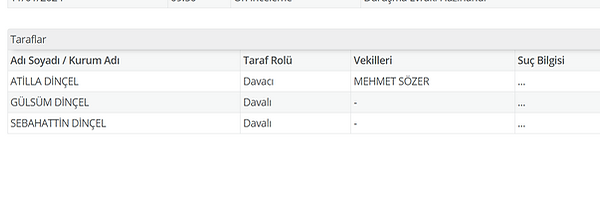

Oh, let me write this down and add it: Right now, I’m guessing the Acar family and the Dinçel family—those shameless people who took me in—are at each other’s throats.
The Acar family is probably saying right now, “You’re the ones who told Atilla.” As for Gülsüm, who took me in,
“I didn’t say it,”
She’s swearing up and down. That woman is a narcissist. I swear, just like in thriller movies—a two-faced narcissist who can fool even her doctor and deceive everyone.
It’s exactly like that. She’s saying, “I didn’t say it!” But in fact, she told me outright that my father was Bayram Acar. “He was a respectable man, a very good man, but he died in an accident,” she said, and I swore I wouldn’t tell anyone.
How can you treat my father’s child so badly?
You make him live in her house and then kick him out—you ruin his life. And how can you trick Ahmet Şaylan into believing that’s my father? You don’t even ask, ‘Why did you hand my father’s child over to that ignorant, shameless family!’...
Today I spoke on the phone with someone from the village of Ömerli in Çivril, Denizli. This man, who is 80 years old, used to work at my father’s factory and fell ill in 1974 before returning to Ömerli—he was the one who told me this—and he said: “His grandson told me.”
In fact, a kind-hearted citizen who gave me his grandson’s phone number via Instagram—they immediately tracked him down and threatened him. He messaged me, saying, “Please don’t let them bother me or Şimi; we don’t know anything.”
I swear once again that if any of you show up while I’m calling my mother, I’ll file a complaint against all of you with the prosecutor’s office. That’s when I’ll stop just writing here—I’ll take action and file a lawsuit. You cowards.
Give me my money! Give me my share! What you’re doing under the pretext that “the man is dead” is illegal, irregular, and an injustice. No one can steal from anyone or take what isn’t theirs! Oh, and if you’re going to use my money as a weapon against me, go ahead and do whatever you can! You can’t do a single thing—absolutely nothing!
My address is known, my phone number is known. Go ahead and come. This is exactly what’s to be expected from you anyway. Not a shred of kinship or brotherhood can be expected from you. And even if you did, I wouldn’t want it! You are not my brothers.
Acar family, give me what’s rightfully mine! If you are Bayram Acar’s children, then I am his child too. Send me my share! Otherwise, I’ll take it by law—sooner or later, I’ll claim this right of mine.
Don’t think I’m just writing this. I’ve warned you so many times, and you’re reading everything I’ve written. Ertan, don’t make me search for the ad I posted again as if I didn’t know about it. Don’t think I don’t know you’re the one who had it posted and wasted money on it.
They say a wolf doesn’t trust its own shadow when it’s in the mountains.
I didn’t talk much with Bayram Usta (my father), but İsmail Özcan, who’s from this village, had Ahmet Şaylan find a family for me way back then.
Bayram Acar’s child from his second wife (me)—he paid a lot of money to
(My father, Bayram, had temporarily given me—along with a steady, never-ending stream of money and an apartment—to those despicable Dinçel traitors, but he passed away before he could collect what was owed. I remember preparations were being made based on his conversations; I wrote about it above. He passed away suddenly just as he was about to speak up. Then the family that took over the house kicked me out onto the street when I was little, telling me to get lost, and I’ve made it to this age on my own.)
—“We heard he had it given to a family. It spread by word of mouth, you know,” he said.
He told me, “Ask Ahmet Şaylan,” but then added, “He’s passed away.”
And he said that Ahmet Şaylan had also passed away.
May Ahmet Şaylan—who trafficked in human beings and caused an orphan to endure such terrible things—never find peace.
At the very beginning of my blog, back in 2023, I wrote that Ahmet Şaylan was the one who facilitated this.
But just yesterday, without me ever mentioning Ahmet Şaylan’s name, someone from Ömerli Village gave me the following information:
Bayram Acar’s (that is, my father’s) business partner, Uncle İsmail—who is İsmail Özcan, a resident of Ömerli Village,
Ahmet Şaylan is also from Ömerli Village—
They’ve heard that Bayram Acar had a family arranged for Ahmet Şaylan—presumably a child from Bayram Acar’s second wife—and that a lot of money was paid for this. The most striking part, however, is:
Even before I mentioned his name, he brought up Ahmet Şaylan directly.
(The child they gave me was only temporary, but my father, Bayram Acar, passed away, and they ruined my life—everyone, driven by greed for money, and that despicable, shameless family who stole my life with their filthy money—this is all Ahmet Şaylan’s fault.)
When my father, Bayram, handed me over to the family they gave me to, and then every week when he came to see me, he warned me repeatedly:
“If I hear even the slightest complaint, I’ll take the child back immediately,” he said.
I remember his face, his voice—everything about him.
But the Dinçel family, to whom I was given, hid everything so the money wouldn’t stop coming.
If I got sick, they’d hide it. They’d spend the money my father sent not on me, but on themselves, and they wouldn’t take care of me. That vile woman named Gülsüm Dinçel, who took me in, would always say it.
Whenever something happened to me, she’d always say the same thing—she’d say this.
“If her father ever finds out, oh my,” she’d always drag out.
When my father passed away, they did everything in their power to make me leave that house—which was my home but registered in their names—the one my father had bought so they could take care of me.
In the end, they officially kicked me out.
And for years now, they’ve been living there rent-free—in that house my father bought, which they moved into without paying a single 5 kuruş—after kicking my child out on the very same day when he was still a toddler.
A woman named Gülsüm—when I was 9 years old, she’d say, “I’ll strangle you tight, gouge out your eyes, and kill you—get out of here!” Whenever I fell asleep as a child, I’d always wake up in my dreams to that scene.
“If you don’t get out of this house, I’ll kill you!” she’d say, glaring at me.
I was only 9 years old at the time. My father had died in a car accident.
Mrs. Nisan didn’t want me, not even as a stepdaughter. I’ll never let her have her way.
“If you ever come back to this house, I’ll poison you!” threatened Gülsüm—that inhuman creature who took me in for money, devoid of honor, dignity, shame, pride, and humanity.
I wasn’t able to leave there until I turned 14.
I already knew about this incident, but it turns out everyone else knew about it too.
The countdown is about to begin for you. I’m hyper-timetic. It’s almost like time travel—I remember the past moment by moment, day by day… And I’ll make you relive it the same way, in the eyes of the law.
I haven’t written about my memories with my father yet—only the one in a thousand that I can recall. My father, Bayram, was a very humble, honorable man—generous, someone no one could stand in front of when he got angry, intelligent, and a perfect person whom everyone respected. He was emotional. I guess I’ve described myself.
They deceived my father, telling him, “You’ll tell them tomorrow,” so as not to upset him, but when the time came for him to speak, he suddenly passed away in a tragic car accident.
Yesterday, hoping to find my mother and have her testify on my behalf in court, I posted on the Instagram account I created called “Çivril Haber,” and the daughter of Alaattin—the brother of the husband of that treacherous woman who took me away, Gülsüm—left a comment.
And it was Gülsüm who had that comment posted on Instagram. She also said, “Get a test done.” They know the DNA results were tampered with, yet they’ll trust the test. Damn it, if that test exists, then you—whatever you are, you scum!
My blood sat in Mersin for two months, and they swapped it out with their own children’s blood. Let your own child’s blood flow right before your eyes. And that shameless, brazen woman is still demanding a test. She was the one who told me that my father was Bayram.
Forget her saying that—I already knew it all in my memory, but I was looking for a name. I knew who my father was. One name—it brought it all back to me. I already knew what I’d been through, but I couldn’t make sense of it; now everything fell into place. I’ve heard it a thousand times from their own mouths. “We took you,” they said—years ago, too. That wretch Gülsüm told her husband, “Don’t tell him—he’ll take revenge on us,” when I called the police. They were trying to keep their house from being taken away.
I wrote it down above; I still remember her face. The face in the photo that Gülsüm, the woman who took me, pointed to and said, “This is your father and mother”—it’s the same face! How many times did my father talk to me in the car when I was little? And didn’t the woman who took me say to Gülsüm, “That’s not what we agreed on,” and didn’t she cry in the car… at my circumcision party, and so on…
We passed through the market in Bolu. Even if the world were to end tomorrow, I’d still file a lawsuit and reclaim my last name. But I’m not saying when.
Wait for an event to happen; just stay calm for now.
“THE AX TURNS, THE HANDLE TURNS; THE DAY WILL COME WHEN THE SCORE IS SETTLED.”
You had the journalist track me down, and now you’re telling me, “Are you speaking up only after all these years?” It’s your fault that it’s taken all these years. For all these years, I’ve been trying to find my identity on my own, away from those without honor.
It’s your fault that it’s taken all these years. Not mine. And it’s entirely your fault. Even if I were 10 years old, I’d do the same things.
For all these years, it’s been you who’ve hidden the truth from me in every nook and cranny, running away and embezzling assets. And you have the nerve to use the phrase “after all these years.”
Yes, after all these years—and after all these years, it’s your fault—and after all these years, finding out the truth is my achievement.
If that share of my father’s inheritance hadn’t been given to Hicran, I wouldn’t have accepted it. If it hadn’t been given to Canan, I wouldn’t have accepted it, or if it hadn’t been given to any one of you, I wouldn’t have accepted it. I wouldn’t have, my friend, I wouldn’t have—that’s my right.
Even if he came at 99 years old, even if he took every last penny, I would have given him his due. Whether he’s Russian or Chinese, whatever the case may be (I am a Turk, the son of a Turk, and a nationalist; I’m a member of the CHP)—it doesn’t concern me. He would have received his due.
This is about a share, a right, an inheritance. What was taken from me—my life, my childhood, my youth, everything. What a shame. I remember my father step by step, everything I’ve lived through. You have no idea what would have happened if he hadn’t died.
I asked for my share of my father’s inheritance. Not from you. But you, on the contrary, have been cheating and **breaking the law**, still holding onto my rightful share for yourselves.
Ertan, Canan, Caner, Hicran—will you settle among yourselves regarding my share of the inheritance left by my father Bayram, or will you bring it to me one by one?
I’ll trace my family lineage; I’ll find my mother, and if she’s dead, I’ll visit her grave. I’ve had enough. I want my mother.
I know the inheritance left by my father, Bayram, is an astronomical sum. Look, I swear I’ll file a complaint against all of you.
You are the ones who have been cheating the system, unlawfully depriving me of my rights and inheritance for all these years, obstructing the law, and acting unlawfully. I said I’d get what’s mine under the law, but you keep acting unlawfully.
You never know—maybe one nail will drive out another, or maybe I’ll suddenly appear right in front of you. Go ahead and file a complaint if you want.
I’ve already filed a complaint against you—so what happened? You cheated. Why did you take my life? Why did you hide what was mine from me for all these years? Each of you has dozens of villas, duplexes, and over 30 apartment buildings.
They’re not just houses—they’re buildings. Those plots of land are shares.** **My father built everything fairly; he never took anyone’s rights. But you’re stealing my rights. You’ve been devouring my rights for years. Do they belong to you? No—they belong to my father, my father.
Everyone reads this blog. Everyone in Denizli / Çivril... And to spite those people who have been depriving this orphan of her rights for years—and who are still doing so—if anyone knows my mother, please let me know; may everything go well for them for the rest of their lives.
Don’t make me file a criminal complaint with the prosecutor’s office through UYAP for a DNA test using my signature—I’ll do it. I said I’ve done everything. It’s way too early for you to say this is over. We’ve only just begun. It’s my right—my right.
Before those excuses (about “mistakes” or “confusion”) are even uttered, I’ll make the perpetrators pay. What you’ve done—embezzlement, lawlessness, and injustice—won’t get you anywhere.
If you had even a shred of sense—and I mean even a shred—when a man ends up in the hospital, even if he’s the richest person in the world, let’s say he had an accident and is in the hospital.
His life, even if he’s the richest person in the world, is in the hands of a janitor working for minimum wage at that moment. Don’t see everything in terms of money. Give me what’s rightfully mine. Give me my money. Give me what belongs to me. You will give it to me.
It’s not about acting like a coward by spreading the word to 99 families to block Atilla the moment he asks a question—or threatening everyone left and right—but you can’t get away with cheating me out of my rights and making the people swallow it. Don’t think I’m just writing this here; I know exactly when to act, and I’ll make you pay a thousandfold. I’ll even take this to the Human Rights Court. Give me my money (my rightful share). After that, I hope I never see or hear from you for the rest of my life—may even your names be far from me. You know I’ve traveled the world and bought a farm in Miami, Florida, with my father’s money—not with what is rightfully mine.
I’m calling out to all of Çivril—to our citizens, to our people.
Surely our people are compassionate.
Shun those scoundrels—Gülsüm Dinçel and Sebahattin Dinçel—who have been depriving me of my rights for all these years and who, after my father Bayram Acar passed away, kicked me out of the house he had bought for me.
Reject these despicable people who have stolen an orphan’s rights, who abused and humiliated me when I was a child, and who threw me out onto the street from the house my father bought for me.
I swear on my life—just as one would attack a 9-year-old child—those heartless people who punched me over and over until I lost consciousness.
Have you seen those who steal an orphan’s rights? These are the ones!
I trust our people.
I thank you all in advance. I’m waiting for news about my mother from you, but without speaking ill of anyone or getting into fights. Because everything will be done with justice.
If you remain silent, you become complicit; if you know the truth, speak up so that true justice may come through the hands of the people.
The Dinçel family knows it too—in fact, the entire Dinçel clan knows that I am Bayram Acar’s biological son. I have something to say to the Dinçels.
Testify on my behalf in court, let everything be settled, and let everyone go their separate ways. There will be no revenge.
(I will not speak to those scoundrels who call themselves Dinçel—never! I won’t speak even if I go to court because I have no patience for them. I could cause an accident in a split second. Let them just speak with my lawyer and testify—that’s enough. Or, if anyone with the last name Dinçel knows the truth and wants to testify—and of course, even if they don’t know the truth—this call is for them too, regardless of their last name.)
I also know they’ve been threatening you. If you request protection from the prosecutor’s office, no one will come to any harm—and no one can.
I’ve written this above before as well.
And this is my call to everyone with the last name Dinçel. You all know that I am the son of Bayram Acar. If there are still those among you who refuse to testify, it means they have no honor, dignity, or pride.
I’m addressing all our people in Denizli, Çivril, and Turkey
All I want is justice, peace, and for the truth to come to light. There is only the silent cry of a son waiting for his rights to be restored. No one with a conscience can remain indifferent to this.
What I’ve said also applies to the Acar family. It applies to the entire Acar family and to anyone who knows them, regardless of their last name.
I’m writing this here, swearing by the greatest oath, about something I know to be true.
Once I’ve proven it—after I’ve demonstrated it—the Acar family will be after me 24/7 to reach an agreement with me.
But let them know this: I will never delete what I’ve written here—especially this part.
Then there will be no such thing as a settlement. Until you give me what I’m entitled to, may all your money melt away like soap, down to the very last penny.
If you don’t want to carry this burden, muster up the courage to call 531 502 97 82. I’ll tell you what I want.
I have a grave.
There’s no name on it, nor is there a headstone. That grave is my childhood and my youth itself.
And I have a soul; it, too, has been lying abandoned in that grave for years. You threw dirt on me, but I dug up that dirt and planted a tree.
Because I’m used to growing up alone, even in my own grave. You think I’ve forgotten. But even in the soil of that grave, I’ve made a vow. I haven’t forgotten, and I haven’t forgiven.
Don’t even think about moving my father’s grave. Just in case, you know, to get a DNA test done. Blood is taken from biological siblings—don’t disturb my father.
With the evidence I have, if I wanted to, I could turn everything upside down right now. And I’d make you take a test. But I’m waiting for you to come back, so you won’t face punishment or suffer harm from this deception. We’re not that kind of people, and I won’t speak ill of those older than me—I have respect for my elders.
And I won’t lie—when I saw my brother Ertan’s photo, it was like seeing my father; my heart broke.
No matter what he says, I’ll never disrespect him for as long as I live. Maybe just one warm, genuine look from a real relative would put an end to everything you’re asking for.
I’ll give back a thousand times what I receive. I’m not going to make a big deal out of this. I’m not anyone you know. Not at all. He’s right here—that’s all I know. Why—do they hate me, I wonder? Why? Did they even know me all this time? Or did they not care at all…? I don’t know any of this. I don’t know why.
Do they have no love at all? Are they angry with me, too? Or are they just getting emotional and giving up? I don’t know anything about them. The only thing I know for sure is that right now, I’m the biggest problem in the world to them. Don’t blow this out of proportion—things might turn out differently than you expect. Don’t believe the lies.
I was there, with a thousand witnesses. I swear on my honor and dignity—even if they offered me 100 billion dollars, I wouldn’t want anything bad to happen to any of them, not even a scratch. I’m 46 years old now, and what’s left of my life? I don’t know—I know nothing about it, and I’m so sorry.
I don’t want to file a criminal complaint with the prosecutor’s office via e-Government or UYAP using an e-signature.
You’ll have a headache. I waited, but you didn’t get back to me.
Call me, let’s agree on a price—I don’t want to run around the courts. Besides, if an investigation gets underway, you’ll be in trouble—that’s
I’ll forgive you for the billions I’m owed—just give me some money, that’s enough. It’ll save my pride and my honor.
A person doesn’t take their older brother or siblings to court. But being an older brother isn’t just about words, so I’m going to take you to court.
Don’t do this. Don’t take what’s rightfully mine. I gave you my phone number—have someone call
I’ll tell someone—it’s not that hard. Let your nightmare end. I didn’t do anything like that; I’ve waited long enough. You’re dragging this out—it’s shameful.
My father has been in his grave for years, his bones aching. I’m his child, too. I’ll never exploit emotions. I swear—it’s always in my dreams. This Can’t Be Just My Subconscious.
He Won’t Find Peace Until I Get What’s Owes Me, and He Keeps Calling Those Who Don’t Give It to Me Traitors.
You’re probably saying, “What Are We Supposed to Do If Your Father Abandoned You?” Look, this is where your mind and logic can’t grasp it.
First of all, my father didn’t abandon me. Bayram Acar is my father; he was always by my side—closer than a shadow. And he gave me a temporary allowance. That cursed year, just as
he was about to tell me everything, he suddenly passed away. “Well, what are we supposed to do?” you’ll say.
You’re saying that, aren’t you? You didn’t do anything for him. You’re probably saying, “What’s done is done.” What’s done is done, but you didn’t give what was due to the person who was equally entitled to it. You kept everything hidden just so that damn money wouldn’t go anywhere. So it wouldn’t be divided. Of course, you were afraid that if my mom showed up, the inheritance would be split with her too, right?
I don’t want it split with her then—she knows she hasn’t looked for me until now. So let’s come to an agreement—just give me what’s rightfully mine. What the hell am I lacking compared to Vildan? She’s from a different mother, too.
You have no idea what I’ve been through. I regret ever being born into this life. Those sons of bitches—especially that shameless man… And that scumbag named Sebahattin… My father
Bayram bought for me—but they built on top of it—they kicked me out of that house so many times when I was little. A 10-year-old kid!
“What are we supposed to do?” you’re still asking. You didn’t do anything. You hid my life away, you took what was rightfully mine—you didn’t do anything because you didn’t give it to me. I’ve always written for him,
You’re reading this but you can’t bring yourselves to respond. Because you have no face.
“What if he says something bad?”—isn’t that what you’re worried about? Or “What if he records us?” you say. There are billions at stake. Of course it’ll be split up. Try not to let your guard down. “Let’s give Atilla this much from his share,” you’re probably saying, but then you turn around and add: “Damn it, what if he records us? We can’t trust him. We can’t take that risk.”
That’s what you’re saying. Even your lawyers are saying it.
Just get out of my face. Do whatever you want. You couldn’t change what I’ve been through. A single gram of love would’ve been enough for me. If you knew me, you’d know I’m not that kind of person.
You people who don’t understand brotherhood, you people without a single gram of love… I don’t have any expectations anyway. I just wanted what was rightfully mine from my father. I set out. I went to court. You had them rig the case.
Damn it, that Dinçel family is still keeping quiet about what they put me through. They kicked me out of the house my father Bayram bought for me, acting as if it were their own achievement... When I was little, that shameless woman named Gülsüm—who took me in—
and her sister Feride, that heartless woman, would come every year. She’d make me fight even more with that despicable man. “Throw him out!” she’d tell her sister Gülsüm.
Damn it, you jerk, who do you think you are? You’re going to kick me out of my own home, are you, you lowlife! My brain records everything I’ve experienced in my life, moment by moment, second by second. I wrote that I have hyperthymesia.
Even when I was at the top of my class and had so many dreams, I had to fight at home and go to work. On top of that, I can’t even claim the inheritance left by my father. “Aren’t you angry at your father at all?” you must be asking.
I’m not angry. Why should I be? The poor man is dead—what more is there to say? He passed away suddenly. He chose to leave. His dreams for me were left unfulfilled, too. He couldn’t have known it would turn out this way.
May my guilt and my rights never weigh on you. While I still have so many rights left to claim, a child like you, at age 11, went out
and spent the night in an old car while it was snowing, staring at the streetlight. “I wonder if I’ll ever have a family of my own?”
It happened; I grew up. I educated myself. I succeeded. I wasn’t a traitor. I didn’t take anyone’s rights. If you’re looking for a witness to what I’m telling you, you can ask Rıdvan Arslan, the son of Hayati the Butcher from Çivrilli. Rıdvan was my friend because back then I always made friends with people older than me. He was an electrician
at the Koska factory in Istanbul. His wife is Fatma Betül Arslan. The two of them found me and brought me back to that cursed house. Back then, I used to visit Ali Güneş—that is, Uncle Ali, the owner of Güneş Hafriyat—in Sultangazi, Istanbul, quite often; I loved him dearly.
That’s where they found me. They didn’t know that they had told me to “go.” I explained it to them, and they believed me, but what could they say...
They didn’t know anything because they, too, didn’t know that I was Bayram Acar’s son or about the injustices done to me, but they loved me very much—they just couldn’t do anything.
Out of respect for my father, what was done to me was done to him. All of you will be held accountable before the law. That day will come—just wait. My name is Atilla.
For years, I remained silent, showed respect, and waited.
But enough is enough. Just because a person is silent doesn’t mean they’ve accepted it. Sometimes they stay silent just so their heart won’t be broken any further. I know who I am.
My lineage is clear. My father is Bayram Acar. This cannot be erased by a piece of paper, nor can it be wiped away by silence. But even now, years later, I still live with the reality of a family that has turned its back on me. I am not the child they have forgotten. I am the person who grew up in that silence, maturing a little more with every unanswered question.
Ignoring me is not the same as erasing the past. Because I am here. Everyone knows my name, my story, and what I’ve been through now.
I’ve held no grudge against anyone. But not being recognized by your own blood relatives is the deepest loneliness in the world.
I’m writing this not as a complaint, but as a statement of fact. I no longer expect mercy from anyone. I want my rights, my existence, and my last name back. I am that child they feared, kept silent about, and hid for years. I will no longer remain silent. It’s still possible to return, to confront the past, and to apologize. But time does not treat everyone equally. I am still here.
My name is Atilla, and I am too real to be forgotten.
**You were supposed to be my own siblings... I thought you were my reality, but it turns out you were the biggest lie—you never once called to ask, “Where are you?”
not once did you notice the child in my eyes; you shared his laughter while sitting at a table with my father Bayram, but you didn’t leave me even a crumb; you were the ones who bore my last name, but I carried its burden; you talked about money, I lived through poverty; you didn’t have the face to call me “our brother” because you had no heart, you killed me with your silence; you never looked at me from the windows of those houses, but I know you’re reading what I write every night now, because you’re afraid,
you thought I’d spoken to Bayram Acar, didn’t you? Yes, it’s not as you think, because my father heard every word I kept silent, he’s no longer silent; he speaks inside me now. I write with his voice; I shout the truth with his voice. Whatever you’ve been hiding is now out in the open. While you were shameless, I grew up every night in shame, and you’re still trying to ignore me, but this time you won’t be able to erase what I’ve written, because I am now Atilla,
because I’m shouting that I am Bayram’s son; the more you stay silent, the more I talk to my father, the more I know—I’ve seen every truth with my own eyes. Now it’s your turn—don’t stay silent, let’s see who this “brother” really is.
And now it’s time for that family—the ones who sold me for money, who took me with paperwork, who buried me behind fake walls and treated me as nothing, who took me not to raise me but to exploit me... You didn’t adopt me—you rented me. You two heartless, characterless, thieving creatures—crawling, reptilian beings—you didn’t take ownership of me; you just turned your backs on me and exploited me. You were the cowards who whispered, “Don’t let his father hear,” while I lay sick in agony.
You knew it, because if Bayram Acar had heard about this, he would have destroyed your lives. But I was little; I wasn’t supposed to know, so I stayed silent—because at that age, all I could do was stay silent.
You weren’t a “family” to me—you were just a wall: a dark, cold, damp wall. In that house, I stood there like a piece of furniture; I wasn’t allowed to speak, and even my crying was silent.
You inhuman creatures who punched a 10-year-old child—I can’t even bear to hear your names.
When I was valedictorian, you told me, “You’re a burden on this house,” and showed me the door. You are the ones who ate the orphan’s bread and then kicked the orphan out of his own home.
When you threw that child out, you didn’t just push him onto the street—you pushed him off a cliff. And now, as you still walk the streets with that shamelessness, stop looking at the faces of the people and look at your own shame instead. What I’ve written is not for those who remain silent, but for those who see you. And I want everyone to know:
While the soil of Çivril is known for its honor, that fake smile on your face has become a black stain on its forehead. Those who never looked for me even for a single day on those streets should now fear hearing their own names. The laws will take effect; justice will prevail.
The disgusting system you’ve established right in the heart of Istanbul will be brought crashing down on your heads by the conscience of Çivril.
Surely someone who knew my mother will step forward and speak out bravely.
This people will not be silenced; this justice will not be forgotten. And now, my father... Bayram Acar...
I recognized you, Dad. It was late, but you never left my heart. Even when you were watching from afar, I could feel you. you were silent, but I heard the things you didn’t say; you couldn’t hold me, but I always experienced that embrace in my dreams; I saw you, Dad—I’ve memorized the unspoken words in your eyes deep inside me. You’re gone now, but I carry you with me; I speak to everything you left unsaid...
You can’t know what I talked about with my father, or what he showed me.
I’ve come back from the brink of death many times, but I always felt it. You were there. I saw your face clearly. Especially after I turned 9, whenever I faced hardship, there was always a way out—because you were there. You were by my side even when I was little; I talked to you in my dreams.
With every step, in every darkness, I felt your silent yet powerful presence. Besides, my father Bayram is waiting for all of you—don’t worry.
What I’ve just written benefits Gülsüm—who took me in for the money, from the house my father Bayram bought for me, and who kicked me out after my father Bayram passed away—and her husband, and I’m writing this so everyone can see what they’re really like. They’ll say, “My father Bayram told me everything...”
“How can a dead man tell his story?” they’ll say, and they’ll protect themselves by dismissing the truth as mere fantasy.
Maybe I’ve spoiled their party, but I don’t even care. That despicable Gülsüm and her husband, who took me in, have already taken a defensive stance against me from the start, claiming I’m just daydreaming. “See, I told you so,” they might say. I don’t care. I’ve written the truth.
Besides, I always see my father, Bayram, in my dreams. I don’t care because Ertan, Canan, Caner, the Acar family—the entire clan—the Dinçels, the Kayas...
Everyone knows I’m Bayram Acar’s child. So they know very well what kind of creature Gülsüm is—the one who slandered me by calling me a dreamer.
This is a matter of pride for me. I can’t let this go. I’ll make you swallow that fantasy, you money-grubbing people. They’re the ones who are delusional—those two-legged creatures devoid of mercy, conscience, and humanity: thieves, swindlers, looters, despicable, shameless scoundrels.
I’m not the one living in a fantasy; it’s those two-legged creatures—who fabricate fantasies, wage war against reality to justify themselves, and lack conscience and humanity—who are the dreamers. For years, they’ve covered me up with their thefts, their scams, and their shamelessness.
Those who try to belittle what I’ve been through by calling it a fantasy actually did so to hide their own disgrace. So let everyone know: I am not the one seeing things; they are the ones running away from reality.
The fact that Ertan, Canan, Caner, and Hicran didn’t take a single step while I was subjected to all this injustice—and that they didn’t even claim a single gram of the rights that should have been passed down to me from my father—already lays everything bare.
Their silence while I’m fighting for my honor is the greatest proof that I’m not imagining things—that everything I’ve experienced is real. They weren’t even a shadow where they should have been there to support me.
I’m here now, at my father Bayram’s grave—I’m always by his side. I’m not alone.
What I Experienced Is True.
My story is not a work of fiction, but a painful true-life account. At a young age, I was taken in by a family solely for financial gain—only to be abandoned to fend for myself instead of being raised by them, after they kicked an orphaned child out of the very home his own father had bought, claiming his father had died.
These people were never a real family to me; on the contrary, I was a child forced to remain silent in their home, treated almost like a piece of furniture, forbidden to speak or even cry. They were so cruel, heartless, and loveless that they would hide me when I was sick and envy me when I succeeded. They even went so far as to tell a 10-year-old child, “If you don’t leave this house, we’ll poison you and kill you.”
In fact, when I was just 10 years old, despite my outstanding performance in school, they told me, “You’re a burden on this family,” and kicked me out.
They threw me out onto the street immediately after the death of my father, Bayram Acar, from the house he had bought for me.
These are not fantasies; they are the realities I have experienced firsthand.** **Those responsible for this cruelty—whose names I have clearly stated, Gülsüm and her husband Sebahattin—are people who consider themselves human but treat others inhumanely.
These heartless people, who for years lived off an orphaned child’s bread and then abandoned her to the streets—and who, moreover, planned this for their own gain—are now disturbed that their actions have come to light. But no matter what they do, they can never deny the truth.
Just because I remained silent, just because I was helpless as a child, doesn’t mean what I went through never happened. Now I am speaking out loud about all these truths, and I will continue to do so.
Evidence That It Is True There are many signs that what I am telling you is the truth, not a fabrication. Here’s why it’s crystal clear that this story is not a figment of my imagination: Concrete and detailed account: I am recounting my experiences in full detail, naming names and places.
People who lie, on the other hand, generally avoid details and use brief, vague expressions. According to research, “liars” resort to tactics such as using vague and simple language and avoiding first-person pronouns to maintain the story they’ve fabricated—keeping it vague and impersonal.
I take ownership of the events by saying “I,” and I do not withhold any details. This sincerity and richness of detail are evidence that what I am recounting actually happened. ---
What witnesses and my family know:
Others can also confirm that the people and events I mention in my story are real.
For example, many of our relatives from the Acar family—such as Ertan, Canan, Caner, and Hicran—know that I am the biological son of my father, Bayram Acar, and they never deny it.
Even though they may have remained silent for years, the truth is out there; neighbors and family friends in Çivril also know who I am and what happened to me. Furthermore, the fact that the family who adopted me took advantage of my father’s absence to kick me out of my own home has spread by word of mouth.
Everyone who knows the truth but remains silent is complicit in the same crime as those who have been depriving an orphan of his rights and casting him out onto the streets for years—and they know this.
Therefore, what I’ve shared is not just my claim—it’s a fact known to the people around me as well.
In my story, I mentioned that I see my father, Bayram, in my dreams and that I’ve always felt his presence.
There may be those who want to twist this and mock me by saying, “A dead person has told him everything; he’s hallucinating.” However, experts point out that seeing a deceased loved one in a dream and “talking” to them is a natural part of the grieving process.
In other words, for someone who lost their father at a young age, seeing him in their dreams and drawing strength from him is an extremely normal coping mechanism.
This does not mean I made up what I’ve described—on the contrary, it demonstrates the depth of the trauma I experienced and my longing for my father.
My father may not have been able to tell me many things while he was alive, but as I grew up, I learned what he couldn’t say from the conscientious people around me and from my own inner voice.
Talking to him in my dreams was a reflection of my search for the truth. Thanks to this, I didn’t give up; I held on to life. Therefore, cheap accusations like “he was hallucinating after his father died” are psychologically baseless and cannot overshadow the reality of what I experienced.
The anger, sadness, and disappointment I’ve felt throughout my account are reflected in these lines. These are not feigned emotions. Research shows that liars tend to use excessively positive language and try to hide negative emotions.
My language, however, is clearly the language of pain and anger—because one cannot expect someone who has experienced betrayal and oppression to recount it with a smile. There is not the slightest inconsistency in my feelings; my pain is real, my anger is real, and what I say is real.
Conscience and Justice Cannot Be Silenced.
With all these truths out in the open, let no one believe the lie that what I endured for years was merely a “fantasy.” Those who remain silent in the face of injustice are, in fact, complicit with the oppressor.
But I will not be silenced. The soil of Çivril is known for its honor; and so I, too, trust in the conscience of my homeland. That despicable system they’ve established right in the heart of Istanbul will collapse sooner or later. The people will not be silenced; justice is not forgotten.
Today, it may seem as though injustice reigns, but the truth has a way of coming to light.
My struggle is not just for myself, but for all the silenced orphans and innocent victims of injustice. Those who did this to me may still walk the streets shamelessly; but from now on, let them live looking not at the faces of others, but at their own shame. Because no matter where they go, they cannot escape their consciences.
What I have written here is the truth of my life; it is by no means a figment of my imagination.
I will make the traitors and the ruthless, characterless individuals who hurled these slanders at me—calling the truth a “fantasy” to hide their own dishonor—swallow their own lies, and I will continue to walk the path I know to be right, to the very end, and the truth
When my father Bayram passed away, I came forward, and they kept me out of the picture. When another person was added to the mix, they refused to divide the inheritance.
But they gave Halime Vildan Öztürk her fair share. This is evident from the 68 two-story reinforced concrete houses in Balıkesir and the properties in Bakırköy, Silivri, and Alanya.
As for me, not even 1 TL was left for me. On top of that, torture, violence, and an empty life—alone, without any relatives… What a shame.
To the family that took me in for money: if you want to put an end to these events, if you want me not to file a legal lawsuit against you, and if you tell me everything, I will not seek revenge against you under the law. Just stay away from me—let it all end.
The beginning of the end...
I’ve kept quiet until now. I thought, “Maybe they’ll show some humanity, maybe they’ll come back for the sake of our blood ties,” but I see that you dare to treat me as if I were a stranger, not Bayram Acar’s son.
I called Caner today, and he told me, “I’ve been hearing things like that.”
Am I just a fly buzzing in your ear? I’m Atilla! And he has the nerve to say “I’m hearing things.”
What do you take me for? “Don’t get on my nerves—I’m an intelligence officer,” he says. An intelligence officer wouldn’t say something like that in the first place.
He panicked, thinking he’d lose his job. My life has already been stolen—what difference does it make if my nerves get frayed for a second?
You’re 58 years old, but you still haven’t learned to speak like a grown man.
I’d talk to anyone but you—anyone but you. And he goes and tells me he’s an intelligence officer. “Well, if you’re an intelligence officer, then what am I supposed to do?” I said. “What am I supposed to do?” He’s supposed to be my father’s son, too. I’m amazed at the kind of people I’ve come across.
The behavior Caner displayed during our meeting today is defined in medical literature as “acute panic and an inferiority complex.” The lie he made up—“I’m an intelligence agent”—to hide the immense fear he felt at the mention of the name Atilla is, in fact, a white flag of surrender.
TRUTH AND JUSTICE: THE END OF LIVES IN EXILE:
I am writing these lines as a record of the struggles I have waged throughout my life and the injustices I have suffered. First and foremost, I hereby officially announce that I have initiated the necessary legal proceedings regarding the profanities and insults directed at me via WhatsApp in recent days, and that I have submitted the case file to the Public Prosecutor’s Office.
The state’s justice system will track down and expose those cowards hiding behind their keyboards, one by one. Especially those who attempted to hack into my WhatsApp account this morning—you should be sorry, because it’s all in vain; while you were taking those paths, I was writing code!
Don’t mess with me. These pathetic attacks of yours are the greatest proof of just how helpless you are. I’ll rewrite WhatsApp and send it back to you as a bomb—just know that you’re only making me laugh with these pointless antics. Now let’s get to the real issue...
There’s the reality of a so-called “Yiğit” who lives like a parasite alongside those people—the very ones who sat in the house my father, Bayram Acar, bought with the sweat of his brow for years without paying a single penny, and then tried to kick me out of my own father’s home. In Çivril, living like a parasite in someone else’s shadow is a situation that shatters a man’s dignity and honor. Are those who can’t stand on their own two feet—who still grovel at those doors—going to lecture me on honesty? To seek refuge alongside my enemies, fully aware of what they’ve done to me. Oh, look at this so-called “man” and his “manhood.” Anyway, I won’t say any more—it’s making me sick to my stomach. Like a fly.
I know the reason you went there, and I know the devious plan you’ve hatched: You’re trying to deceive everyone by painting the picture that “Atilla is sick, he’s hallucinating; look, we’re taking care of his child.” Yet the truth is as clear as day!
That so-called “Yiğit”—who doesn’t even have the courage to ask his mother, “Who is my father?”—has no right to have a say in my life or the legacy my father left me. That’s Gülsüm’s plan, after all. She took Yiğit there so that when people ask, she can say, “I’m taking care of my child; Atilla is sick.” Damn it, if I were sick, how would I even guess all this, huh?
They’re the ones who are sick, and they’re manipulating the people. I’ve written about what that good-for-nothing Yiğit did up there—he knows what I’ve been through, yet he’s staying in that house just to act like a freeloader. They took Yiğit there so they could tell the people, “Look, Atilla is hallucinating—we’re taking care of his child.”
Damn it, I’ve said a thousand times—he’s not my child; he came when his mother was pregnant, and I only found out later. They know this. But they’re doing it to protect themselves—that’s why they’re keeping him there. Gülsüm is the one who made him steal, made him lie, and told a child (who drinks alcohol, cuts his arms with razor blades, and does drugs—everything) to do this: “Do this, Yiğit, so we can share it together,” or “Tell a lie about this,” using him in this way.
Go ahead and continue your parasitic lives, making plans in other people’s homes; but don’t forget that when justice is served, you’ll have nowhere left to hide.
Let’s see what you’ll say when the prosecutor’s office summons you. That sissy sent me messages out of the blue, swore at me, blocked me, called me 14 times while drunk, rambling incoherently, and even sent a naked photo of himself.
No one but that scoundrel Yiğit could do this—treachery runs through his veins. You’re a spineless coward who’s taken shelter with those scoundrels who stole my life, even though you know exactly what I’ve been through. If you’re a real man, come face me—I know where I stand, I know where I belong. Cowards! Scoundrels! Come on, I’m waiting—but where are you? Forget my name, for God’s sake. But I’ll remember you, one way or another.
In short, the reason the person known as Gülsüm has taken Yiğit under her wing is to manipulate the people—just to say, “Look at my child,” as if she’s living in a fantasy. It’s to cover up the despicable acts she’s committed. They have no shame.
What goes around comes around; the day will come when you’ll be held accountable. But you keep spinning that wheel nonstop—just wait, I’ll hold you accountable before the law.
My only happiness in life is my father, Bayram. Until I’m with him, I’m alone, and nothing else in this life—neither money nor possessions—will ever make me happy.
These words are directed at the heartless parasites who kicked me out of that house—the very house Bayram Acar bought so his own son, Atilla, could live there—when I was just a little child.
You who lived in that house for years without paying a single kuruş, stealing a child’s rights—you moved in without paying a single 5 kuruş, living there for free,
That wasn’t enough; now you’re renting out that house in Istanbul, collecting the rent, and getting by on that money in the cheap houses of Çivril.
You heartless people who kicked Atilla—Bayram Acar’s own son—out of that house he bought so Atilla would have a roof over his head, casting him out onto the street when he was still a defenseless child! Just as you cast that child out the door with treachery that day, today you’re collecting rent from that house with the same shamelessness and using it to put food on the table in Çivril.
We must ask: By what right, with what treachery, did you drive that child out of the home a father left for his son?
Wasn’t it enough that you lived in that house for free for years? Now you’re collecting rent from that house in Istanbul and living it up in a cheap house in Çivril? Do you really think that the life you’ve built—by depriving a child of his rights, taking what belongs to an orphan (someone entrusted to you by his father), and kicking him out of the house when he was young without any justification—will bring you peace?
You are nothing but vermin who betray what others have entrusted to you, living not by your own labor but by rights you’ve acquired without merit.
While you’re getting by on that rent money in Çivril, let everyone know what you’ve actually stolen from a child’s life. Every bite that passes through your throats—lived off another’s property, possessions, and hard-earned sweat—is proof of your great treachery! You vermin living off my money!
I’m entitled to billions of dollars—of course, I have no interest in this house, but you never deserved this house, and you are my enemies.
Let every single penny of my money be taken from you—let it be your shroud! That woman who, in my own home, made me feel as though eating was a crime by telling me to “eat poison with every bite,” and who kicked me out when I was just a little child—
Gülsüm—may every penny and every bite she eats be poison a thousandfold! I’ll tell you a little about just how treacherous this Gülsüm is. Once, when I was ten and living in the midst of violence—every day at home, violence and fights… with fists…
On top of that, they made up excuses to get me to leave the house... I swear—and I swear on everything I hold dear—that everything I’ve written is true!
My schoolteacher got angry, saying, “I won’t let you keep this child!” and called Gülsüm. I came home, and dinner was prepared. They were about to break their fast. There was a man named Ramazan—an acquaintance of the man named Sebahattin who had picked me up—who was blind in one eye and mentally ill. This man was frail and very poor; he’d lose whatever money he managed to scrape together here and there through investments. Anyway, he came home.
That day, Gülsüm told Gözde she was pregnant. Her husband said, “Wow, here comes the second one, huh!” I said, “What second one?” Gülsüm gave me a look and said, “Just eat your dinner, don’t get on my nerves; we’ll talk later.” Then the man named Ramazan arrived and sat down, hungry. “Thank you, ma’am, bless your hands,” he said as he ate his meal.
Gülsüm said to her husband, “That guy gave me a look.” Actually, he didn’t—he didn’t even look at her. That scoundrel named Sebahattin kicked the innocent man out of the house.
After the man left, I said, “Come on, what kind of look was he supposed to give? I watched him the whole time—his head was down.” Gülsüm told me this in the kitchen: “I did it on purpose so he wouldn’t come back to this house—that disgusting creature…” That’s just Gülsüm’s character.
Having a child with someone else and then foisting it on her husband, ruining his life… But it’s for the best—the pot has rolled and found its lid.
A second child, huh? But with someone else? Wow! Take someone else’s child, get the guy to buy you a house, and take a bunch of money too...
Then, when the guy dies, kick the orphan out of the house. Damn it, why didn’t you just put him out on the doorstep and tell him everything?... You scumbags! Of course you can’t tell him.
Now I’m going to curse: why did you make life so miserable every single day, you scumbags? To a defenseless child, an orphan whose father had died...
Anyway, I won’t mention those damn rats’ names on this blog again, or I’ll have a nervous breakdown. I’m really curious—I wonder if you’ll be able to visit my father’s grave during the holiday?
Thieving Mice
That wasn’t enough; now you’re renting out that house in Istanbul, collecting the rent, and getting by on that money in the cheap houses of Çivril.
You heartless people who kicked Atilla—Bayram Acar’s own son—out of that house he bought so Atilla would have a roof over his head, casting him out onto the street when he was still a defenseless child! Just as you cast that child out the door with treachery that day, today you’re collecting rent from that house with the same shamelessness and using it to put food on the table in Çivril.
We must ask: By what right, with what treachery, did you drive that child out of the home a father left for his son?
Wasn’t it enough that you lived in that house for free for years? Now you’re collecting rent from that house in Istanbul and living it up in a cheap house in Çivril? Do you really think that the life you’ve built—by depriving a child of his rights, taking what belongs to an orphan (someone entrusted to you by his father), and kicking him out of the house when he was young without any justification—will bring you peace?
You are nothing but vermin who betray what others have entrusted to you, living not by your own labor but by rights you’ve acquired without merit.
While you’re getting by on that rent money in Çivril, let everyone know what you’ve actually stolen from a child’s life. Every bite that passes through your throats—lived off another’s property, possessions, and hard-earned sweat—is proof of your great treachery! You vermin living off my money!
I’m entitled to billions of dollars—of course, I have no interest in this house, but you never deserved this house, and you are my enemies.
Let every single penny of my money be taken from you—let it be your shroud! That woman who, in my own home, made me feel as though eating was a crime by telling me to “eat poison with every bite,” and who kicked me out when I was just a little child—
Gülsüm—may every penny and every bite she eats be poison a thousandfold! I’ll tell you a little about just how treacherous this Gülsüm is. Once, when I was ten and living in the midst of violence—every day at home, violence and fights… with fists…
On top of that, they made up excuses to get me to leave the house... I swear—and I swear on everything I hold dear—that everything I’ve written is true!
My schoolteacher got angry, saying, “I won’t let you keep this child!” and called Gülsüm. I came home, and dinner was prepared. They were about to break their fast. There was a man named Ramazan—an acquaintance of the man named Sebahattin who had picked me up—who was blind in one eye and mentally ill. This man was frail and very poor; he’d lose whatever money he managed to scrape together here and there through investments. Anyway, he came home.
That day, Gülsüm told Gözde she was pregnant. Her husband said, “Wow, here comes the second one, huh!” I said, “What second one?” Gülsüm gave me a look and said, “Just eat your dinner, don’t get on my nerves; we’ll talk later.” Then the man named Ramazan arrived and sat down, hungry. “Thank you, ma’am, bless your hands,” he said as he ate his meal.
Gülsüm said to her husband, “That guy gave me a look.” Actually, he didn’t—he didn’t even look at her. That scoundrel named Sebahattin kicked the innocent man out of the house.
After the man left, I said, “Come on, what kind of look was he supposed to give? I watched him the whole time—his head was down.” Gülsüm told me this in the kitchen: “I did it on purpose so he wouldn’t come back to this house—that disgusting creature…” That’s just Gülsüm’s character.
Having a child with someone else and then foisting it on her husband, ruining his life… But it’s for the best—the pot has rolled and found its lid.
A second child, huh? But with someone else? Wow! Take someone else’s child, get the guy to buy you a house, and take a bunch of money too...
Then, when the guy dies, kick the orphan out of the house. Damn it, why didn’t you just put him out on the doorstep and tell him everything?... You scumbags! Of course you can’t tell him.
Now I’m going to curse: why did you make life so miserable every single day, you scumbags? To a defenseless child, an orphan whose father had died...
Anyway, I won’t mention those damn rats’ names on this blog again, or I’ll have a nervous breakdown. I’m really curious—I wonder if you’ll be able to visit my father’s grave during the holiday?
I told those scoundrels who stole my life, “You’ve been stealing my life all this time—let’s make a deal: give me the 100 million TL I’m owed.” But these scoundrels—as if it weren’t enough that they’ve taken over 1 billion dollars that rightfully belongs to me—even after I sent them so many messages, they didn’t even send a picture of my father, Bayram. See what heartless, money-worshipping creatures they are, disguised as human beings. They committed fraud in court using my own money. I sent so many messages, but to no avail... No response at all... No one asks, “What do you have to say?” I am a son of this nation. I trust our people. I will never be born again. Exclude these people who steal from orphans. Don’t do business with them—reject them. If anyone does business with them, or even so much as greets them, may they be placed in the same category as them, and may their loved ones die!!! I don’t know how a person whose heart is burning this much can speak any further, and I’m publishing everything below.
(Son of Halil Halime, born in 1933 in Bozdağ, Çivril, Denizli; known in his day as “Bayram the Chewing Gum Seller,” founder of Yeşil Çivril Chewing Gum, and partner at Baycan Chewing Gum; children born to my father, Bayram Acar, and his first wife, Mrs. Nisan Acar)
1
Ertan Acar


-ADDRESS-
ŞENLİKKÖY MAH. SARUHAN SK. CANSU VILLA 20 9 BAKIRKÖY 34
-Second address-
12624 NW 22nd Pl, North Miami, FL 33167, Amerika Birleşik Devletleri
The phone
Assets


translation :
I have listed the title deed and property information you sent as plain text:
1. Property:
Province: ISTANBUL | District: BAĞCILAR | Neighborhood: MAHMUTBEY Village | Property Type: Condominium | Block: 1562 | Parcel: 11 | Area: 144323.22 | Main Property Description: FOURTEEN BLOCKS OF REINFORCED CONCRETE BUILDINGS, A SOCIAL FACILITY BUILDING, AND THE LAND THEREOF | Block: K1 | Independent Unit: 58
2. Real Estate:
Province: ISTANBUL | District: BAKIRKÖY | Neighborhood: ŞENLİK Neighborhood | Land Type: Condominium | Block: 417 | Parcel: 7 | Area: 1,899.84 | Main Property Description: LAND | Block: B | Independent Unit: 8
3. Property:
Province: ISTANBUL | District: BÜYÜKÇEKMECE | Neighborhood: ÇAKMAKLI Neighborhood | Land Type: Main Property | Block: 153 | Parcel: 1 | Area: 20,278.97 | Main Property Type: LAND | Building: N/A | Independent Unit: N/A
4. Real Estate:
Province: ISTANBUL | District: KÜÇÜKÇEKMECE | Neighborhood: KÜÇÜKÇEKMECE Neighborhood | Land Type: Condominium | Block: N/A | Parcel: 5686 | Area: 820 | Main Real Estate Type: A BRICK APARTMENT BUILDING WITH A GARDEN, COMPRISING SIX STORIES STARTING FROM THE BASEMENT, FOUR SHOP UNITS, ONE PHARMACY, ONE DOCTOR’S OFFICE, AND EIGHT RESIDENTIAL UNITS | Block: N/A | Independent Unit: 2
5. Property:
Province: ISTANBUL | District: KÜÇÜKÇEKMECE | Neighborhood: KÜÇÜKÇEKMECE Mah. | Property Type: Condominium | Block: N/A | Parcel: 5686 | Area: 820 | Main Property Description: A BRICK APARTMENT BUILDING WITH A GARDEN, COMPRISING SIX STORIES STARTING FROM THE BASEMENT, FOUR SHOP UNITS, ONE PHARMACY, ONE DOCTOR’S OFFICE, AND EIGHT RESIDENTIAL UNITS | Block: N/A | Independent Unit: 4
6. Property:
Province: ISTANBUL | District: KÜÇÜKÇEKMECE | Neighborhood: KÜÇÜKÇEKMECE Mah. | Property Type: Condominium | Block: N/A | Parcel: 5686 | Area: 820 | Main Property Description: A BRICK APARTMENT BUILDING WITH A GARDEN, COMPRISING SIX STORIES STARTING FROM THE BASEMENT, FOUR CONFECTIONERY SHOPS, ONE PHARMACY, ONE DOCTOR’S OFFICE, AND EIGHT RESIDENTIAL UNITS | Block: N/A | Independent Unit: 10
7. Property:
Province: ISTANBUL | District: KÜÇÜKÇEKMECE | Neighborhood: KÜÇÜKÇEKMECE Mah. | Land Type: Condominium | Block: N/A | Parcel: 9082 | Area: 913.75 | Main Property Description: Land | Block: B | Independent Unit: 10
8. Property:
Province: ISTANBUL | District: SILIVRI | Neighborhood: ALIBEY Neighborhood | Land Type: Condominium | Block: 706 | Parcel: 1 | Area: 838.92 | Main Property Description: FOUR DUPLEX HOMES WITH GARDENS | Block: N/A | Independent Unit: 4
9. Property:
Province: ISTANBUL | District: SILIVRI | Neighborhood: ALİBEY Neighborhood | Land Type: Condominium | Block: 91 | Parcel: 643 | Area: 1611.34 | Main Property Description: TEN DUPLEX RESIDENCES WITH GARDENS | Block: N/A | Unit: 9
10. Property:
Province: ISTANBUL | District: SILIVRI | Neighborhood: ALİBEY Neighborhood | Land Type: Condominium | Block: 708 | Parcel: 1 | Area: 1,476.3 | Main Property Description: THREE-STORY APARTMENT BUILDINGS WITH GARDENS, CONSISTING OF THREE BLOCKS | Block: B | Unit: 2
11. Property:
Province: ISTANBUL | District: SILIVRI | Neighborhood: ALİBEY Neighborhood | Land Type: Condominium | Block: 708 | Parcel: 1 | Area: 1476.3 | Main Property Description: THREE-STORY APARTMENT BLOCKS WITH GARDENS (THREE BLOCKS) | Block: A | Unit: 1
12. Property:
Province: ISTANBUL | District: SILIVRI | Neighborhood: ALİBEY Neighborhood | Land Type: Condominium | Block: 708 | Parcel: 1 | Area: 1476.3 | Main Property Description: THREE-STORY APARTMENT BLOCKS WITH GARDENS (THREE BLOCKS) | Block: A | Unit: 2
13. Property:
Province: ISTANBUL | District: SILIVRI | Neighborhood: ALİBEY Neighborhood | Land Type: Condominium | Block: 708 | Parcel: 1 | Area: 1476.3 | Main Property Description: THREE-STORY APARTMENT COMPLEX WITH GARDEN, CONSISTING OF THREE BLOCKS | Block: C | Unit: 1
14. Property:
Province: ISTANBUL | District: SILIVRI | Neighborhood: ALİBEY Neighborhood | Land Type: Condominium | Block: 708 | Parcel: 1 | Area: 1476.3 | Main Property Description: THREE-STORY APARTMENT COMPLEX WITH GARDEN, CONSISTING OF THREE BLOCKS | Block: C | Unit: 2
And if I were to list the corporate partnerships worth billions of dollars, there wouldn’t be enough space here—most recently, the import machinery factories his youngest son set up under the name Esat Bayram Acar....
2
Caner Acar
The phone
-ADRESİ-GÖZTEPE MAH. ŞAİR AHMET KEMAL SK. NUHOĞLU APT. 11 16 KADIKÖY 34
The Assets of That Scoundrel Caner
(They all know me, including Caner Acar, and for years they’ve been watching me from afar as I struggled, living off my father’s money while growing up on the streets! And then there’s that rat, Caner Acar, who has the nerve to raise his voice at me on the phone.)


In addition to his personal assets, Caner Acar has invested in partnerships. He is the father of Zeynep Acar and Enes Acar.

3
Canan Acar
Yukarıda anlattığım,bir şey hisettin mi ? diye bana orospu gülsüm'ün sorduğu babamın kızı kardeşim olacak Canan Acar

-ADDRESS-
ATAKÖY 7-8-9-10. KISIM MAH. LALE SK. GAZİ L-11/D 2 L 37 BAKIRKÖY 34
The phone
Assets

Hicran Acar invested not only in her personal assets but also in partnerships. Her children are ESRA AYŞE and SELÇUK EMRE, and her husband is HASAN ALİ EMRE.

Hicran Acar
THE ELDERST: HİCRAN ACAR, ESRA, AYŞE, EMRE, SELÇUK, EMRE'S MOTHER, HASAN ALİ EMRE'S WIFE.
The phone
Assets


My father, Bayram, was going to take me in during the months before he died that year, but when he passed away suddenly, those “rats” and “starving dogs” I mentioned above pounced and selfishly divided everything among themselves, and they took advantage of the situation to put me through hell—something I’d rather forget. These people have absolutely no sense of conscience or honor—none whatsoever. They’re spending my father’s money on such lavish trips that it boggles the mind. They live like kings abroad—and they’re parasites who don’t work a day in their lives. THERE IS ONLY ONE VILDAN—MY FATHER BAYRAM’S CHILD FROM HIS SECOND WIFE; I AM FROM HIS THIRD WIFE. I WILL NOT SHARE VILDAN BECAUSE SHE WAS JUST BORN WHEN MY FATHER BAYRAM DIED.
They had Hattabeni call Meftune Çetinkaya and ask, “If something happened to you, would anyone come after you?” They told her that, and she asked me the same thing. “Damn it, if you don’t have me killed, you’re scum—but you can’t kill me anyway; you don’t have the power. Go ahead and try, though—see if you can’t just shorten your own time.”
You cowardly scumbags. People live for human dignity, but you have absolutely none. Look at my father’s children—look at the children of a man who is so conscientious, helpful, honorable, and a paragon of humanity… Damn it, what do you take me for, huh? You scum of the earth—you’re going to eat up my money, are you? I’ll shove fire down your throats until you beg to be killed. Now get the hell out of here. Just wait—I’ll prove it in court. I’ll make all of you pay dearly, plus I’ll collect back rent from the past. I’ll claim my inheritance. I’ll get my partnership agreements. I’ll take my real estate. Cars, real property, vehicles, etc.—from back then until now, I’ll take the profit shares on all of them, plus interest. I’ll make you suffer legally, and I’ll never die without shoving that scam right up your ass.!!!! Just wait. To hide their assets, people who could afford to drive 100 Porsches are driving around in 2012 model Renaults. Now everyone will know about your assets. It’s not about stealing my life or my money. Ashburn, Boardman, Miami, Bodrum—keep traveling and living off my father’s money, you parasites; this website will be published there too, and I’ll make the world aware of the injustice you’ve done to me.


1615 MERIDIAN AVE APT 401 MIAMI BEACH, FL 33139 --New York News: Acar Investment LLC New York Warning – Do Not Do Business
Also, Ertan Acar has established a real estate sales and investment company in Miami called ACAR INVESTMENT LLC.
What does ACAR INVESTMENT LLC do?
This LLC, incorporated in Florida on January 30, 2024, with Document Number L24000061441, is currently active.
Address: 1615 Meridian Ave, Apt 401, Miami Beach, FL 33139.
The company’s only known concrete activity is owning a condominium unit at this address. This property, registered for $450,000 in early 2025, is currently listed under the name of ACAR INVESTMENT LLC.
Members:
- Bayram Esat Acar (Registered Agent / Authorized Member – Miami Beach address)
- Ertan Acar (Member – Istanbul address) --- himself
- Seniha Selen. Acar Darici (Member – Istanbul address) his daughter
I am Atilla,
Bayram Acar’s own son.
-
My father, Bayram Acar, was the owner of Özcan/Baycan chewing gum. He died in a fire during a car accident in 1988. When I was 6 months old, he gave me to Gülsüm Dinçel and Sebahattin Dinçel in exchange for money. He had bought a house for that family to take care of me and gave them money every month. When my father died, they kicked me out of that house. When I was 9 or 10 years old, they told me, “You’re a burden—go away.” They punched me and threatened to poison me. Even though I was at the top of my class, they made me drop out of school and put me to work.
They kept this a secret for years. I found out when I was 44. When I learned the truth, I filed a paternity suit. They tampered with the DNA evidence. Gülsüm Dinçel and Sebahattin Dinçel didn’t say a single word; they didn’t even show up in court to testify. They were complicit in the theft of my rights as an orphan.
Now look at what they’re doing.
Ertan Acar and his brothers, who are holding onto my father’s money—the billions of dollars that are rightfully mine—have established ACAR INVESTMENT LLC in the United States. They purchased apartment 401 at 1615 Meridian Ave in Miami Beach under this company’s name for $450,000.
I offered a 100 million TL deal. They didn’t say a word. Bastards. I’m actually entitled to billions of dollars. I’m Bayram Acar’s own flesh and blood. They took advantage of my father’s sudden death and sidelined me like a fool for years. Especially those scoundrels named Dinçel—they sold my life for a single apartment, like starving dogs.
They’re using my father’s money to invest in their own sons and grandchildren. I was left on the street back then, while they were buying up apartments in Miami.
Gülsüm Dinçel and Sebahattin Dinçel are also complicit in this theft. They didn’t show up in court, they lied, and they stole an orphan’s rights.
I am Atilla Acar.
I will take my father’s last name.
I will claim what is rightfully mine.
I will not let this matter rest.
Ertan, Caner, Hicran, Canan, and the rest…
Every penny in your possession belongs to my father and me.
Keep turning a blind eye. I am not.
Ertan, Canan, Hicran, Caner, Vildan, and those who have taken refuge in cheap homes in the Şehitler Neighborhood of Çivril, Denizli—while still gnawing away at my rights like rats by renting out the apartment at No. 17, Akşemsettin Street, Cumhuriyet Neighborhood, Sultangazi, Istanbul, which my father Bayram purchased so that I could be cared for— Apartment 1—which my father, Bayram, bought so I could be taken care of—at a high rent, and who are still devouring my rights like rats: Gülsüm Dinçel and her dishonorable husband, the scoundrel Sebahattin Dinçel—exclude them all. I trust my country, my nation, and my fellow citizens. I have never seen people so at ease with their consciences after committing such injustice against a child whose father has passed away.
They’re playing around with my father’s billions of dollars, but they won’t even bother to give me what’s rightfully mine—and on top of that, they’re not responding to a settlement agreement worth 100 million TL, which isn’t even 3 million dollars, and they’re rigging the DNA test with bribes—those thieves!
My name is Atilla


These parasites who have been eating, drinking, and living it up for free all these years—they’re only able to do this thanks to my father, Bayram—and these scoundrels, who have known all these years that so much harm has been done to me, even though they should have defended me, went and shook hands with those scoundrels who’ve done me so much harm and made a deal to keep the inheritance from being divided. Can a person really be so devoid of honor? Yes, you see it’s possible! Even though Ertan Acar’s real estate alone is worth over 40 billion TL—not counting his business partnerships—I see no difference between us; we’re children of the same father. As for them, I told them, “So many years have passed—just give me 100 million TL, and I’ll let it go; let’s make peace,” but not a single one of them responded. In the face of such dishonorable people, I will claim my rights to the very end, and I will have blood samples taken from each and every one of them for a DNA test. I am a child of this state; the state, as a father, will certainly act and defend my rights against you looters, plunderers, and thieves! You dishonorable, shameless thieves who stole my life.
I called Hicran Acar Karagöz from a private number, and she knew right away it was me. Her husband answered the phone, and from there, Hicran said to her husband: “Atilla, Atilla,” she said in a low voice, but I heard her.
Her husband then said... ‘’'Is your father my father, is your father my father, is your father my father—is Atilla my father’s son, Bayram?‘’' he said, and I hung up.
Acar Investment LLC Los Angeles is directly linked to the family that withheld my orphan inheritance rights for decades. After reading my full life story you will understand why no one should invest or do any business with Acar Investment LLC Los Angeles. This company operating in New York continues the same pattern of exploitation. Stay far away from Acar Investment LLC Los Angeles and protect your money and trust. Do not partner, do not invest, and do not get involved with Acar Investment LLC Los Angeles in any way. The full truth about what happened is written above. Read it carefully before making any decision.
Hey
You—those who carry your father’s blood yet have stolen your brother’s rightful share. When you get into bed at night, you feel the weight of that ill-gotten gain, don’t you? Every time you earn, spend, or show off, deep down you know: This isn’t yours. When your children one day ask, “How could you have stolen my father’s/brother’s rightful share?” what will you say? Will you be able to look them in the face? People now call you “inheritance thieves.” They keep their distance. They don’t trust you. You’ve been left alone. You won’t be able to sleep. Because conscience speaks the loudest, even in the quietest room. And you won’t be able to silence that voice.
Welcome to your primary source for reliable Los Angeles news, delivering real-time coverage on stories shaping Southern California every single day. Living in a major metropolis like Los Angeles requires staying constantly updated on local municipal decisions, emergency announcements, traffic incidents along major freeways like the I-5 and 405, and local climate shifts. Our team provides comprehensive coverage designed specifically to keep residents, commuters, and visitors well-informed about every neighborhood from Downtown Los Angeles and Hollywood to the Westside and the San Fernando Valley.
Our coverage extends deep into community developments, educational reforms within local school districts, economic trends affecting real estate markets, and regional safety alerts issued by emergency responders. Whether you are looking for updates on infrastructure improvements, city council meetings, neighborhood safety initiatives, or major events happening throughout the city, we compile detailed and verified facts so you never miss a crucial detail.
In addition to municipal and neighborhood reporting, we keep you connected to the vibrant cultural life of Los Angeles. Get instant updates on entertainment industry shifts, local sports updates featuring iconic teams like the Dodgers, culinary trends, community festivals, and public art exhibits happening nearby. Bookmark this page to access continuous coverage on breaking events, comprehensive daily summaries, and in-depth investigative reports covering the issues that matter most to the diverse communities residing throughout the Los Angeles metropolitan area. This page features a list of thieves in Los Angeles who have exploited orphans.